The Ara Pacis in Brief
Six stops to grasp the essentials when you're short on time: the wall bearing the words of Augustus, a first look at the altar, the she-wolf, the goddess Roma, the procession, and the story of how the pieces were found and put back together. About forty minutes is all you need.
Museum: Museo dell'Ara Pacis
The Written Wall, Wall of the Res Gestae
The wall in front of you is covered in words, and they were written by the first emperor of Rome, when he was seventy-six years old. His name is Augustus. He tells of his deeds in the first person, with short, concrete sentences, and at the end he writes that he is seventy-six years old. The year is fourteen after Christ. The title of the text is Res Gestae, the things done. Augustus wanted the account engraved on bronze tablets, in front of his tomb. Those tablets no longer exist. What you have in front of you is a modern copy, from nineteen thirty-eight, on the wall of the museum that faces the entrance of the Mausoleum: the emperor's tomb, just a few steps from here. In those pages there is a passage that concerns the place you are about to enter. In chapter twelve, Augustus recalls his return to Rome from Spain and from Gaul. The Senate decides to consecrate an altar to Augustan Peace. And every year, in front of that altar, magistrates, priests and Vestal Virgins must celebrate a sacrifice. An altar recalled in a few lines, by a man who had changed the history of Rome. Soon you will see it up close. Enter the museum from the Lungotévere in Augústa, walk through the gallery with the white busts, and stop at the threshold of the glass room where the altar can be seen.
The First Look, Ara Pacis Pavilion
Stop at the threshold and look. The altar is right there, whole, inside a room of glass, with the light changing on the walls. Today the marble is white. It seems, however, that originally it was colored: in November two thousand nine, for one evening, the colors were projected onto the reliefs to show how it might have looked. It is an almost square marble enclosure, about eleven meters by ten, and inside, at the center, stands the altar itself. The Senate decides to build it on the fourth of July, thirteen Before Christ, for the return of Augustus from Spain and Gaul. It is dedicated on the thirtieth of January, nine Before Christ, the birthday of Livia, the wife of Augustus. It stands in the Campus Martius, one mile from the boundary of the city. But the Tiber is near, and it shows no mercy. Little by little it brings mud and sand, the ground rises, and the altar ends up buried under about four meters of silt. Then they will find it again, piece by piece. For now, just look at it: the enclosure is almost four meters high, and it was born for one thing only, peace.
She-wolf and Sacrifice, Side with the She-wolf
A man with his head covered offers a sacrifice, and for two thousand years scholars have debated who he is. Look at the two large panels on this side, the one from which people climbed up to the altar. On one side is the Lupercal: the god Mars, father of the twins, the shepherd Faustulus and the she-wolf nursing Romulus and Remus. Only a few fragments of this scene remain, but they are enough to recognize it. On the other side is the sacrifice. A man with a veiled head and a scepter in his hand stands near a rustic altar, decorated with festoons. Behind him, high up, a few small figures look out from a little shrine on the rock: they are the Penates, the protective gods. By tradition, that man is Aeneas, the Trojan hero from whom Augustus's family descended. Some scholars instead think of Numa Pompilius, the second king of Rome. Two stories of origins on the same façade: Romulus and Remus, and Aeneas. The message for those who looked at it was clear: Augustus is the heir of Aeneas. One last thing. To climb up to the door there are nine steps: count the ones in front of you. Go to the side opposite the one with the she-wolf: the one with the seated goddess Roma and the woman with the children.
Roma and Tellus, Side with the Goddess Roma
A goddess seated on a heap of weapons, and beside her a woman with two children in her lap. No one knows for certain who the second woman is. The panel of Rome is almost lost, but the goddess can still be recognized: she sits on a pile of captured weapons. She represents the city, and those weapons are the sign of the victory that brought peace. The other panel is one of the best preserved, almost intact. At the center sits a matronly woman, with two children in her lap and some fruit. On either side are two nymphs: one sits on a swan in flight, a symbol of the air, the other on a sea dragon, a symbol of the sea. Around them, reeds, a vase from which water flows, flowers, a reclining heifer and a grazing sheep. Who is the woman? Scholars have proposed Venus, Italy, Peace, or Earth, which the Romans called Tellus. Perhaps the image was meant to be all of these things at once. The message is peace on land and at sea: fields that bear fruit, flowing water, children who are safe.
The Procession, Family Side
This is not a real procession. It is the one Augustus wanted everyone to see. Walk along the frieze: priests, magistrates, and then the imperial family, in a line as if at a festival. Women and children are very much present, and this was a novelty for a Roman public monument. Scholars recognize Augustus, with his head veiled as pontifex maximus, and farther along Agrippa and the little Gaius Caesar. Among the figures is Antonia the Younger, holding the little Germanicus by the hand. And there is an adult who signals for silence to some children. The identifications are not one hundred percent certain, but they are generally accepted. What is certain, instead, is that the scene does not depict a real event. In thirteen Before Christ, Augustus was not yet pontifex maximus. In nine Before Christ, Agrippa was already dead. It is an ideal image, designed to show who could have succeeded him. Imagine a trumpet blast, and the procession setting off. Take another step back and look at the whole enclosure from a distance. Then look for a spot from which you can see the ancient marble next to the restored marble.
The reassembled puzzle, the Ara Pacis reassembled
What you see is a puzzle with many missing pieces, and to put it back together they had to imagine what wasn't there. Look for a spot where the stone changes appearance: on one side the ancient marble, on the other the restoration. The first fragments were found in fifteen sixty-eight, others in eighteen fifty-nine, and from nineteen oh three regular excavations began. In February nineteen thirty-seven, the government ordered the altar to be excavated and rebuilt, for the two thousand years since the birth of Augustus. To pull out the last fragments from beneath a building, the engineers froze the soil. To know what the altar looked like, they have almost only two ancient coins, which show it from two opposite sides. The work of completion was entrusted to Odoardo Ferretti, an artist, who made up for the missing parts with imagination and experience. The fragments that ended up in Florence and in the Vatican returned to Rome. For those in the Louvre and in Villa Médici, which could not be recovered, casts were used. The Ara was inaugurated on the twenty-third of September, nineteen thirty-eight, on the day of the two thousand years since the birth of Augustus. The short tour ends here. Thank you for listening to the Ara Pacis. If you still have time, go outside and look at the Mausoleum, the tomb of Augustus, in front of the wall with his words.
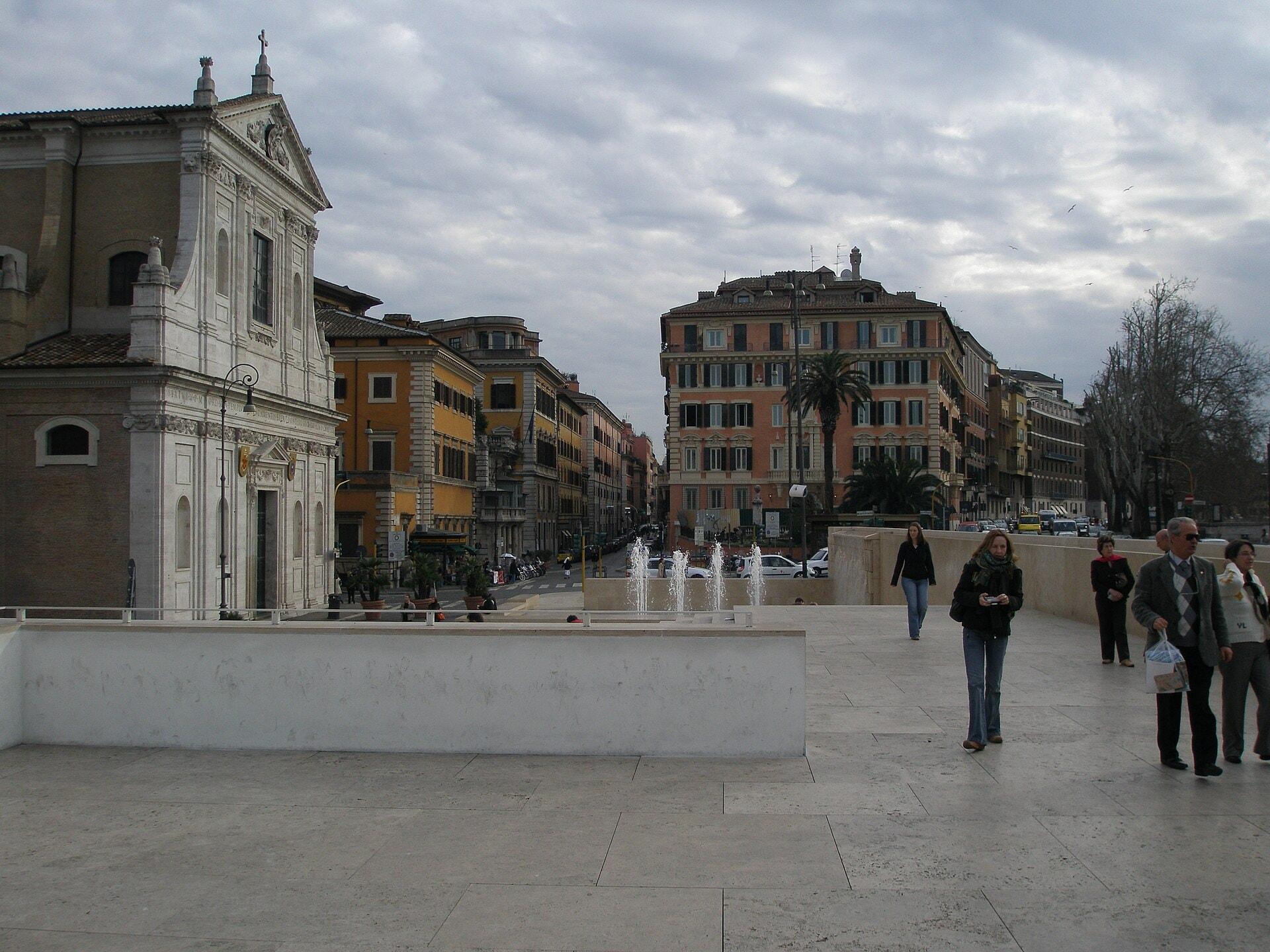

Museo dell'Ara Pacis
The Ara Pacis in Brief
6 stops40
Six stops to grasp the essentials when you're short on time: the wall bearing the words of Augustus, a first look at the altar, the she-wolf, the goddess Roma, the procession, and the story of how the pieces were found and put back together. About forty minutes is all you need.
Free short route. More stops in the full route: 10 Continue with the full route