Pompeii in Brief
The six stops in the Forum area, if you are short on time or enter in the afternoon: Porta Marina, the Sanctuary of Apollo, the Forum with Vesuvius, the Temple of Jupiter, the Macellum and the Basilica. About three quarters of an hour in the heart of the city, returning to Porta Marina.
Museum: Pompei
Sea Gate, Porta Marina
Stop beneath the vault before you climb. For you, this is the entrance. For the Pompeians, it was an exit: the road that passed through here led to the sea. Look at how it is built. The gate has two openings. The main one is taller, and was used by horses and pack animals. The smaller one, set further forward, was the passage for pedestrians. Two roads in one, each with its own traffic. It is the most imposing of the city's seven gates. Its Roman concrete vault dates to 80 BC, when Pompeii became a colony of veterans of General Sulla. This is not the beginning of the story of this wall: the circuit of the walls was already laid out in the sixth century BC. Today it is more than three thousand two hundred meters long, and it had twelve towers. One practical note before we begin. This short route stays around the Forum and takes about three quarters of an hour, on ancient, uneven paving: wear comfortable shoes and take your time. The audio starts automatically when you approach a point: keep the map open. The park entrance ticket is not included in this guide. Before you climb, look once more at the road behind you. Two thousand years ago, those who left from here set out on their way toward the sea. Walk up the uphill road, leaving the gate behind you, until you reach the porticoes of a sanctuary with two statues of archers.
Coordinates: 40.748509, 14.483085
Erased Measures, Sanctuary of Apollo and Mensa Ponderaria
Imagine arriving here with a sack of grain to sell. Before the deal can be closed, someone has to measure it. This happened in this portico, in front of a counter: the Mensa Ponderaria. The one in the niche in the wall is a copy; the original is in Naples. It was used to check measures of capacity, for liquids as well as for grain. You poured the contents into the appropriate vessels, closed them with a stopper, and emptied them after the check. The remarkable thing is that this counter already existed before the Romans. Three inscriptions in the Oscan language, the language of Pompeii before Rome, tell us so. They were erased in 80 BC, when the colony arrived and the measures were updated to the Roman system. The new, Roman inscription remains visible. Now look at the portico around you. This is one of the oldest places of worship in Pompeii, dedicated to Apollo. There was already a temple here in the sixth century BC. Between the third and second centuries it was completely rebuilt: a temple on a podium, surrounded by a colonnade, with the altar at the center of the courtyard. Here the ludi Apollinares were celebrated, the festivals in honor of the god, with the initiations of the boys and girls who recognized Apollo and his twin Diana as their protectors. The statues of the two archers are copies: the originals are in Naples. Look at the colonnade one last time: the square is right in front of you. Leave the portico toward the large, long, narrow square that opens before you.
Coordinates: 40.749213, 14.484416
Bare Square, Forum
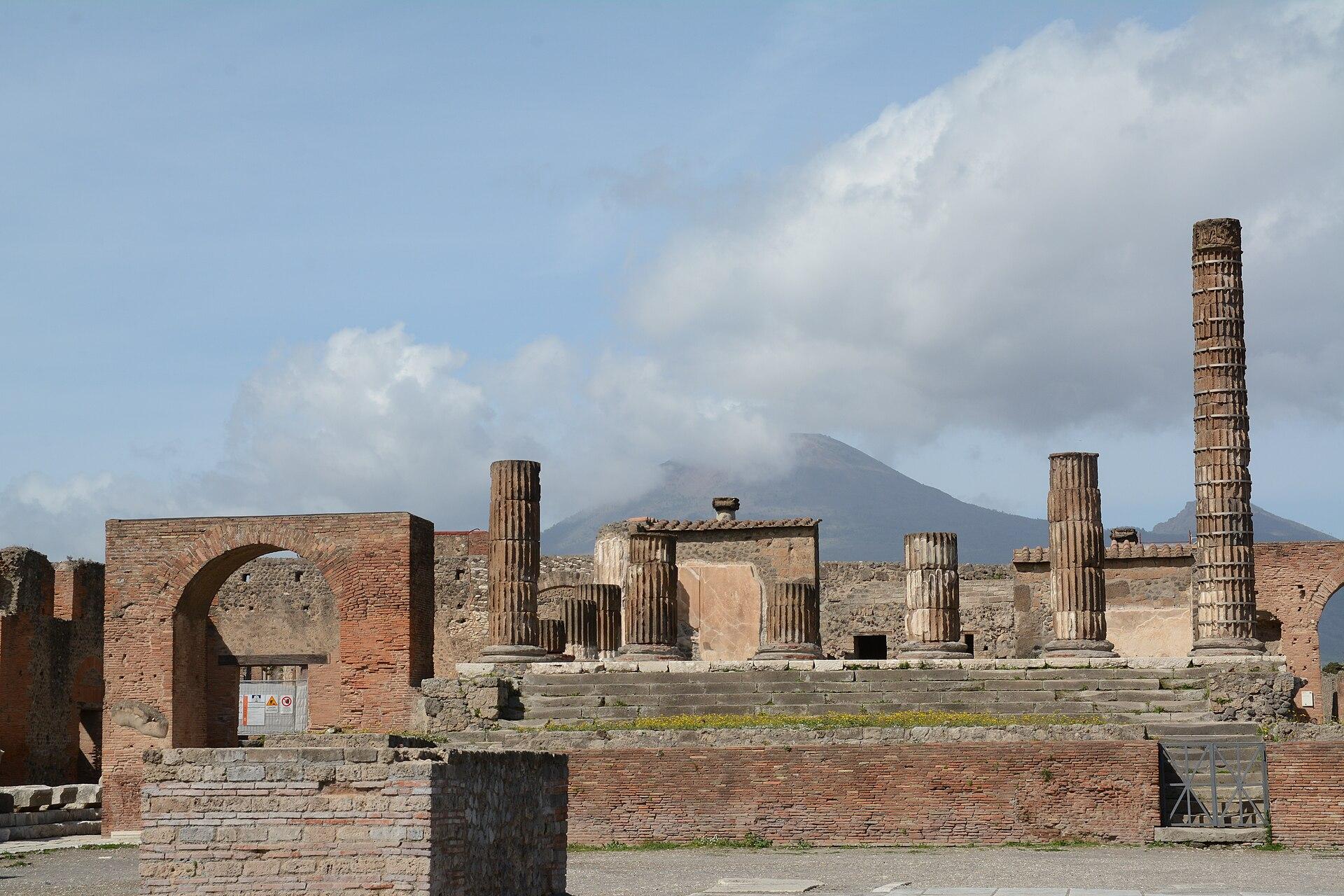
Stand in the center and look to the far end of the square. If the sky is clear, you can see the Temple of Jupiter and, behind it, Vesuvius. The temple's façade gives the square its axis, in line with the volcano. This is the Forum: the center of daily life. The buildings of administration and justice face onto it, along with the markets and the most important places of worship. The square measures about one hundred and forty-three meters by thirty-eight, and carts were not allowed in. Try to imagine it full. Porticoes all around, and on the ground, large slabs of travertine. On some of them you can still see the recess where the bronze letters of a great inscription were set. In 1813, Queen Caroline Bonaparte ordered excavations to be carried out here. The excavators expected treasures. Instead, they found a square that had already been emptied: its decorations had been carried off back in antiquity. Of the statues of those who were honored, none was found. Only the pedestals remain. What you see, then, is a stage without actors. But the most important thing remains: the space. Every day, here, an entire city came together. Walk toward the temple at the far end of the square, the one with columns above a high flight of steps.
Coordinates: 40.749329, 14.484851
The Wounded Temple, Temple of Jupiter
In a banker's house in Pompeii, there was a small family shrine with two marble reliefs. They showed the effects of the earthquake of the year 62 on some public buildings. In one of them you can recognize this temple, with two equestrian statues on either side of the podium. That banker was called Lucius Caecilius Iucundus. His archive was also found in his house: one hundred and fifty-four wax tablets recording sums of money entered from the year 52 to the year 62. A man who recorded every sum. Now look at the temple. It dominates the north side of the square, with Vesuvius behind it. With the colony of 80 BC it became a Capitolium, like the one in Rome: three cult statues, Jupiter, Juno and Minerva, on a high base, so that they could be seen by anyone passing through the square. Of all this, today you mainly see the podium and the staircase. Inside the podium open the favissae, underground rooms created to hold offerings to the gods. According to some studies, they later served for the city's public treasury. In the year 79 the temple is still a building site: the restoration work is not finished and the temple has no roof. Leave the temple and head toward the portico at the corner of the square, the one with the open shops beneath the columns.
Coordinates: 40.749947, 14.484508
Fish and Emperor, Macellum
Close your eyes for a moment: voices, stalls, the calls of the vendors. This was the Macellum, the market where people did their shopping. Look at the courtyard: a tuff quadriporticus, built between 130 and 120 BC. At its center stood a circular structure, the tholos. It was used to sell and to clean fish. Think of those who stood here every morning, with their hands in the water and the counter full. On the south side, the shops line up. On the opposite side there is a large room with a masonry counter, perhaps also used for selling fish. The walls of the porticoes were painted with scenes of daily life, such as the sale of fish and poultry, and with mythological subjects. But shopping was not the only activity here. On the east side, in a raised position, there is a hall for worship. In the niches stand copies of two marble statues, one female and one male in armor, found together with a fragment of a larger statue, perhaps of Titus or Vespasian. The market and the cult of the emperor, under the same portico. People bought fish, and honored those who ruled. Cross the square to the far end, the part farthest from the Temple of Jupiter: look for the large building with five entrances between pillars.
Coordinates: 40.750072, 14.485117
The Tribunal, Basilica
A debt to collect, a contract to sign, a dispute with a business partner. In Pompeii, all of this was settled right here. You are in the Basilica: the space of business and justice. Look how large it is: fifteen hundred square meters, the most sumptuous building in the Forum. You enter from the square through five entrances, divided by tuff pillars. Inside, there are three aisles separated by two rows of brick columns with Ionic capitals. Now look for the tribunal, at the far end, in the center of the short side. This is where the magistrates sat when cases were heard. Nearby stood an equestrian statue, and the walls were covered with stucco imitating large blocks of marble. And this is one of the oldest examples of a basilica in the entire Roman world: the construction dates to between 130 and 120 BC. It was brought back to light starting in the nineteenth century, when excavations began in the area of the Forum. Before you go, imagine you are the magistrate at the far end of the hall: look at who is waiting in front of you. The short route ends here. To leave, walk down the sloping road toward Porta Marina, where you came in: it is only a few steps.
Coordinates: 40.748737, 14.48448

Pompei
Pompeii in Brief
Outdoor6 stops45
The six stops in the Forum area, if you are short on time or enter in the afternoon: Porta Marina, the Sanctuary of Apollo, the Forum with Vesuvius, the Temple of Jupiter, the Macellum and the Basilica. About three quarters of an hour in the heart of the city, returning to Porta Marina.
Free short route. More stops in the full route: 57 Continue with the full route