Santa Croce at a Glance
Six stops in about 45 minutes: the square, Michelangelo, Galileo, Giotto, Cimabue's Crucifix and the Pazzi Chapel. For those short on time who want to see what brings them here.
Museum: Basilica di Santa Croce
The Match, Piazza di Santa Croce
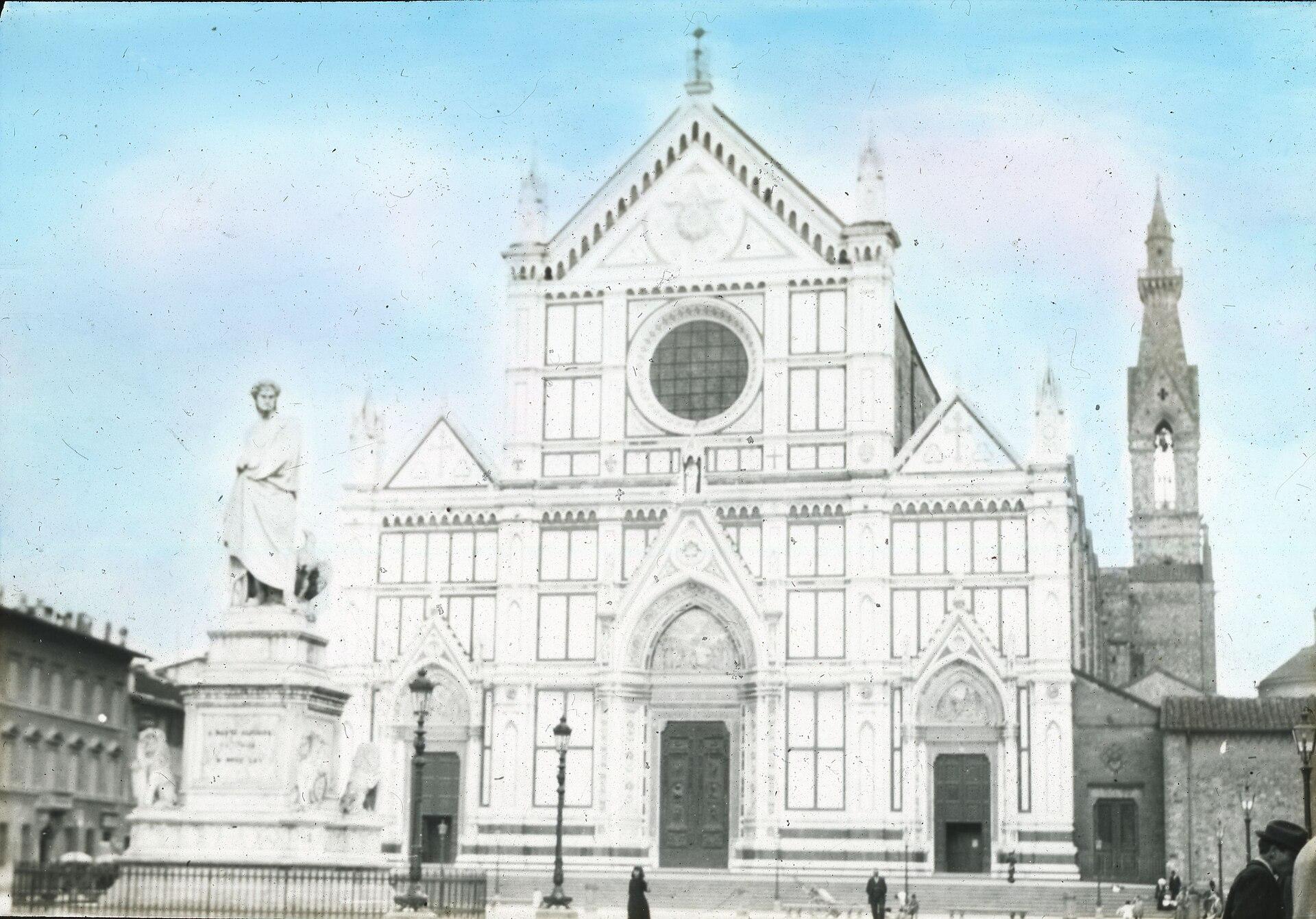
Stop here, in the square, in front of the façade. Before going in, put on your headphones and keep the volume low: inside it is a church, and people speak quietly. Imagine this place in February 1530. Florence is under siege by the imperial troops, camped on the hills. And what do the young Florentines do? They organize a football match right here, in the square, in full view of the enemy. A challenge: look, we are not afraid. It is said that musicians played on the roof of the church, and that a cannonball flew over their heads without causing any damage. Today, costume football is still played in this square, every June. But the square came into being for another reason. In the thirteenth century the Franciscans chose an isolated, marshy area near the Arno. About a century later, space was needed for the crowds who came to listen to the friars' sermons. The façade in front of you is much younger: it was completed in 1865, the year in which Florence celebrated six hundred years since the birth of Dante. His statue is right here beside it. Enter from the side of the basilica, where the ticket office is: to enter you need the Opera di Santa Croce ticket. Once inside, go to the wall of the square and look along the nave toward the altar: the first great tomb is the next stop.
The bale, Michelangelo's Tomb
You are standing in front of Michelangelo's tomb. Three figures beneath a bust: they are Painting, Sculpture and Architecture. The design is by Giorgio Vasari, and it takes twelve years to finish, from 1564 to 1576. But the best story is how Michelangelo gets here. He dies in Rome on 18 February 1564 and is buried in the Basilica of the Santi Apostoli. His nephew Leonardo brings him back to Florence. According to Vasari's account, the body leaves in secret, "as merchandise, in a bale". As if it were any ordinary cargo. It arrives on 11 March. It was supposed to remain a secret, but the news spreads, and the church fills with people. So much so that it is difficult to bring the body into the sacristy, where it is displayed for people to pay their respects. After thirty years away, Florence sees Michelangelo again. Duke Cosimo wants an honoured place for him right here in Santa Croce. It was here that the artist, in his lifetime, had chosen to be buried, where his ancestors lay at rest. Look up and find the three interlaced crowns: it is the emblem of the Accademia del Disegno. Vasari linked it to the three circles with which Michelangelo marked the blocks of marble he chose in the quarries. Cross the nave: on the other side, opposite this one, there is an almost identical tomb, with a bust holding a telescope in its hand.
The Missed Funeral, Galileo's Tomb
This tomb is almost a twin of Michelangelo's. And yet it tells the opposite story: a story of closed doors. At the top, in a shell-shaped niche, the bust of Galileo gazes at the sky. In one hand he holds the telescope, in the other a celestial globe. Galileo died in 1642 and was buried almost in secret, in a small room near the Novitiate chapel. No monument. His disciple Vincenzo Viviani tried, but ecclesiastical circles opposed it: honoring a man suspected of heresy seemed inappropriate. It took almost a century. In the end it was Grand Duke Gian Gastone de' Medici who decided, wanting to limit the power of the Church. The monument dates from 1737, designed by Giovan Battista Foggini. Look at the sides of the sarcophagus: Astronomy, with a parchment showing sunspots, and Geometry, with a table on the inclined plane. And in the center, in the cartouche, the planet Jupiter with its satellites: Galileo had discovered them, and he called them "Medicean planets". Go back to the other side of the nave and walk toward the altar all the way to the end, where the nave opens out to the sides into the transept. In front of the main altar, look for the frescoed chapels right next to it: the one where a dying saint is surrounded by friars. The transept is on a raised level, with a few steps: if you cannot climb them, skip to stop 11.
Giotto's team, Bardi and Peruzzi Chapels
You are in the Bardi Chapel, and there is something new: the restoration is finished. After four years of work, the Stories of Saint Francis, painted by Giotto after 1317, are fully visible again. Look for the scene with the sultan, and the one in which Francis dies, with the friars in despair. Giotto tells the life of the saint in a clear way, understandable to everyone. And look at how he paints the architecture: a painted structure that overlaps the real one, like a great ciborium. The restoration has shown one thing: Giotto did not work alone. The differences in style reveal several painters, under his coordination. A team, a workshop. About five thousand small losses have been repaired, and the incised lines with which Giotto planned the architecture have been mapped digitally, for the first time. In the eighteenth century these frescoes had been covered with a coat of whitewash. They were rediscovered around 1851. Now look at the neighboring chapel: the Peruzzi Chapel, also by Giotto, with the stories of the two Saints John, around 1310. Here he paints almost everything a secco, on dry plaster: a technique that does not keep well. For this reason today it is harder to read. From the end of the transept, look for the doorway that leads to the Novitiate corridor and to the Sacristy. There are a few steps: if you cannot climb them, skip to stop 11.
The Wounded Cross, Sacristy
In front of you is an enormous cross: four metres thirty by almost four. The Christ was painted by Cimabue, before 1288, and is depicted dead: his colour is the true colour of death. But look closely: in several places the colour has vanished. Why? On 4 November 1966 the Arno flooded Florence. In the Cenacolo of Santa Croce the water reached five metres and two centimetres, almost the height of two rooms. The cross is there, and it is submerged in water, mud and heating oil. It is carried away by makeshift means to the Limonaia of the Boboli Garden, prepared to receive panel paintings. Then a long restoration, at the Fortezza da Basso, and a series of exhibitions in Europe and America. Part of the colour could not be recovered. The cross has become the symbol of that wound. In 2013 it was hung here, in the sacristy, to protect it should the water return. Take a moment. The damage has not diminished the strength of this Christ. Go back into the basilica and look, along the nave, for the door that leads to the cloisters. Go through it: you are in the first cloister, and the building with the portico of columns and the small domes is the Pazzi Chapel.
The Cube and the Dome, Pazzi Chapel
You are under the portico of the Pazzi Chapel. Go in and stop in the centre, under the dome. It is one of the first architectural works of the Renaissance, and inside it has kept its original appearance. Look at how everything seems to be in proportion. There is one module: a cube, with an umbrella dome above it, and on either side two wings with barrel vaults. The lines in grey pietra serena stand out against the white plaster, like a drawing. The design is by Filippo Brunelleschi. Andrea de' Pazzi wanted it, after the fire of 1423, as a family chapel and a meeting room for the friars. Brunelleschi directed the works from 1443 until his death in 1446. The portico was added later, in 1461. And in 1478 the works stopped. The Pazzi had plotted a conspiracy against the Medici, and were banished from Florence. Look up: the glazed terracotta roundels are the twelve Apostles, by Luca and Andrea della Robbia. And the small dome over the altar shows the stars: the sky of Florence on 4 July 1442. There are different hypotheses about what this means. To leave, follow the cloister towards the square. When you are outside, look at the façade: that is where you started.

Basilica di Santa Croce
Santa Croce at a Glance
6 stops45
Six stops in about 45 minutes: the square, Michelangelo, Galileo, Giotto, Cimabue's Crucifix and the Pazzi Chapel. For those short on time who want to see what brings them here.
Free short route. More stops in the full route: 6 Continue with the full route