Palazzo Pitti in Brief
Six stops in about an hour: the square, the Raphaels in the Sala di Saturno, the Velata, Rubens's war, the grand duke who spied through the little window alongside Titian, and Canova's Venus. For those short on time who want to see the Planetary Rooms.
Museum: Palazzo Pitti
The Challenging Banker, Piazza Pitti
Stop here, in the middle of the square, and look at the whole façade. A wall of rough-hewn stone, immensely long, with two wings that reach forward to embrace you. All of this was born of envy. In the mid-fifteenth century, a Florentine merchant, Luca Pitti, wanted a house larger and more imposing than that of the Medici, his rivals. He had it built on the slopes of the Boboli hill. But he died leaving it unfinished: on the façade there were only three large doors and two rows of seven windows. Look down, at either side of the main doorway: the two windows that seem to kneel were once doors, and were transformed later. In 1549 the palace was bought by Eleonora di Toledo, wife of Cosimo I de' Medici: the family Pitti had wanted to outdo took his house for itself. Then came the Habsburg-Lorraine, who added the two wings: the square became three times larger. Then the Savoy. In 1919 King Victor Emmanuel III gave it to the Italian State. And yet, after four centuries of other owners, the palace is still called Pitti. Two notices before you enter. Your ticket is checked at the main doorway, and this tour does not include it. Inside, keep your phone on silent and the volume low. Enter through the central doorway, the one where tickets are checked, cross the courtyard and follow the signs for the Palatine Gallery, on the first floor. Look for the room with the Raphaels: you will recognize it by the large altarpiece with the Madonna beneath a fabric canopy.
Madonna in Exile, Room of Saturn
You are in the Raphael Room. The Palatine Gallery holds the largest concentration of his works in the world, and this room is their treasure chest. Look for a small painting: a standing Madonna holding the Child in her arms, against a black background. It is called the Madonna of the Grand Duke, and the name conceals a story of exile. The Grand Duke is Ferdinand III of Lorraine. Between 1799 and 1800, from Vienna, he authorizes the purchase of the painting, which arrives at Palazzo Pitti. Then Napoleon arrives, and the Grand Duke leaves for exile, taking the painting with him. On his return, he keeps it in his private rooms. And he allows it to be shown to the public only when he is away from Florence. A secret: the X-rays taken by the Opificio delle Pietre Dure show that beneath the black there was a room, with a pillar and a piece of landscape. The dark background, in all likelihood, came later. Now look for a tondo, a mother clasping her son, seated on a chair. This is the Madonna of the Chair. It was one of the most copied paintings in Florence: young artists, with their stools and easels, made copies in order to learn, and foreign travelers bought the copies as souvenirs. Move on to the next room: you will recognize it by the iron hooks high up, beneath the ceiling, where the throne canopy once hung.
The Veiled Woman, Room of Jupiter
Look up, beneath the vault: do you see those iron hooks? This is where the canopy of the throne once stood, and beneath it, on a podium, the grand duke held his audiences. The vault is by Pietro da Cortona. Jupiter crowns the prince, to whom Hercules has handed his club. Among the figures there are four women: they are the four satellites of Jupiter, discovered by Galileo and announced in a book of 1610 dedicated to Cosimo II de' Medici. Now look for a portrait: a woman with a veil over her hair and her hand on her heart. She is known as the Velata, the Veiled Woman. The veil tells us that she is married. What her name was, nobody knows. One tradition identifies her with the Fornarina, the woman loved by Raphael. But the dress and the jewels are those of a young noblewoman. Look at the sleeve: pale silk, as large as half the painting. The true protagonist is the sleeve. Raphael painted it after his move to Rome. And Raphael's name? In 1622 an inventory records: said to be by the hand of Raphael of Urbino. Then the name is lost, and the painting goes under other names. Only in 1839 did a scholar, Passavant, restore it to Raphael. The painting hangs on hinges: when there was no electric light, the attendants would turn it to find the best light. Move on to the next room, dedicated to Mars: you can recognize it by the ceiling with a battle of ships along the edge and by a large painting about war, with a woman dressed in mourning.
Against War, Room of Mars
Look up: along the edge of the ceiling a naval battle rages, and at the center cherubs hold aloft the Medici coat of arms. This is still Pietro da Cortona. But the painting you are looking for is on the wall, large, and speaks of something else entirely. It is Rubens's *The Consequences of War*. At one side a woman dressed in mourning, with a crown of towers on her head, raises her arms to the heavens: she is Europe. At the center, Venus tries to hold back Mars, the god of war, who advances with sword in hand. A fury, Discord, drags him away with a torch. On the ground lie trampled books, and the arts, music and architecture, overwhelmed. Rubens is not only a painter: he is also a diplomat, and during the years of the Thirty Years' War he travels from court to court. He painted this picture in 1637 and 1638. On 12 March 1638 he wrote to Justus Suttermans, who had acted as intermediary, to say that he had received the final payment, and he relates that the crate containing the painting had left three weeks earlier. Around 1691 Rubens's heirs sold it to Grand Prince Ferdinando de' Medici. In 1799 the French took it to Paris, and it returned to Florence in 1815. A painting against war, which traveled in wartime. Cross the next room, the Room of Apollo: look up, and you will see a Hercules with a celestial globe. Then look for the room with a white statue of a woman drying herself and the portraits by Titian.
Eye of the Grand Duke, Room of Venus
This was the antechamber where the public waited before being received by the Grand Duke. Raise your eyes, up high among the stuccoes, behind a lunette: there is a small window. From there the ruler could spy on and listen to what was being said in the room below. The vault is by Pietro da Cortona, 1641 and 1642: it is the first of the Planet Rooms that he painted. Minerva carries the young prince away from the arms of Venus and entrusts him to Hercules. Now look for a man with a long beard, a wide red cloak and a heavy gold chain: Pietro Aretino, portrayed by Titian in 1545. The writer Ariosto called him the scourge of princes. He himself gave the portrait to Cosimo I de' Medici. And in his letter he jokes: the portrait breathes, its pulse beats and its spirit moves, just like him. But with more money, he writes, the drapery would be shinier and softer. As if to say: Titian paints in proportion to what he is paid. And then there is the Concert: three musicians, one of whom plays the spinet. For a time they called it Luther, Calvin and the Nun: the colors of the garments have changed and so has fashion, and a layman was mistaken for a friar, and a young man with a plumed hat for a woman. Turn toward the white marble statue: a standing woman drying herself after her bath.
The Venus Italica, Room of Venus
Here she is: a woman of white marble, standing, as tall as a real woman. She is drying herself after the bath, and at her feet stands the vase of perfumed ointments. This is the Venere Italica by Antonio Canova. In 1802 the French carry off from Florence the Venus de' Medici, the most famous statue in the Uffizi, to take it to the Louvre. The King of Etruria, Louis of Bourbon, asks Canova, who is passing through the city, to make a copy of it. He is reluctant. Then he has an idea: not a copy, but a standing Venus, invented by himself, to challenge the ancient one. In 1809 Napoleon's sister, Elisa Baciocchi, Grand Duchess of Tuscany, persuades the emperor to pay the agreed twenty-five thousand francs. On 29 April 1812 the statue arrives in the Tribuna of the Uffizi, on a revolving base. Ugo Foscolo writes that she is a most beautiful woman, capable of inspiring love, whereas the ancient one is an impassive goddess, though a most beautiful one. Then Napoleon falls. In 1815 Canova goes to Paris to recover the works that were taken away. The ancient Venus returns to the Uffizi, and the Italica, dethroned, is sent to Palazzo Pitti. Your short tour ends here. With the same ticket you can still see the Gallery of Modern Art, the Museum of Fashion and the Palatine Chapel. The Boboli Gardens and the Royal Apartments require a separate ticket or reservation, and the Treasury of the Grand Dukes is closed. Thank you for listening to Palazzo Pitti.
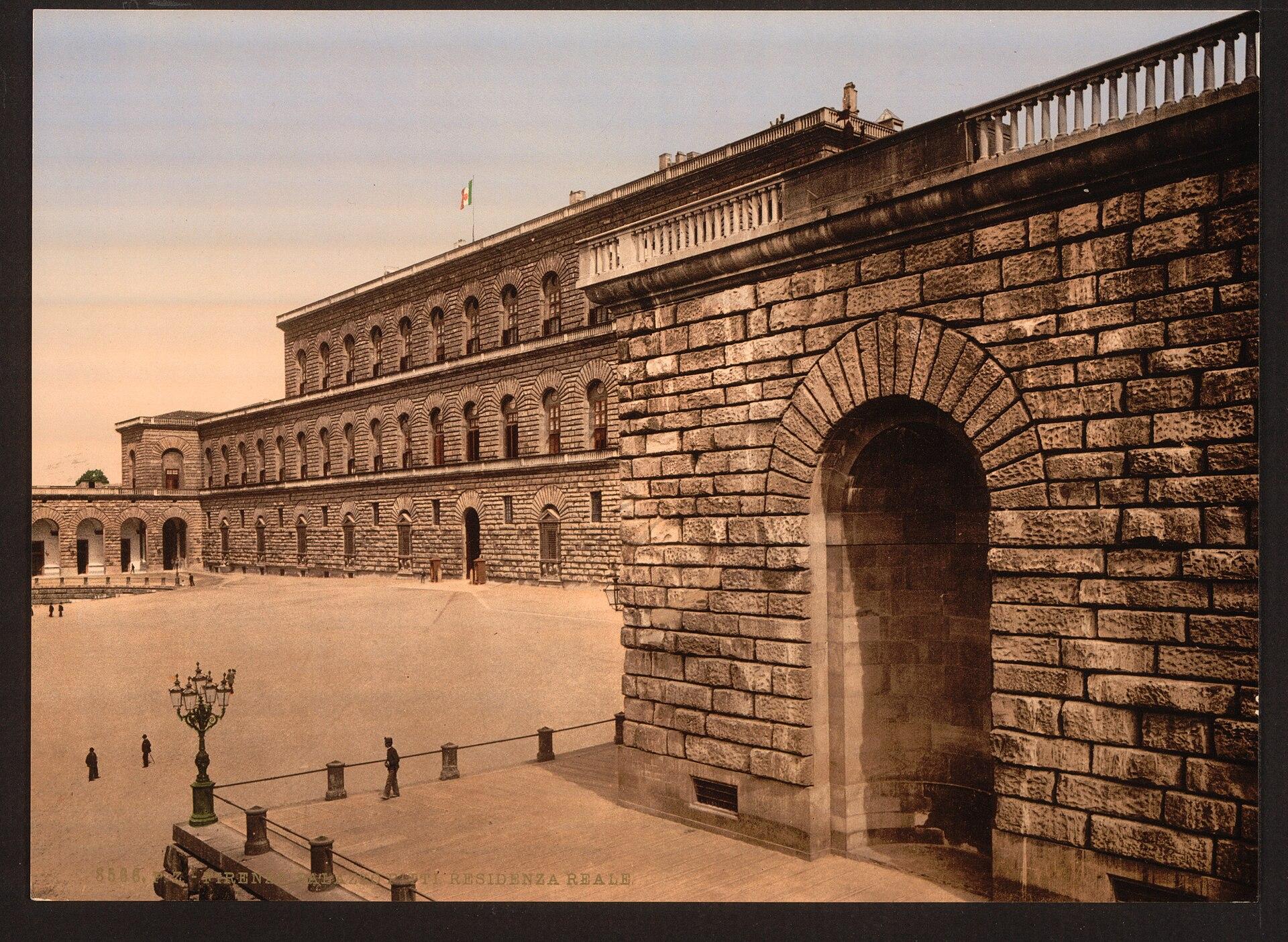

Palazzo Pitti
Palazzo Pitti in Brief
6 stops60
Six stops in about an hour: the square, the Raphaels in the Sala di Saturno, the Velata, Rubens's war, the grand duke who spied through the little window alongside Titian, and Canova's Venus. For those short on time who want to see the Planetary Rooms.
Free short route. More stops in the full route: 6 Continue with the full route