The Piazza dei Miracoli in Brief
Six stops for about an hour's stroll on the lawn, with no ticket required: the name invented by a poet, the architect walled into the façade, the Tower that began to lean right away, how it was saved, the Baptistery and the entrance to the Camposanto.
Museum: Piazza dei Miracoli e Torre di Pisa
The Invented Name, Prato dei Miracoli
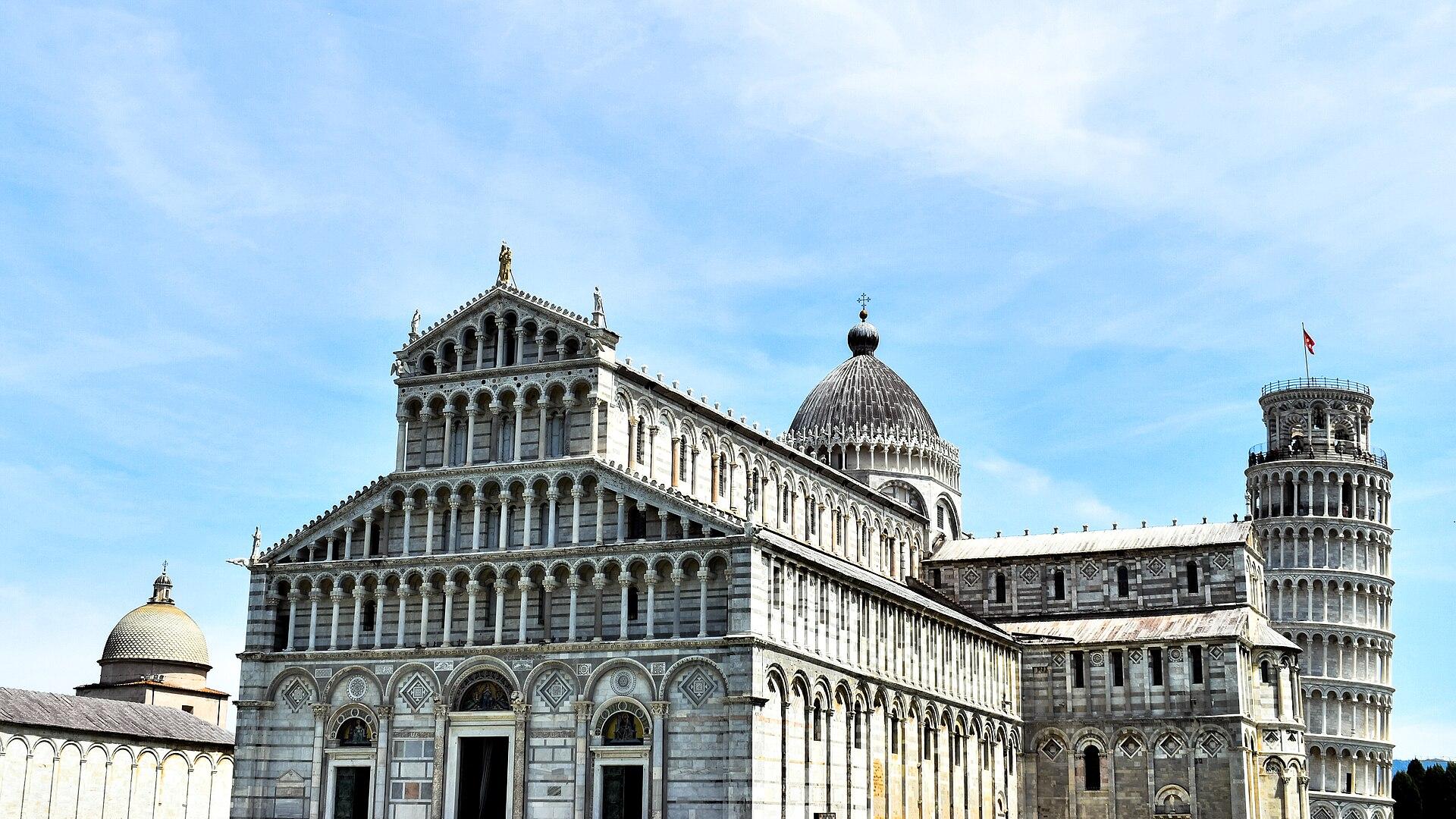
Stop on the lawn and look around. This name, Piazza dei Miracoli, is not ancient. A poet invented it. His name is Gabriele D'Annunzio. In 1910 he publishes a novel, Forse che sì forse che no, and on one page he writes: Prato dei Miracoli. More than eight hundred years have passed since the first stone of the Cathedral, and finally someone finds the right word. The miracles, for him, are four: the Cathedral, the Baptistery, the Camposanto and the Bell Tower, the one everyone calls the Tower. You have them all in front of you together, and to the north the square is closed off by the long white wall of the Camposanto. Born in different years, by different hands, and yet they sit well next to one another, as if someone had chosen them on purpose. Since 1987 this square has been a UNESCO World Heritage Site. But before being an icon it is a lawn, and you can walk on the grass, except where a sign forbids it. So try to do as the poet did. Stand still for a moment, and look as if it were the first time. Now come closer to the façade of the Cathedral, the one with the rows of small loggias one above the other, and stop near the wall.
The New Daedalus, Cathedral Façade
Look at the wall of the façade, at eye level. Do you see a large marble chest set into the wall? It is a tomb. Inside, or at least right beside it, rests the man who began this cathedral. His name is Buscheto, and he is the first architect of the Cathedral. Work begins in 1064. The plaque that accompanies the tomb, a sarcophagus from the Roman era, praises him as a new Daedalus: as the man who, in myth, built the labyrinth. We do not know where he came from. His name seems to be of Greek origin, and some think of a Byzantine family. What is certain is that here in Pisa he had made a name for himself that outlived him for centuries. The Cathedral is consecrated in 1118, when Buscheto is no longer alive, by Pope Gelasius II. Then another architect, Rainaldo, lengthens the naves and designs the façade you are looking at. Pay attention to the marbles. Some are Roman pieces, reused. It was a way of saying one thing only: Pisa is a second Rome. Think about it: an architect who rests in the wall of the church he began. You can't be any closer to your work than that. Follow the long side of the Cathedral, the one with the blind arcades, until you see the leaning bell tower, and stop at a distance from which you can see all of it.
The Leaning Tower, At the Foot of the Bell Tower
Who designed it? We do not know for certain. For centuries it was thought to be Bonanno; today some scholars propose Diotisalvi, the architect of the Baptistery. The name has not come down to us. What we do know is how it happened. On 9 August 1173 the foundations were laid, and then work stood still for a year. The construction site started up again, but when the masons reached the middle of the third floor, the ground gave way. It is soft clay, and it could not hold. The construction site stopped. About a hundred years went by. In 1275 work resumed, under the guidance of a master builder: Giovanni di Simone, with the sculptor Giovanni Pisano. They added three floors, and here comes the most beautiful part: the three new floors bend in the direction opposite to the lean, to try to straighten the tower. Look closely: you can see the curve. In the middle of the following century the bell chamber reached the top, and the tower was finished. No one ever built it leaning. It is the ground that bent it, a little each year. It was never a watchtower: it is the bell tower of the Cathedral. Close your eyes for a moment. Up there, in the chamber at the top, there are seven bells. Stay where you are. Now look at the base of the bell tower and the lawn around it.
Saving the Tower, At the Foot of the Bell Tower
In January 1990 the Tower closes. It risks falling, and no one can climb it anymore. The world looks at Pisa and waits. One man leads the international committee that must save it: Michele Jamiolkowski, professor at the Politecnico di Torino. It is not a race against time. It is a race against the ground. First come the wrong attempts. In 1934 Mussolini, who calls the Tower a national disgrace, has the base drilled to inject cement. The result is worse: the Tower sways, and leans even more. Then the right method arrives. Large lead counterweights are placed on the north side. And then, the decisive move: instead of adding, removing. Beneath the north side, earth is dug out, little by little, and the Tower straightens a little. The result, in numbers: four hundred and sixty millimeters less overhang at the seventh cornice. After a lifetime of slow falling, the Tower returns to how it was in the early nineteenth century. On 15 December 2001 it reopens to visitors. It is estimated to remain safe for at least three centuries. A group of experts still monitors it today. It does not stand straight, and that is not the aim: it stands still. Now go back toward the Baptistery, the great cylinder in front of the façade of the Cathedral, and stop at its foot, looking at the dome.
The Sound Cylinder, Baptistery
Look up at the dome: two colors. Red, in tiles, on one side; gray, in lead slabs, on the other. It is thought that at some point the money ran out. The architect left his signature on a pillar, and you can look for it: Deotisalvi magister huius operis, that is, Diotisalvi is the author of this work. Work began on 15 August 1152, although the Pisans, who counted the years differently, wrote 1153. It is the largest baptistery in Italy: more than one hundred meters in circumference, and almost fifty-five in height. Nicola Pisano and then his son Giovanni made it more Gothic, with the sculptures that crown the circuit. If you go in, there is something that lasts only a few minutes, and you must not miss it. The Baptistery has a double dome, and for this reason it works like a musical instrument. About every half hour, the staff intone a few notes and let the reverberation do the rest. If you are inside, stop in the center and listen. If you are still outside, imagine a choir: the stone does not let it die. Now cross the lawn toward the long white wall with blind arcades, on the opposite side of the Cathedral: it is the Camposanto.
Holy Land, Entrance to the Camposanto
Stop in front of the portal, with the marble tabernacle above the door. From here, for a moment, you are outside of time. The Camposanto was founded in 1277. Its purpose is to gather in a single place the tombs that until then were scattered around the Cathedral. Archbishop Federico Visconti wants a spacious and dignified place, secluded and enclosed. According to tradition, the lawn inside holds holy earth brought from Palestine. This is why it is called Campo Santo: it is not a metaphor, it is the name of a piece of land. Look at the wall along the lawn: forty-three blind arches, all in white marble, with small human heads carved at the springing of the arches. According to the Opera, they mark the presence of the craftsmen who worked on the construction site. The tabernacle above you is by Lupo di Francesco, from 1313. The works stop after Pisa's defeat at Meloria, in 1284, and are only completed in 1464. In the nineteenth century the Camposanto becomes one of the first public museums in Europe. The curator, Carlo Lasinio, gathers within these walls sculptures and paintings from churches and convents of the area. Here the short route ends. If you wish to enter, with a ticket you can visit the Camposanto, and resume with the full route. Otherwise, stay a moment on the lawn: the square is yours.

Piazza dei Miracoli e Torre di Pisa
The Piazza dei Miracoli in Brief
6 stops60
Six stops for about an hour's stroll on the lawn, with no ticket required: the name invented by a poet, the architect walled into the façade, the Tower that began to lean right away, how it was saved, the Baptistery and the entrance to the Camposanto.
Free short route. More stops in the full route: 10 Continue with the full route