San Giovanni in Laterano in brief
One hour, free admission, six stops: the façade, Borromini's nave, the twelve apostles, the canopy over the papal altar, the apse and the baptistery. No tickets and no separate opening hours to check. Keep your shoulders and knees covered: this is a living church.
Museum: Basilica di San Giovanni in Laterano
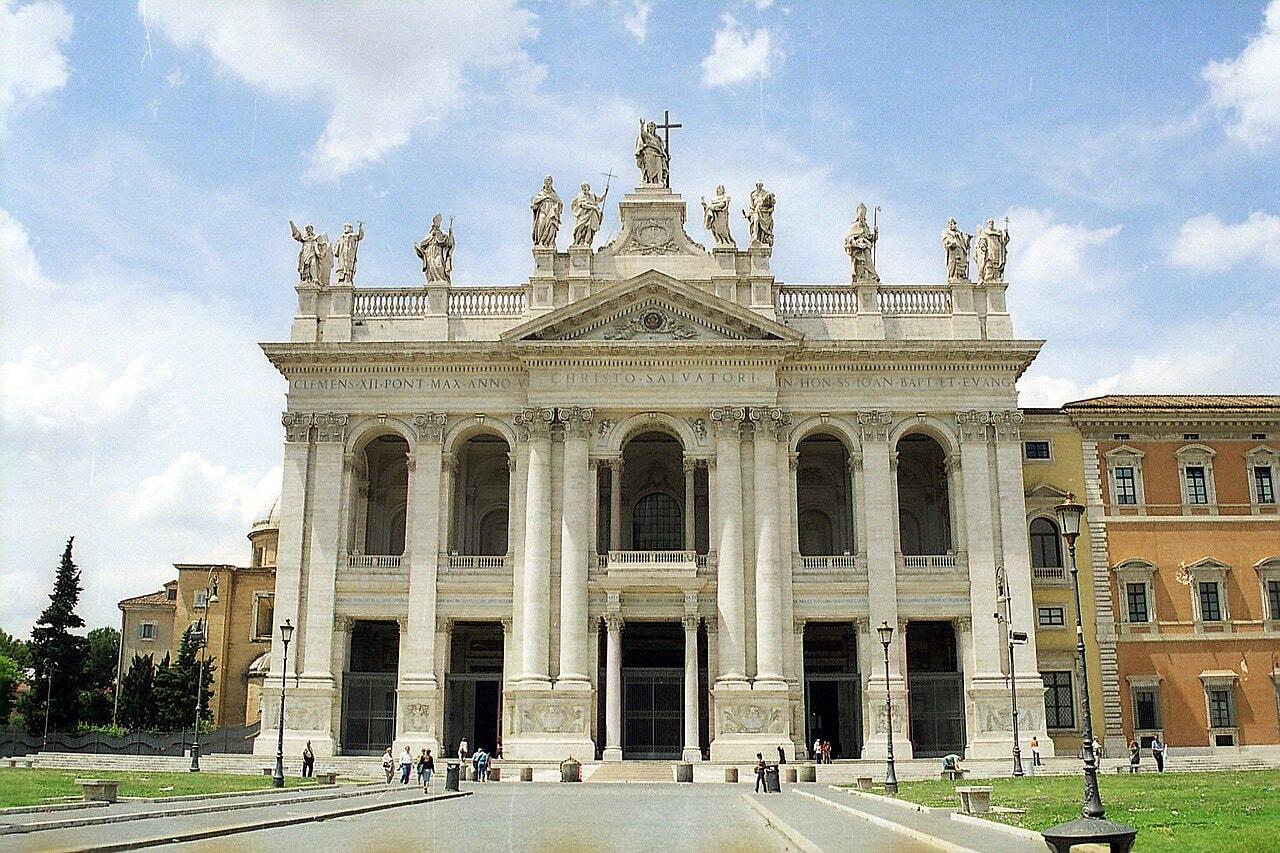
Mother and Head, Galilei's Façade
Look for the large Latin inscription on the façade. It says that this church is the mother and head of all the churches of the city and of the world. This is no ordinary church: it is the cathedral of Rome, the church of the pope. It is the first of the four major papal basilicas, and the oldest in the West. Pope Sylvester the First dedicated it to the Saviour in 324. The popes after him added the two Johns, the Baptist and the Evangelist. That is why it is called San Giovanni. The façade dates from the eighteenth century, and was designed by Alessandro Galilei. It was a surprise victory: Pope Clement XII announced a competition, and Galilei beat architects more famous than himself, such as Nicola Salvi, the designer of the Trevi Fountain. It was finished in 1735. Some say it looks more like the façade of a palace than of a church. Galilei erased every trace of the ancient basilicas and chose a classical language. Raise your eyes to the top: a group of statues, with Christ and the cross among several holy bishops. It is the last thing you see of this church before going in. Enter the basilica in silence, with shoulders and knees covered: during Mass some areas are not accessible. Stop in the central nave, looking toward the altar.
Five Aisles, Central Nave
Here you are, inside. Stop and look up. Five aisles, a coffered ceiling and, at the far end, the pope's altar. Breathe. This is the cathedral of Rome. But it is not the first church you see on this ground: it is the fourth. The first is consecrated by Sylvester the First in 324. Then come sackings, an earthquake at the end of the ninth century, two fires in the fourteenth century. Each time, it is rebuilt. In the seventeenth century Pope Innocent the Tenth wants to redo the interior for the Jubilee of 1650, and calls on Francesco Borromini. Borromini does not tear down the ancient columns: he encloses them within new pillars. Then he hollows large niches into the pillars. The floor of coloured marbles, beneath your feet, still comes from the Middle Ages. In the side aisles Borromini plays with light, with his "rooms of light" that diffuse it. Above, inside oval frames decorated with palm leaves, laurel and other plant motifs, he leaves pieces of Constantine's ancient wall in view, like relics. Try to imagine who arrived here as a pilgrim. Five aisles in a row, and the whole church in a single glance. Look at the niches in the great pillars: twelve giants await you there.
The Twelve Giants, Central Nave
Twelve apostles, and one is not the one you expect. He stands in the place of Judas, and he is not Matthias: he is Paul. The statues are larger than life. The niches designed by Borromini, in the shape of a tabernacle, reuse columns of verde antico marble that stood in the side aisles. They remain empty for decades. Then, in 1702, Pope Clement XI and Cardinal Benedetto Pamphilj announce the project: twelve apostles, one per niche. The series is complete in 1718. Each statue is paid for by a prince. The pope pays for the one of Peter, and the cardinal for the one of John. The sculptors are the best in the Rome of the time. Almost all follow the designs of the pope's favorite painter, Carlo Maratta. Only one says no: Pierre Le Gros. And he gets to do it his own way. Higher up, between one window and the next, the same pope has large ovals with the prophets painted. Choose one now. Look at the face, the hands, the folds of the mantle. Twelve statues, and each has a different character. Walk along the nave to the great Gothic canopy above the altar and stop at its foot.
The Canopy, Papal Altar
A Gothic canopy in a Baroque church. It seems out of place, and it is much older. It is called a ciborium. The Sienese architect Giovanni di Stefano builds it, after the fires of the fourteenth century, and inaugurates it around 1370. A king also contributes, Charles V of France. High up, behind a dense gilded grille, are the reliquaries with the heads of Saint Peter and Saint Paul. Tradition places them here since at least the ninth century. Today's reliquaries date from 1804: the earlier ones had been stolen in 1799. Beneath the canopy is the papal altar. Inside the altar is venerated the table on which, tradition says, Saint Peter celebrated. The ciborium has stood there for more than six hundred years. In front of the altar, lower your gaze: the confessio, with the gilded balustrade, is neo-Gothic. Pope Pius IX commissions it, in 1851. Here the pope has always celebrated as bishop of Rome. Everything else in the basilica looks toward this point. Look to the far end, beyond the canopy, where the church closes in the apse.
The Cathedra, Apse
At the back there is a seat. For a pope it is the most important place in the basilica: the cathedra of the bishop of Rome. The cathedra was the symbol of a bishop's authority, and for this reason the church that houses it is called a cathedral. What you see is a nineteenth-century copy. The original, in Cosmatesque style, can now be seen in the cloister. The apse, too, is not the one from long ago. In the 1880s Pope Leo the Thirteenth had the one built by Nicholas the Fourth torn down and rebuilt it larger, with a new choir. In the choir, six galleries house some of the pipes of the basilica's organ. Look at the mosaic above the cathedra. It was made in the thirteenth century by Jacopo Torriti and Jacopo da Camerino, for Nicholas the Fourth. In the nineteenth century Leo the Thirteenth's mosaicists remade it, reusing only the gold tesserae of the background. That gold is more than seven hundred years old. At the center is the cross, and from it four rivers flow down: they are the Gospels. The sheep and the deer drinking are the faithful. And there is the patron, Nicholas the Fourth, kneeling, presented by the Virgin. The short itinerary continues outside. Leave the basilica and look for the baptistery, the eight-sided building separate from the basilica.
Eight Sides, the Baptistery
For many generations this was the only baptistery in Rome. Throughout Italy, others took it as their model. Count the sides: there are eight. Inside, around the font, runs an ambulatory with a coffered ceiling. The first construction dates to the fourth century, probably commissioned by Constantine, on the site of a bath complex. In 432 Pope Sixtus the Third rebuilt it, and the work continued until about 440. Beneath the dome is the font, made for the complete immersion of those being baptized. Around it stand eight ancient columns of red porphyry, more than six meters high. Above them, eight slimmer columns of white marble. The brick exterior has a frieze designed by Borromini. A legend says that Constantine was baptized here. In reality he was baptized in the East. Look up: the frescoes tell the story of Constantine's life. Pope Urban the Eighth had them painted. Look for his coat of arms on the floor: it has bees. Your short tour ends here. Thank you for listening to San Giovanni in Laterano. Stay a moment beneath the dome, in silence.

Basilica di San Giovanni in Laterano
San Giovanni in Laterano in brief
6 stops60
One hour, free admission, six stops: the façade, Borromini's nave, the twelve apostles, the canopy over the papal altar, the apse and the baptistery. No tickets and no separate opening hours to check. Keep your shoulders and knees covered: this is a living church.
Free short route. More stops in the full route: 11 Continue with the full route