The Florence Cathedral in 45 Minutes
Façade, Uccello's clock, the English general, Dante, the Last Judgment and the dome seen from the outside: six stops, all free of charge, for those short on time.
Museum: Duomo di Firenze
Six Hundred Years, Façade
Stop here, in front of the central door, and look up. This façade looks ancient, but it was finished in 1887. The first stone of the cathedral, however, was laid on 8 September 1296. Almost six hundred years of work. The cathedral stands on top of an older church, Santa Reparata. At the beginning the project is by Arnolfo di Cambio. In 1412 it takes the name of Santa Maria del Fiore: a reference to Florence and its lily. Arnolfo's façade remained unfinished. In 1587 the decorative part that was there was destroyed. After an international competition, the architect Emilio De Fabris designed a new one. He died before seeing it finished: Luigi Del Moro completed it, in 1887. Look up, in the gallery. These are the Twelve Apostles, with the Madonna and Child. And the three large bronze doors were made between 1899 and 1903. Those who began did not see the end, and those who finished did not know the beginning. This is the Duomo: a work of many generations. Enter through the central door of the façade, the one open to those without a ticket, and go through the checks. Just inside, turn toward the inner wall of the façade: above the door there is a large clock.
Hours at Sunset, Uccello's Clock
One thing, first of all: this is a church, and a service may be taking place. Keep the volume low, or use headphones. If you came in from the side, turn toward the main entrance. Above the door, in the center of the wall, there is a large clock with a single hand. Paolo Uccello painted it in 1443. Look at the corners: four heads, of prophets or evangelists, look at you. But the time it shows is not the one on your phone. The dial is divided into twenty-four hours, and the day does not begin at midnight: it ends at sunset, at the sound of vespers. They are called Italic hours. They were still in use in the eighteenth century. This is one of the last clocks of this type still working. Think of those who came in here centuries ago: they looked at the hand to know how much light was left. On the same wall there is also a large round stained-glass window, with the Assumption of the Virgin. The design is by Lorenzo Ghiberti, the same artist as the Gates of Paradise: in this square, everything brings you back to the same names.
The English General, Monument to John Hawkwood
Stop in front of the great knight painted on a horse, above a sarcophagus. It looks like a bronze statue. But it is a fresco: painted in green and gray, to make the viewer believe that it is metal. The knight is John Hawkwood, an English captain in the service of Florence. The Florentines called him Giovanni Acuto. He died in Florence in March 1394 and was buried in the cathedral with great honors. Then King Richard II of England asked to have his remains back, and the sarcophagus was left without him. The city wanted to remember him, and it entrusted his portrait to Paolo Uccello. Look at the horse: it raises the two legs on the same side together, the gait called amble. Vasari thought it was a mistake. Other scholars defended it. The cathedral's overseers were not pleased: on 28 June 1436 they asked Uccello to redo it. On 31 August, after his retouching, the painting was considered finished. On the sarcophagus you can read in Latin that Hawkwood was the most prudent and the most expert in the art of war among the captains of his time.
Dante and Florence, Michelino's Painting
In front of you is a large painting with a man in a red tunic, holding an open book. He is Dante Alighieri. Domenico di Michelino painted it in 1465, from a design by Alesso Baldovinetti. It is a large painting, about two meters thirty by two meters ninety, in tempera. The commission coincides with the two hundredth anniversary of Dante's birth: Florence wanted to honor its great men, even in the cathedral. Together with the two knights from before, it is part of a project: to fill the Duomo with illustrious Florentines. Look at how he has placed him. With one hand he holds the open Commedia. With the other he points to the three realms: the Inferno, the mountain of Purgatory, the heavens of Paradise. And now look to the right. That is Florence, with its walls. You can recognize the dome with the Bell Tower of the Duomo, and two towers: that of the Bargello and that of the Palazzo dei Priori. Golden rays leave the book, and go straight toward the city. The painter's message is simple: this book has brought glory to Florence. In the painting the dome already has its lantern at the top, but not yet the golden ball, which will come later.
Vasari's Sky, Last Judgment
Look up, from the closest point you can reach. Above you the dome is entirely painted. It was not meant to be this way. Brunelleschi had envisioned golden mosaics. After his death the costly project was set aside, and the dome remained plastered in white. Then Grand Duke Cosimo the First chose the theme: the Last Judgment. The work began in 1572 with Giorgio Vasari. Vasari died on 27 June 1574, when he had completed only a third of the work. He had painted the circle of the twenty-four elders of the Apocalypse, the one closest to the lantern. The rest was finished by Federico Zuccari, with his assistants, in 1579. He worked in a different way, a secco: faster, but more delicate over time. Among the elect, Zuccari painted real people: Vasari himself, Giambologna and other artists. The predecessor portrayed in the sky he was unable to finish. This entire surface, three thousand six hundred square meters, is the largest ever decorated in fresco. Leave the Cathedral and walk along its side, with the Bell Tower behind you, toward the highest part of the red roof: from there we will look at the dome from outside.
The Octagon Challenge, the Dome from Outside
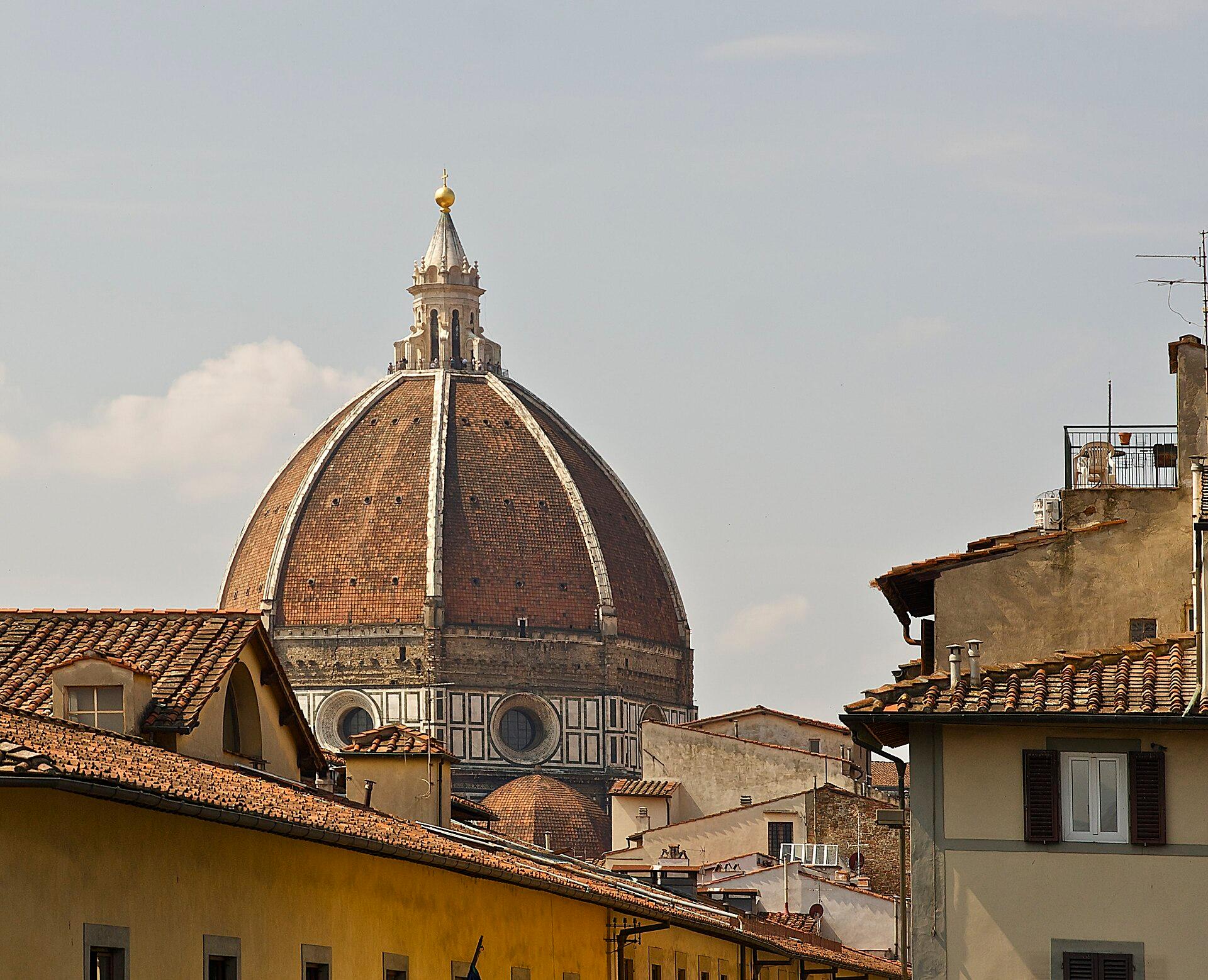
Raise your eyes to the dome. In 1418 the Opera del Duomo announced a competition: to cover an enormous opening with a masonry dome, without the large wooden scaffolding that was normally used. It was an almost impossible challenge. The competition had no official winner. Brunelleschi and Ghiberti were appointed master builders. Work began on 7 August 1420. The dome has two shells, with a space of about one meter twenty between them, eight great marble ribs, and bricks laid in a herringbone pattern. Inside it measures forty-five point five meters in diameter, and outside, fifty-four point eight. It remains the largest masonry dome ever built. At the top is the lantern: begun in 1446, finished in 1461. Above it, a large golden ball. Verrocchio made it, between 1468 and 1472. But a storm brought it down, and a larger one was put up. A white marble disc, at the back of the square, marks the spot where it came to rest. With the cross, the whole structure is one hundred and sixteen point five meters high. Here the short tour ends. If you want to see the dome from inside, the Brunelleschi Pass takes you up, from the Porta della Mandorla, on the north side. Thank you for listening: the square is yours, enjoy the rest of your visit.

Duomo di Firenze
The Florence Cathedral in 45 Minutes
6 stops45
Façade, Uccello's clock, the English general, Dante, the Last Judgment and the dome seen from the outside: six stops, all free of charge, for those short on time.
Free short route. More stops in the full route: 6 Continue with the full route