Santa Maria Maggiore in brief
Six stops, all with free entry and no ticket needed: the square, the nave, the mosaics, the apse, the icon of the Salus Populi Romani and the tomb of Pope Francis. In about forty-five minutes you hear the essentials of the basilica, with a voice that tells you where to stop.
Museum: Basilica di Santa Maria Maggiore
The August Snow, Piazza di Santa Maria Maggiore
One night in August, in Rome, it snows. We are on the Esquiline Hill, and according to tradition, that is exactly how it happened. That night the Virgin appears in a dream to two people: the patrician Giovanni and Pope Liberius. She asks for a church in her honor, and says that she herself will show the place, with a mantle of snow out of season. The next morning the snow is on the hill. The Pope is the first to lay the foundations, and the basilica is built with the patrician's wealth. Every August fifth, the basilica commemorates that day: during Mass, a rain of white petals falls from the ceiling. Look up, near the façade. The bell tower is seventy-five meters tall: it is the tallest bell tower in Rome. Before entering, three practical things. Inside, there is absolute silence, and phones are forbidden: listen with headphones, at low volume, with your phone in your pocket and on silent. No phone calls and no flash, out of respect for those who are praying. Shoulders and knees must be covered, and no hats. And during the day Masses are celebrated: if you find one in progress, walk quietly and stay at the edges. When you have finished, enter the basilica and stop just inside, in the center of the nave.
The Panorama, Nave
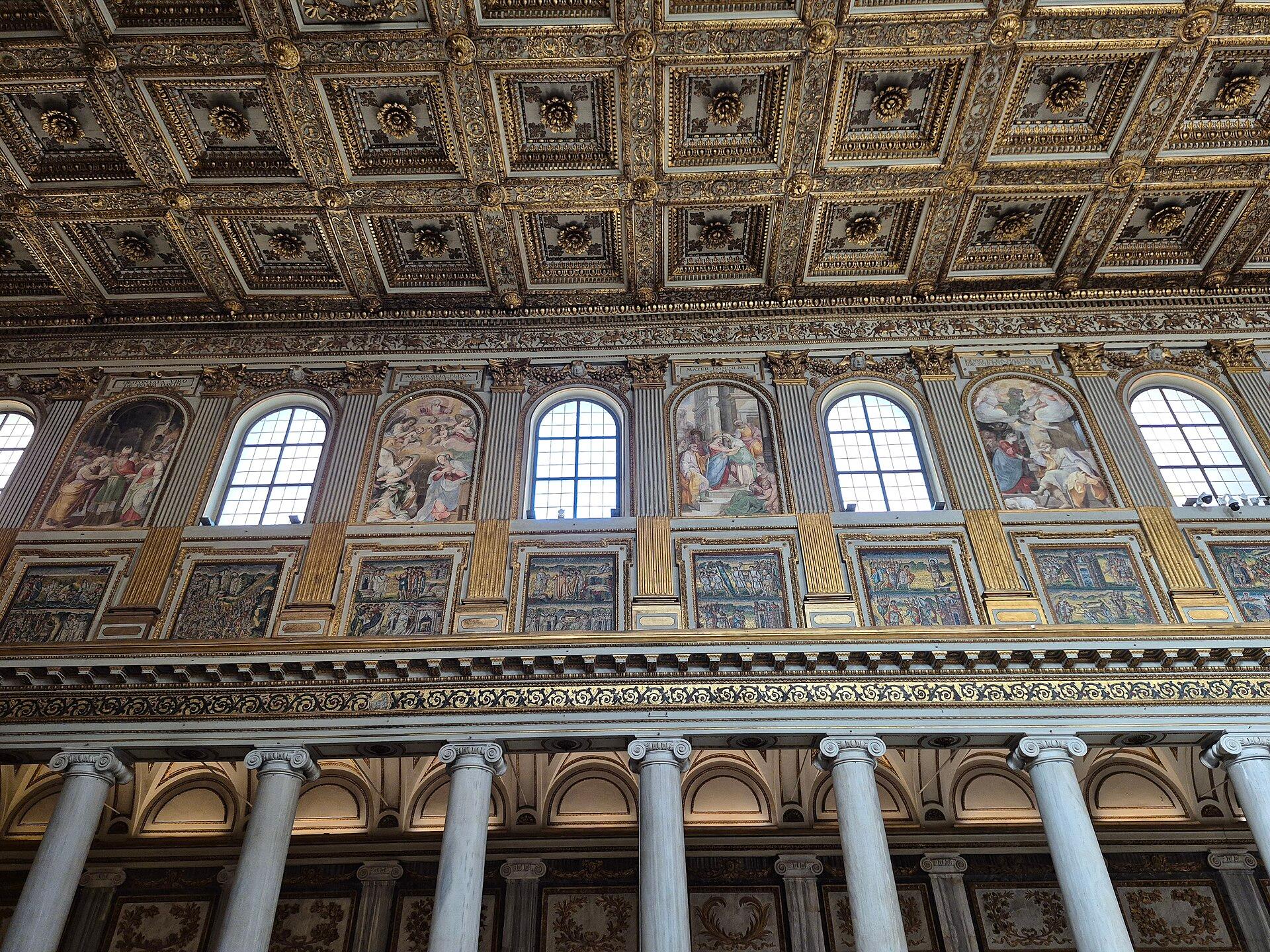
Stop here, just inside, and look all the way to the end. You are looking at a church sixteen centuries old. Santa Maria Maggiore is the only one of Rome's great early Christian basilicas to have kept its original appearance intact. It was rebuilt by Pope Sixtus the Third, between 432 and 440, right after the Council of Ephesus, which in 431 had recognized Mary as the Mother of God. Sixtus dedicated it to her. Today it is one of the four papal basilicas of Rome, the first Marian sanctuary in the West. Look at the columns. They are made of cipollino marble, and they come from ancient warehouses and from pagan temples demolished after the arrival of Christianity. Pieces of ancient buildings, reused for a new church. Beneath your feet runs a Cosmatesque floor, made of colored marbles. Above your head, a gilded wooden ceiling. Take a moment: the first impression is the most beautiful part of the visit, and it is free. Now look up. Stay in the nave and raise your gaze to the high walls, above the columns, where the mosaic runs.
Stories in the Mosaic, Nave
Sixteen centuries ago, someone told the Bible as a comic strip, on the walls of this nave. The mosaics above the columns date back to the time of Sixtus the Third, around 430. They mark the beginning of Christian narrative art on a large scale, and are considered the first cycle of images to appear in a church in Rome. On the left side unfold the stories of Abraham and Jacob: the growth of the people of God. On the right side, Moses and Joshua, under whose leadership that people gets the better of its enemies. There used to be forty-two panels, many with two scenes one above the other. Today twenty-seven remain: twelve on the left and fifteen on the right. In the eighteenth century new windows were opened, and some scenes were lost. They are very high up, and from here they look small. Choose one and follow it with your eyes, like a comic panel: there is always someone leaving, someone arriving, someone watching. Now walk toward the altar. Go toward the altar and look at the far end, in the apse, behind the canopy.
The Coronation, Apse
Up in the apse, Mary is seated on the throne beside Jesus, at the moment she is crowned. All around, a mosaic of gold. Pope Nicholas the Fourth had it made, between 1288 and 1292, and entrusted its direction to Jacopo Torriti. The works were part of the preparations for the first Jubilee, the one of 1300. The coronation of Mary is a theme that came to Rome from France. At the sides of the throne stand angels and saints: on the left Francis, Peter and Paul, on the right John the Baptist, John the Evangelist and Anthony of Padua. Below, scenes from the life of Mary: the Annunciation, the Dormitio, that is, her last sleep, the Adoration of the Magi and the Presentation of Jesus at the Temple. In front of the apse, the canopy of the altar, designed by Fuga, hides the view from you a little. Move one step to the right or to the left, and the mosaic reappears. Then look for the relic most closely linked to Christmas. Now go to the left aisle and look for the Pauline Chapel: there you will find the icon of the Salus Populi Romani, or its copy.
The Madonna of Rome, Salus Populi Romani
Every time he set out on a journey, Pope Francis came here. And when he returned, he came to give thanks. In all, one hundred twenty-six times, before a single icon: the Salus Populi Romani. It is a panel of cedar wood, one hundred seventeen by seventy-nine centimeters. It shows the Madonna at half length, holding the Child in her arms. Tradition attributes it to Saint Luke, the evangelist and patron saint of painters. According to tradition, Rome carried it in procession for three days, and Pope Gregory the First prayed before it so that the plague would end. For the icon, Pope Paul the Fifth had the Pauline Chapel built, a sumptuous shrine. Every last Sunday of January, the basilica commemorates the day of the transfer. Look for the icon, or its copy if the chapel is closed for works. Stop for a moment: for the Romans, this is not an ancient panel, it is a companion on the road. A few steps from here there is another place, a quieter one. Stay in this stretch of the left aisle: a few steps away, between the Pauline Chapel and the Sforza Chapel, is the tomb of Pope Francis.
Francesco, Tomb of Pope Francis
You are standing before the tomb of Pope Francis. Lower your voice, or remain silent. Santa Maria Maggiore is the place he himself chose for his burial. The tomb is in this nave, between the Pauline Chapel and the Sforza Chapel, near the altar of Saint Francis of Assisi. The tombstone is a simple slab, with a single name engraved: FRANCISCVS. On the opposite wall is a depiction of the pectoral cross he wore. A short distance away, on the right side of the Pauline Chapel, a plaque recalls his visits to the icon of the Salus Populi Romani: one hundred twenty-six times, to pray before her. It was unveiled on the twenty-first of April, 2026, on the first anniversary of his death. At this stop there are no sounds or commentary: just a few facts, and then silence. Many people come here to pray: leave them their silence. If there is a line, listen calmly; when it is your turn, pause for a moment. Then, if you wish, continue without hurry. The short tour ends here. Thank you for listening to Santa Maria Maggiore: leave in silence, or stay a moment longer. To go up to the Loggia of the Blessings and the museum, listen to the full tour.

Basilica di Santa Maria Maggiore
Santa Maria Maggiore in brief
6 stops45
Six stops, all with free entry and no ticket needed: the square, the nave, the mosaics, the apse, the icon of the Salus Populi Romani and the tomb of Pope Francis. In about forty-five minutes you hear the essentials of the basilica, with a voice that tells you where to stop.
Free short route. More stops in the full route: 11 Continue with the full route