San Vitale in Brief
Six stops for the essential visit: the crooked door, Vitale's well, the dome, the apse with Bishop Ecclesius, and the two panels of Justinian and Theodora. About thirty minutes is all you need. An entrance ticket with a reserved time slot is required.
Museum: Basilica di San Vitale
A Crooked Door, Threshold and Portico
A bishop returns from Constantinople, around 525, and decides to build a new church. His name is Ecclesius. Here you are on the threshold, in the entrance portico. Before going in, notice something strange: the entrance is crooked. In an ordinary basilica you walk straight in and have the altar at the far end. Here the portico is set askew in relation to the apse, and there are two doors, one on the axis and one oblique. Why? The sources do not explain it. What you can see is a different plan: not a long corridor, but an eight-sided heart, with a second ring around it. A form like this has a relative in Constantinople, the church of Saints Sergius and Bacchus. Before this church, there was a small shrine here from the fifth century, dedicated to Saint Vitalis. The new church was built under the Goths and was consecrated in 547 by Bishop Maximian, when by then the emperor Justinian ruled over Ravenna. Ecclesius does not live to see it: he dies in 532. Keep this bishop in mind, who dreams of a church and does not see it finished. You will meet him again further on. Go in and look at the walls. Look for a panel of stone and tesserae set upright, like a painting: it is an ancient floor, with a vase and two peacocks.
Vitale's Well, The Floor of the Well
A soldier, a condemned physician, a well. This, according to tradition, is how the story of Vitale, the saint who gives this church its name, begins. Vitale is a Roman soldier escorting a judge, Paulinus, on a journey to Ravenna. There, a Christian physician, Ursicinus, is condemned to death. Vitale stays by his side until the end. This is how they discover him: he too is a Christian. The judge has him buried alive. How do we know? From Saint Ambrose, Bishop of Milan. Inside a sarcophagus he found a little book that told the story of Vitale, his wife Valeria and their sons, tradition says: Gervasius and Protasius. You will find them again further on, in two medallions on the arch in front of the altar. What you see in front of you is the floor of an ancient well: a mosaic of geometric motifs, with a vase and two peacocks, reassembled vertically. It was found in 1911 and restored in 1982. Three steps lead down to a small pool of water, where legend places the site of the martyrdom. The coins you see in the water are left by visitors, as a good-luck wish. Vitale is commemorated on the twenty-eighth of April. Now walk toward the center of the space and look up: the dome opens above you.
The Light Dome, Beneath the Dome
Look up. That dome is not made of bricks, but of terracotta tubes, fitted one inside the other. Think of a stack of nested glasses, arranged in a circle. It is a traditional Ravenna technique, and it serves one purpose: to weigh little. Everything around here is made to seem light. Large semicircular niches, with two rows of superimposed small arches. Basket-carved capitals, so openworked that they look like marble lace. The paintings on the dome are much more recent. Three painters made them between 1778 and 1782: Serafino Barozzi, Ubaldo Gandolfi and Jacopo Guarana. Here two worlds meet. The dome and the shape of the portals come from the Roman tradition. The capitals and the polygonal apse come from the Byzantine East. Above the capitals, in the blocks that support the arches, stylized animals and the cross are carved. One last thing. A two-level corridor runs around this space. The upper one is called the matroneum, and it is thought to have been reserved for women. Walk toward the back, toward the altar, and look up at the great semicircle of the apse: a young Christ seated on a blue globe, all gold and purple.
Vitale and Ecclesius, Apse
Look at the apse, at the back: it is the heart of the whole mosaic programme. In the centre is a young Christ, beardless, in purple and gold, seated on a blue globe. In one hand he holds a scroll. With the other he offers a crown: the crown of martyrdom. It is received by Vitale, the man from the well, with his hands covered by his robe as a sign of respect. On either side are two archangels, Michael and Gabriel. Closing the scene is a bishop holding an object. He is Ecclesius, the man who dreamed of this church. And the object is his model. Then raise your eyes again, above the arch of the apse. Two flying angels hold a large disc, and on either side are two cities: Jerusalem and Bethlehem. Think about the dates. Ecclesius dies in 532. The church is consecrated in 547. He offers the model of a building he never saw finished. Before you move on, look at how the light entering from the windows plays with the mosaic and the marbles. On either side of the apse, beneath the large lunettes, there are two panels facing each other. Look for the one with the man wearing a crown and a purple robe, surrounded by soldiers and churchmen: it is Justinian.
Justinian Wasn't There, The Emperor Panel
Before you stands one of the most powerful men of his time: the Emperor Justinian. And yet he never came to Ravenna. Never. In the mosaic he is at the centre, with the diadem, the halo and a golden paten in his hands, the plate for the bread of the Eucharist. In front of him walk a subdeacon with the censer, a deacon with the book of the Gospels and a bishop with the pallium and the cross. That bishop is Maximian, the same one who consecrates the church in 547. Look above his head: his name is written there. He is the only one in the whole procession. This is why it is thought that he oversaw the works. Then look at the feet: they overlap, as in a row, to say that everyone advances together behind the emperor. No perspective, all the figures on a single plane, against a golden background. The scene tells of a gesture: the offering of sacred vessels that emperors made to important churches. A gift that came from afar, in image. Now the panel opposite: a woman with a crown, a golden chalice in her hand, surrounded by ladies of the court.
Theodora the Absent, the Empress Panel
Here is the empress, Theodora. She, too, never came to Ravenna. She died in Constantinople on 28 June 548, about a year after the consecration of this church. She carries a golden chalice with gems. Her mantle is purple and, at the bottom, embroidered in gold, are the Magi bringing their gifts. Just as the Magi bring gifts to the infant Jesus, so she and Justinian offer their gifts to Christ. He the bread, she the wine. She has a crown, a halo and jewels: a solemn, formal image. Her panel has a richer background than Justinian's, with a dome and curtains. In front of her are two dignitaries, behind her the ladies of the court. Next to them, a fountain on a column: in the language of mosaics, the salvation that comes with baptism. Who was Theodora really? The historian Procopius of Caesarea speaks of her in two opposite ways: well in some works, very badly in the Secret History. Here no one speaks. There is only the gold, and her, advancing. Your short tour ends here. Take your time as you leave. If you have the ticket that includes it, the Mausoleum of Galla Placidia is in the same complex: it can be visited in about five minutes, at its booked time. Thank you for listening to San Vitale.
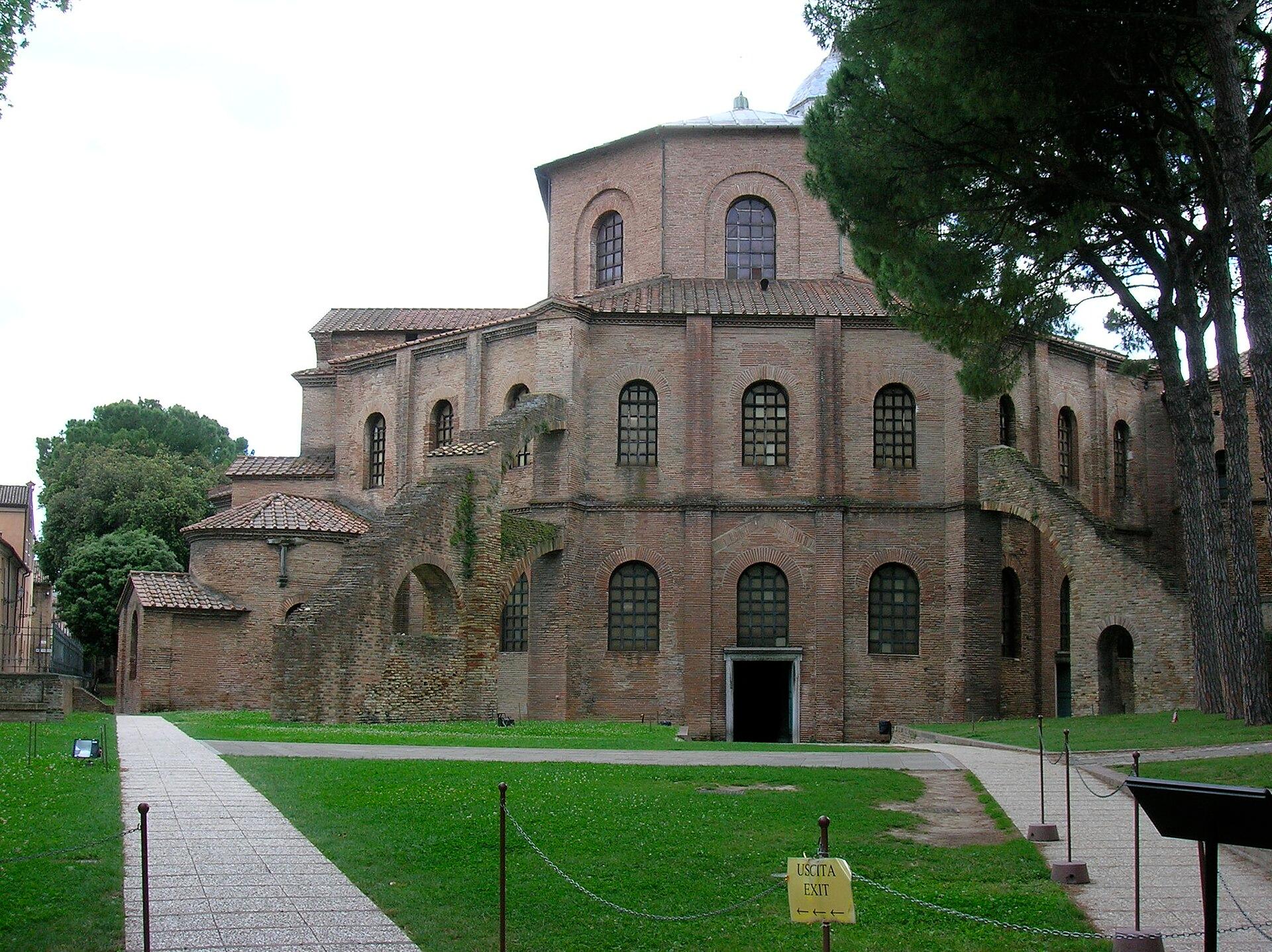

Basilica di San Vitale
San Vitale in Brief
6 stops30
Six stops for the essential visit: the crooked door, Vitale's well, the dome, the apse with Bishop Ecclesius, and the two panels of Justinian and Theodora. About thirty minutes is all you need. An entrance ticket with a reserved time slot is required.
Free short route. More stops in the full route: 6 Continue with the full route