Capitoline Museums in brief: six masterpieces
The She-Wolf, Marcus Aurelius, Caravaggio, the Forum from above, the Venus and the Dying Gaul: the best of the oldest museum in the world, for visitors short on time.
Museum: Musei Capitolini
The She-Wolf, Hall of the She-Wolf
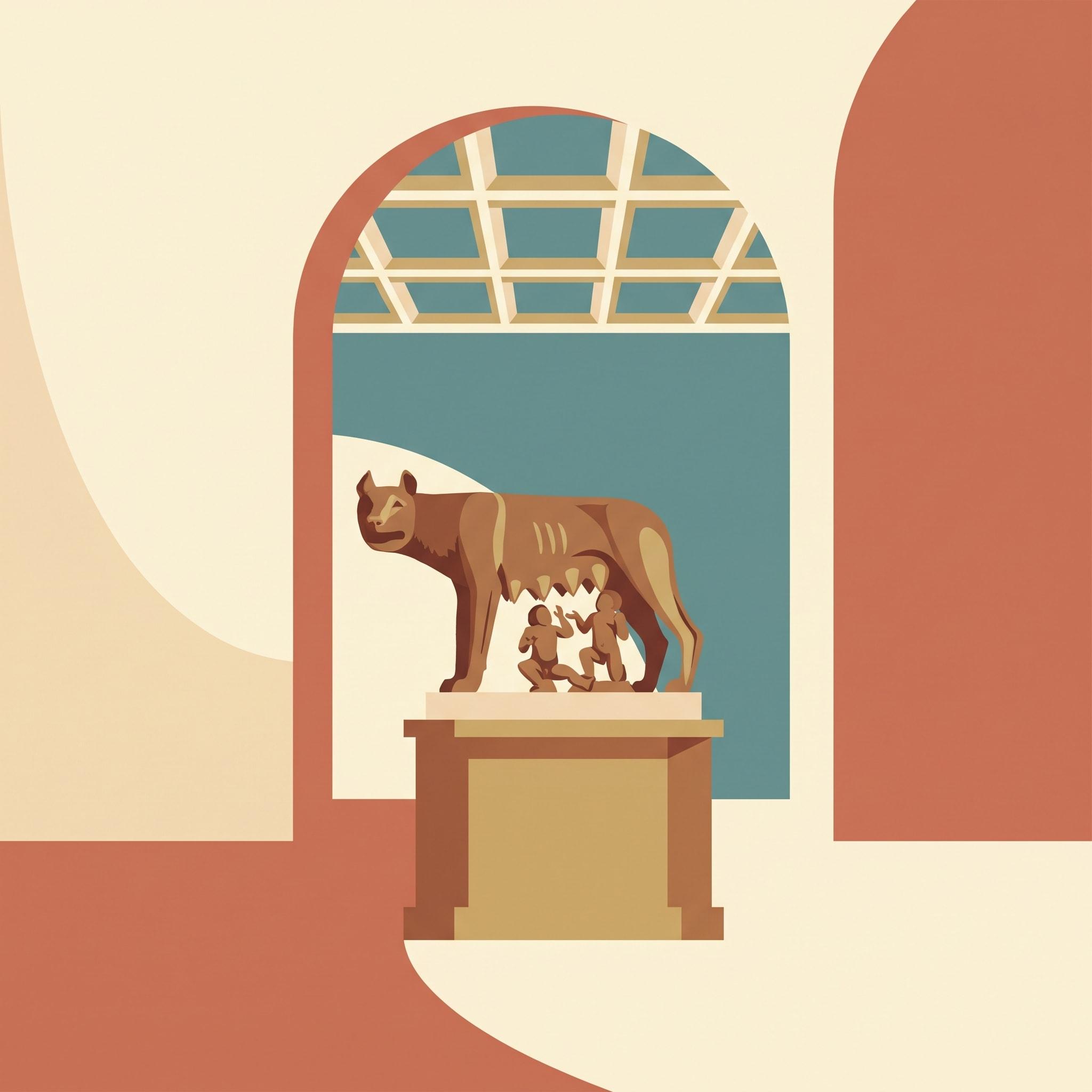
Where are the twins? For centuries, beneath this she-wolf, they were not there. You are standing in front of the Capitoline Wolf, a bronze seventy-five centimetres tall. Since the tenth century it has stood at the Lateran, and it is not a work of art: it is a symbol of justice. Trials were held there, and executions "at the wolf" are recorded until 1450. In 1471 Pope Sixtus IV donated it to the Roman people. Only afterwards did someone add the two twins, which some attribute to Pollaiolo. A woodcut of 1499 already shows it with the twins. Look at them: they came later. With them, a symbol of justice becomes the symbol of Rome. And the Wolf, when was it born? For years it was believed to be Etruscan, from the fifth century BC, and that is the date the museum's label still gives. In 2006 the restorer Anna Maria Carruba put forward another idea: it might be medieval. Analyses of the casting earths point to the thirteenth century. These are two competing datings, and the question remains open. What you see before you could be more than two thousand years old, or about eight centuries. Continue along the route towards the Exedra, the great glass hall.
The Rescued Horseman, Exedra of Marcus Aurelius
In Rome there were twenty-two equestrian statues like this one. Why is she the only one to have reached us? Look up: Marcus Aurelius on horseback, four metres twenty-four of bronze, under the glass of the hall designed by Carlo Aymonino. It was cast between 161 and 180 AD, perhaps in 176 for a triumph over the Germans, perhaps after his death. The ancient sources never mention it. For centuries it stands at the Lateran. The story goes that it is saved because it is mistaken for Constantine, the first Christian emperor. In 1538 Pope Paul the Third has it moved to the Capitoline Hill. Michelangelo designs the base, even though he apparently did not agree with placing it in the middle of the square. In 1849, in the revolutionary days of the Roman Republic, demonstrators put a tricolour in its hand. In 1979 a bomb in the nearby Palazzo Senatorio damages the base. A legend also runs through the square: on the day of judgement, the bronze will turn back to gold. The one you see today in the square is a copy. The original is here, inside, sheltered. Now go up to the second floor, to the Pinacoteca.
Two Caravaggios, Hall of Saint Petronilla, Picture Gallery
Two paintings by Caravaggio in the same room, and one is painted over another painting. Look first for the Fortune Teller. A gypsy woman reads a young man's palm. According to the biographer Bellori, Caravaggio saw her pass in the street and portrayed her from life. He painted it in the last years of the sixteenth century, and the first to buy it was Cardinal Del Monte. In 1977 an X-ray revealed the secret: beneath the paint there is another work, The Coronation of the Virgin by the Cavalier d'Arpino. Caravaggio painted over a colleague's work. Now look for the Saint John the Baptist, from 1602. It was commissioned by Ciriaco Mattei for his palace, not for a church. The saint bears the name of Mattei's son, Giovanni Battista. And the pose? Caravaggio took it from one of the nudes on the ceiling of the Sistine Chapel, by Michelangelo. Both arrived on the Capitoline Hill around 1750. Pope Benedict the Fourteenth wanted works for the museum, and had the Fortune Teller appraised by Cardinal Valenti Gonzaga. A second version is in the Louvre. Now go back to the ground floor and descend to the underground gallery. Halfway along, take the side staircase that goes up to the Tabularium.
Above the Forum, Tabularium
To get here you have crossed the foundations of the hill, beside the temple of Veiovis. The temple was older than the building, and the builders went around it: this is why the plan has a recess. Now move closer to the open arcade. Look down. This is the Roman Forum, seen from above. The museum disappears and the city remains. The building where you are standing was the Tabularium, the archive of the State: here the laws and official acts of Rome were kept, engraved on bronze tablets. In 83 BC a fire damaged the hill. The dictator Sulla had it rebuilt, and the work was completed by Quintus Lutatius Catulus, consul in 78 BC. The date can be read in an inscription. Now look, in front of you, for the remains of the temples. That of Vespasian, that of Concord. And further on the Rostra, the speakers' platform. More than two thousand years ago, this wall closed off the Forum on the side of the Capitoline Hill. Today it is still a viewpoint. Take a moment. From no other point in the museum do you see Rome like this. Now return to the gallery, continue to the end and go up to the courtyard of Palazzo Nuovo, then to the first floor, as far as the Venus room.
The Venus, Cabinet of the Venus
Why would a pope buy a naked goddess and give her to the people? You are in the Cabinet of the Venus, the small room that bears her name. The statue is one hundred and ninety-three centimetres tall. It was found in Rome around 1670, near the basilica of San Vitale. More than eighty years pass. In 1752 Pope Benedict the Fourteenth bought it from the Stazi family and donated it to the museum. Look at the hands: they cover the body. She is a "Venus pudica", that is, modest, a variant of a type that descends from the Aphrodite of Knidos by Praxiteles. The Museums speak of about a hundred replicas. Napoleon took it to Paris, under the Treaty of Tolentino. It returned to Rome in 1816. In the meantime, in its place, there was a plaster cast, which later left for Great Britain. Take a moment, and look at it by walking around the statue: the room is small, and the light changes. Now return to the gallery and continue to the end: the last room is the one with the Dying Gaul.
Dying Gaul, Hall of the Gladiator
A wounded warrior, with a collar around his neck. For centuries they called him a gladiator. He is not. You are standing before the Dying Gaul. The sign is at the neck: a torques, the collar of the Celtic peoples. Look also at the tousled hair. He is a Galatian, a Celt of Asia Minor. This is a Roman marble copy. The original was bronze, and is lost: it may date to 230-220 BC and was commissioned by Attalus I, king of Pergamon, to celebrate the victory over the Gauls. He is the enemy, and they sculpt him with dignity. He was found in the early seventeenth century, in the excavations of Villa Ludovisi: the first record is from 1623. For a long time they called him the dying gladiator, because of a misunderstanding. In 1797 Napoleon took him to Paris. He returned to Rome in 1815, thanks to Canova. In 2014 he left for America: three months at the National Gallery in Washington, about seven hundred thousand visitors. He came back home on 20 March. Take a moment. This is the last room. When you return to the Piazza del Campidoglio, look for the horseman at the center: what you see is the copy, and you have already met the original.

Musei Capitolini
Capitoline Museums in brief: six masterpieces
6 stops60
The She-Wolf, Marcus Aurelius, Caravaggio, the Forum from above, the Venus and the Dying Gaul: the best of the oldest museum in the world, for visitors short on time.
Free short route. More stops in the full route: 20 Continue with the full route