Herculaneum in Brief
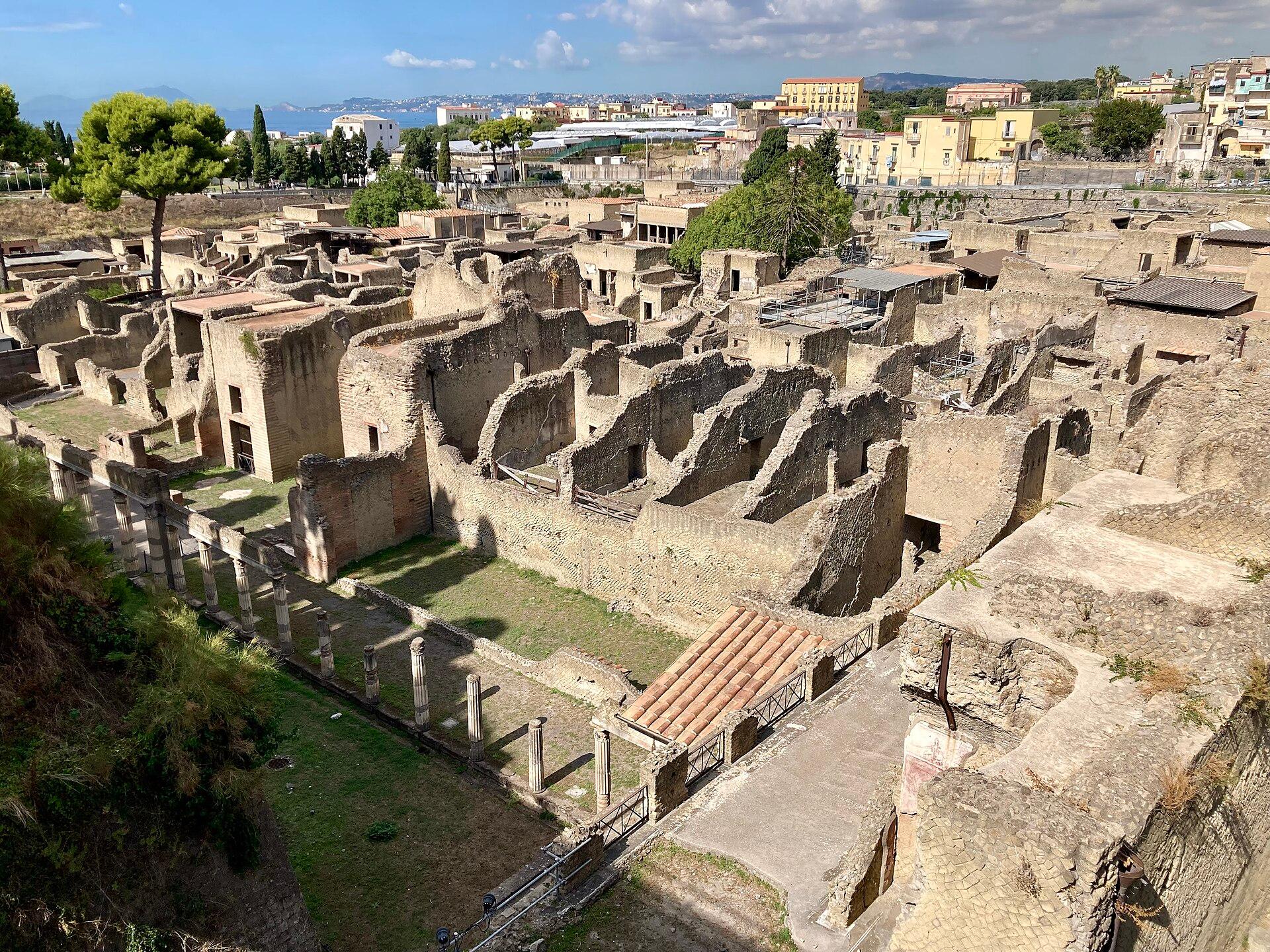
The six stops not to be missed if you are short on time or enter on a winter afternoon: the beach, the benefactor, the House of the Stags and its named bread, the Augustales, the baths and the wattle-and-daub apartment building. About one hour, with exit by the bridge reached from the third cardo.
Museum: Parco archeologico di Ercolano
Where the Sea Once Reached, Ancient Beach and Fornices
Stop here, on the sand. Two thousand years ago the waves lapped at these walls. Today the sea is far away: the volcanic material pushed the shoreline forward by about four hundred meters. And do you know what people thought for a long time? That the inhabitants of Herculaneum had escaped. Only a few skeletons had been found in the city. Then, in the spring of 1980, the archaeologist Maggi discovered the opposite. The vaulted arches open before you: these are the fornices, the harbor warehouses and shelters for boats. About three hundred people had taken refuge there, women and men, young and old, masters and slaves. They had brought with them their most treasured belongings: jewelry, coins, house keys, amulets, even a surgeon's kit. They hoped for rescue from the sea. They were reached by a burning cloud. Look at these arches with respect, without hurrying. Two practical things. This tour does not include the entrance ticket, which is bought separately. And if it is a winter afternoon and you have little time, choose the short route. Now go up the ramp built against the walls, to a large rectangular square with an altar covered in marble: it is the terrace of Marcus Nonius Balbus.
The Benefactor, Terrace of Marcus Nonius Balbus
In front of you is an altar covered in marble, and an entire square dedicated to one man. His name was Marcus Nonius Balbus. Why did Herculaneum owe him so much? Balbus had been praetor, proconsul of Crete and Cyrene, and tribune of the plebs in 32 BC. He was a supporter of Octavian, the future Augustus. And he did not forget this city: he restored and built many public buildings. In his honor at least ten statues were erected. By decree of the local senate, this altar was dedicated to him. On the side facing the sea there is a long inscription recording the honors he received upon his death. Beside it stood his statue wearing a cuirass: the head turned up in Maiuri's excavations, and a large piece of the bust only in 1981. Those arriving from the sea saw the fornices first, and immediately afterward this terrace. It was designed to welcome and to impress. Here in front of you is a building that today cannot be visited like the others: the Suburban Baths, among the best preserved in the Roman world. They are being restored and can be seen only on certain days, with a separate ticket. A statue of Balbus, however, awaits you in the Antiquarium, at the end of the tour. Now go up along the fifth cardo, the main street, to the house with the garden and the terrace over the sea: it is the House of the Stags.
The Bread with a Name, House of the Stags
How do we know the name of a man who lived here? From a piece of bread. A carbonized loaf, with a stamp: Celer. Celer was a slave of Quintus Granius Verus, freed shortly before the eruption. That bread allowed scholars to identify the owner of the house. A newly freed man, and a name that reaches us inside a loaf of bread. Imagine the cryptoporticus, the corridor with large windows onto the garden: a white mosaic floor with chips of colored marble, frescoed walls. In the garden there were round marble tables and statues of stags attacked by dogs, of a satyr with a wineskin, of a drunken Hercules. The originals are now in the Antiquarium. You will find them again at the end. At the far end, aligned with the garden, there is a large hall, beneath a pediment with a mosaic of blue glass paste: cupids on sea animals and the head of Oceanus. Then a terrace open to the sea. Stop for a moment. Whoever lived here had that sea in front of them every day. Now go up along the fifth cardo to the widest street running alongside the buried city, the decumanus maximus, and follow it to the building with four columns at its center: it is the Seat of the Augustales.
From Slaves to Notables, Seat of the Augustales and Chalcidicum
Imagine being born a slave. One day you are freed. And then what? In Herculaneum there was a path: becoming an Augustalis. The Augustales formed a guild dedicated to the cult of the emperor Augustus, in the area of the Forum, where political, religious and commercial life took place. For a freedman, joining it meant climbing the social ladder. You are in a square building, with walls of blind arches and four columns in the center. An inscription on the wall records that two brothers built it, while Augustus was still alive: Aulus Lucius Proculus and Aulus Lucius Julianus. On the day of the inauguration they offered a lunch to the members of the local senate and to the Augustales. At the back there is a chamber with frescoes: Hercules welcomed into Olympus with Jupiter, Juno and Minerva. A little further on, the Chalcidicum: a portico with arcades between two large arches decorated with marble and stucco. For almost twenty years it could only be viewed from a walkway, and it reopened in 2026. The statues that are now in the National Archaeological Museum of Naples were found here. Now turn into the street that descends toward the sea, the third cardo, and look for the entrance with a corridor that leads to the baths.
The Baths in the Center, Central Baths
Two doors, a single complex. The Central Baths had a section for men and one for women, supplied by a large well. They were identified in 1873 and fully excavated in 1931. If you enter the men's section, from the third cardo, a corridor leads you to the changing room, the apodyterium. Look at the niches in the wall: they were used to leave clothes. Then the cold room, the frigidarium, round, with red walls, four yellow niches and a blue dome. Then the lukewarm room, the tepidarium, with a black and white mosaic: a Triton, a sea god, among dolphins, an octopus, a squid and a little cupid with a whip. Finally the hot room, the caldarium, with the apse. The women's section opens onto the fourth cardo. Here there is a fine copy of the Triton mosaic, and the caldarium has two seats: one of white marble, one of rosso antico. The well drew water at a depth of eight and a quarter meters. Now follow the fourth cardo, up to the balcony over the street supported by brick columns: it is the House of the Wattle and Daub.
The Apartment Building, House of the Wattle and Daub
Look up, toward the balcony supported by brick columns. What is this house? An apartment building. A rental house, with several families on the upper floor. It is called the House of the Wattle and Daub because almost all of it is built that way: a wooden frame of squares, filled with rubble stone. An inexpensive technique, considered not very sturdy and easy prey for flames. In Pompeii it is never used for load-bearing walls. Here they experimented with it: Herculaneum was more open to the new ideas that came from Neapolis, that is, Naples. The balcony belongs to a first-floor apartment, with its entrance at number thirteen. From numbers fourteen and fifteen you enter the ground-floor house and the shop. From here come beds, wardrobes and a portrait in carbonized wood. It reopened recently, after decades of closure. If the first floor is open, go up: it is the first house in Herculaneum from which the public can look out onto the street from above, the fourth cardo, the road that led to the sea. If you have finished here, follow the signs toward the exit: you leave by the bridge reached from the third cardo. You cannot re-enter with the same ticket, so take the time for one last look.

Parco archeologico di Ercolano
Herculaneum in Brief
6 stops60
The six stops not to be missed if you are short on time or enter on a winter afternoon: the beach, the benefactor, the House of the Stags and its named bread, the Augustales, the baths and the wattle-and-daub apartment building. About one hour, with exit by the bridge reached from the third cardo.
Free short route. More stops in the full route: 11 Continue with the full route