The Doge's Palace at a Glance
Six moments for those short on time: the courtyard, the room where ambassadors were received, the Council of Ten, the Great Council Hall with the Paradise, the doge erased from the frieze, and the Bridge of Sighs. About fifty minutes. Admission not included.
Museum: Palazzo Ducale di Venezia
The Stage, Courtyard and Giants' Staircase
You are in the courtyard of the Doge's Palace, from which Venice was governed for centuries. At the helm was a doge, but never alone. At the far end you see the richest marble façade of all, with the great staircase: it is the Giants' Staircase, the old ceremonial entrance. At the top stand two colossal statues, Mars and Neptune, sculpted by Jacopo Sansovino in the second half of the sixteenth century. The god of war and the god of the sea: the power of Venice on land and at sea. This courtyard was the stage of power. Here the doge's coronation ceremonies were held, along with tournaments and, every year, a bull hunt. At the center, two bronze wellheads supplied water to the whole palace. On one side, just a few steps away, stands Saint Mark's Basilica. The oldest wings of the palace have simpler, more austere façades: the one in front of you is the richest. Today the visitor route begins from another staircase, but stop for a moment to look at this one. Almost everything you will see in the rooms was designed to say one thing only: here, Venice rules. The short route skips the first rooms. Go up the wide Censors' Staircase, under the portico on the opposite side from the Giants' Staircase, and follow the marked route to the Anticollegio Room, after the great room of the four marble portals.
Where You Wait, the Anticollegio and the Collegio
You are an ambassador. You have made a long journey to speak with Venice. And now you must wait. You wait here, in the Anticollegio Hall, the anteroom of honor for embassies and delegations. Around you are the four mythological paintings by Tintoretto, brought here in seventeen sixteen from the Square Atrium. Veronese's "Rape of Europa," instead, is being restored and has been replaced by a copy. Then the door opens, and you find yourself in the Collegio. Here the work of the Senate was prepared, the dispatches of the ambassadors were read, and foreign delegations were received. It was the hall of foreign policy. It was also called the Full Collegio, when it brought together the Savi and the Signoria. Look above the doge's seat. Paolo Veronese painted the doge Sebastiano Venier kneeling, to thank the Redeemer. In the background is the battle of Lepanto, in fifteen seventy-one, when Venier led the Venetian fleet. So whoever spoke with the Republic had a victory above their head, in plain view. Go back to the great hall of the four portals and go through the door that leads to the Hall of the Ten: the one with the semicircle of seats.
The Ten, the Council of Ten and the Bussola
Speak softly. You have entered the hall of a tribunal that had a reputation for being powerful and ruthless. The Council of Ten was born after the conspiracy that Bajamonte Tiepolo organized in thirteen ten. It was meant to be a temporary body, to judge the conspirators. Then it stayed. It dealt with religious orthodoxy, foreign policy, espionage and the defense of the State. It was made up of ten members, plus the Doge and his six counselors: look at the hemicycle, there are seventeen panels in a semicircle. Raise your eyes: the ceiling is made of carved and gilded wood, divided into twenty-five compartments. At the center, Jupiter descends from the sky to strike down the vices with lightning. But it is a copy: the original by Paolo Veronese was taken to the Louvre by Napoleon Bonaparte. Next door is the Sala della Bussola, the antechamber for those summoned by the magistrates. Here waited those who had to appear before the Ten. The large wooden bussola above the door has the statue of Justice at its top. The short route skips the Armory. Follow the marked route toward the first floor, to the largest hall in the palace: it has seven large pointed windows and, on the back wall, an enormous canvas.
Paradise, Hall of the Great Council
You are in the largest hall of the Doge's Palace: fifty-three meters by twenty-five, among the largest in Europe. Every Sunday, at the sound of the bell of Saint Mark's, the nobles of Venice gathered here with the doge. In the Great Council sat between one thousand two hundred and two thousand patricians. Imagine the murmur of a crowd of nobles, all in the same hall. Look at the far wall: there is the Paradise, one of the largest canvases in the world, over twenty meters wide. But it was not the original plan. On the twentieth of December, fifteen seventy-seven, a fire destroys many works in the palace, and Guariento's great fresco, from thirteen sixty-five, almost disappears. You can see its remains in a nearby hall. In fifteen eighty-two the Republic announces a competition. Veronese and Bassano win ex aequo. But Veronese dies in fifteen eighty-eight, and the work has not yet begun. It falls to Jacopo Tintoretto. He paints it with his son Domenico, and finishes it by fifteen ninety-two: today you see it behind the doge's throne.
The black veil, Frieze of the Doges
A doge, in this room, no longer has a face. Raise your eyes, under the ceiling: there is a frieze with the portraits of the doges, one after another. Look for the spot where there is a black veil. That doge was called Marin Faliero. He had been elected in thirteen fifty-four, at the age of eighty. He governed for less than a year. According to the traditional account, he attempted a coup d'état, and the conspiracy was discovered. Some historians think, instead, that he was a victim of the Venetian oligarchy. On Friday, the seventeenth of April, thirteen fifty-five, he was condemned and beheaded in the courtyard of the palace, the one you entered from. Venice did something even harsher: it erased him. It is called damnatio memoriae, the condemnation of memory. Away with the name, away with the face. In place of the portrait, a black veil and an inscription in Latin: "Hic est locus Marini Faletri decapitati pro criminibus". Here is the place of Marino Faliero, beheaded for his crimes. The other portraits, on the other hand, are imaginary. The earlier ones were lost in the fire of fifteen seventy-seven, and these were painted afterwards, largely by Domenico Tintoretto. The short route goes straight to the Bridge of Sighs. Follow the marked route as far as the Hall of the Magistrate for the Laws: from there a small staircase descends toward a narrow corridor.
The Bridge, the Bridge of Sighs and the New Prisons
The narrow corridor you are standing in is one of the two passages of the Bridge of Sighs. Beneath you flows the water of the Palace Canal. Imagine a prisoner crossing it, from the courtroom to the cell. Through the small windows he catches a glimpse of the lagoon, San Giorgio, freedom. The bridge was built at the beginning of the seventeenth century to connect the palace to the New Prisons. It is enclosed and covered, with two corridors separated by a wall: one leads to the rooms of the Magistrate for the Laws and of the Criminal Forty, the other to the Avogaria. The name does not date from the time of the Republic. It was invented by the Romantics, much later. The New Prisons date from the sixteenth century. They are one of the first examples, perhaps the first in Europe, of a freestanding building designed solely as a state prison. The cells are larger, brighter and better ventilated than the old ones. The walls are lined with larch planks. The Prisons operated until nineteen nineteen. The short tour ends here. Follow the marked route to the exit through the Foscari archway and, outside, turn around to look at the Porta della Carta.
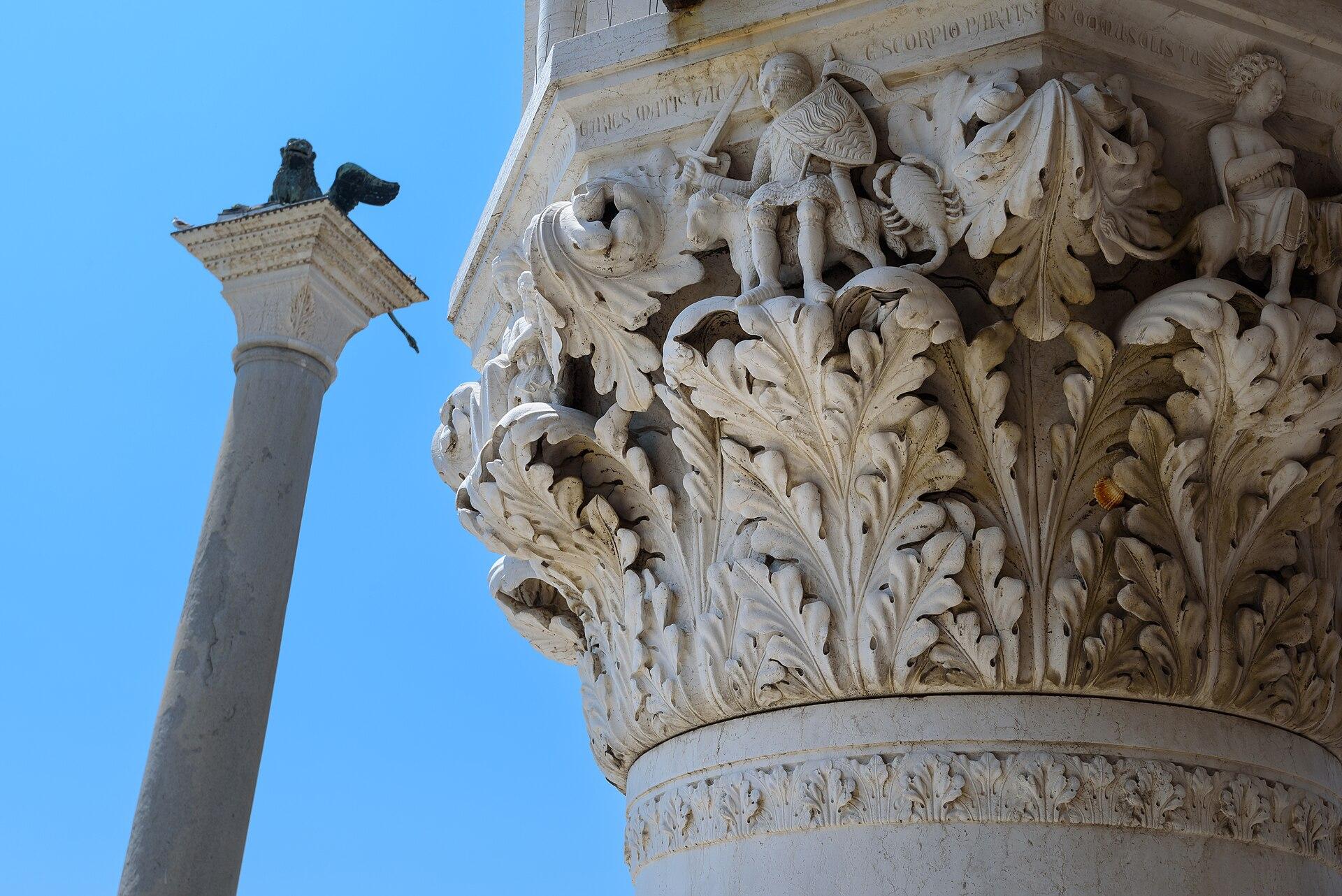

Palazzo Ducale di Venezia
The Doge's Palace at a Glance
6 stops50
Six moments for those short on time: the courtyard, the room where ambassadors were received, the Council of Ten, the Great Council Hall with the Paradise, the doge erased from the frieze, and the Bridge of Sighs. About fifty minutes. Admission not included.
Free short route. More stops in the full route: 9 Continue with the full route