Boboli Gardens at a Glance
Six stops in about an hour: the Artichoke, the Amphitheatre, Abundance at the top, the Viottolone, the Mostaccini and the Isolotto. For those with little time who want to see the two axes that made the garden famous throughout the world.
Museum: Giardino di Boboli
Fountain of Pieces, Artichoke Terrace
Welcome to Boboli. Before you start walking, a piece of advice: keep your headphones on. Loudspeakers are forbidden here, and this garden has a silence to be respected. You are on the terrace of the Artichoke Fountain, behind Palazzo Pitti, where the courtyard opens onto the garden. If you came in through another entrance, look for a large octagonal basin, with tritons and nereids on the shaft. There it is. It looks like a fountain made all in one piece. It is not. It was begun in 1639 and put in place between 1641 and 1642, at the wish of Grand Duke Ferdinand II, by the Florentine sculptor Giovan Francesco Susini and his assistants. And they built it with pieces taken from other fountains in the garden. Look at the marble cupids on the corners and inside the basin. Some are riding swans and tortoises, with bows and arrows. They were sculpted in 1621 and 1622 for another fountain, down there at the far end, in the Isola basin. At the end of the tour you will see where they came from. One last thing. At the top, there once was a bronze lily from which the water flowed. Today it is lost, but it is what gave the fountain its name. The garden extends over about thirty hectares, on gravel and almost always on a slope. Go slowly, and bring some water with you. The garden opens up before you: look for a large stepped basin with an obelisk in the center, it is the Amphitheater.
Quarry turned theatre, Amphitheatre
You are standing on the low edge of a large stepped basin, with an Egyptian obelisk at its centre. Before it was a theatre, this was a quarry. From here came the pietra forte stone with which Palazzo Pitti is built. The idea was Tribolo's, for Duchess Eleonora of Toledo. But Tribolo died, and in 1550 the basin was made as a theatre of plants: an amphitheatre of greenery, made of plants. Later the grand dukes wanted it in masonry. Work resumed in 1630, under Giulio Parigi, and was completed in 1634. Then came the festivities. In 1739 a performance was staged here for Grand Duke Francesco Stefano of Lorraine. From 1765 Grand Duke Pietro Leopoldo made it the stage for country festivities, and sometimes he also opened them to the public. The Egyptian obelisk and the large granite basin arrived later, from the collections of Villa Medici, in Rome. The obelisk was raised in 1790, the basin put in place in 1840. The steps are currently being restored and cannot be climbed. Look at them from here, from below. Climb the double ramp behind the obelisk: at the top you will find a large woman of white marble with a sheaf of golden wheat.
La Dovizia, Statue of Abundance
Look up. At the top of the garden's first axis stands a woman of white marble holding a sheaf of wheat in gilded bronze. She is called Dovizia, that is, Abundance, and for centuries she has dominated the whole complex. She was begun by Giambologna, the great sculptor of the Medici, and finished by Pietro Tacca. It is said that the work dates to 1636, and that Giambologna had already begun it in 1608. Now for the part that will intrigue you. It is said that the face bears the features of Joanna of Austria, wife of Grand Duke Francesco I, who died in 1578 at the age of thirty-one. And that the statue was originally made for a celebratory column in a square in Florence, which was never built. That is how she would have found her place up here. Boboli was created in 1549, designed by Tribolo, for Duchess Eleonora of Toledo. It is considered one of the greatest examples of an Italian garden: hedges, trees and flowerbeds arranged in a regular, symmetrical way on the hillside. Take a minute, and if you have the breath, turn around and look down at the climb you have made. You have crossed a garden built with terraces, ramps and staircases, in which every ascent leads to a statue or a fountain. Stay up here and look for a large lawn with an enormous split bronze face: from there an avenue of cypress trees leads downhill.
The Split King, Viottolone
Look at that face. An enormous bronze face, more than four metres high, split like an archaeological find. In a Medici garden. It is Tyndareus, king of Sparta, and the Polish sculptor Igor Mitoraj, who made it in the late 1990s, donated it to the Uffizi Galleries on the occasion of a major exhibition of his work. Tyndareus, in myth, is the husband of Leda and the father of Clytemnestra, and according to some versions also of the beautiful Helen. Mitoraj loved fragments: heads and faces put back together, like memories of passing time. Now turn around: from the lawn the Viottolone begins, a long downhill avenue lined with two rows of cypresses. It originated from major excavation works begun in 1612. When Giulio and Alfonso Parigi enlarged the garden, under Cosimo II and Ferdinando II, it was the Viottolone that gave the direction. Along the avenue there are statues at the crossings: ancient and modern, mostly from the eighteenth century. And alongside run the Cerchiate, avenues shaped like tunnels of holm oaks. Look for squirrels, robins and blackbirds: they live there today. At the beginning, here, the garden was used for growing crops and hunting. Today it serves to give you shade and silence. Go down the avenue and look, at the end of one of the avenues that cross it, for a stepped fountain with many small basins and small angry faces.
Uccelli del granduca, Fontana dei Mostaccini
Look at this stepped fountain, with many small basins connected by little channels. And look at the mascarons: small faces with frowning expressions. They are called "mostaccini". It was made by Romolo del Tadda, between 1619 and 1621. It was not just decoration. It is said that those little basins served to attract birds. The mechanism was simple. The little birds came down to drink. Nearby were the ragnaie, small woods where nets were stretched between the branches, and there the birds were caught. The avenue of this fountain is called Viale dei Mostaccini. When the Cerchiata Grande, the long tunnel of holm oaks, reaches it, it flows into it. And at this point, once, three large ragnaie came to an end. A court garden, but also a hunting ground. At the beginning, its purposes were largely agricultural and hunting-related. The Cerchiate, the covered avenues shaped like tunnels, served to shelter the plants. Stop for a moment in silence. How many voices can you hear? Continue down the avenue, as far as the big gates with columns: behind them, a round basin with an island.
Statue on the Move, Isolotto
You are standing in front of the gates of the Isolotto. A large basin with an island at its centre, connected to the mainland by two walkways. Alfonso Parigi designed it in the seventeenth century, under Cosimo II and Ferdinando II. The inside of the basin is currently being restored, so you look from the edge. At the centre of the island stands Giambologna's statue of Oceanus. Here, however, it arrived after a move. It once stood at the centre of the Amphitheatre, where you have just been. It seems it was moved to leave the floor free for performances. It seems that the original is now in the Bargello and that what you see here is a copy. Around it, three reclining river gods, the rivers Nile, Ganges and Euphrates, pour their waters into the basin. The move has a second episode. Before the statue, the island held a Bath of Venus, with marble cupids. Do you remember the ones riding swans and tortoises on the terrace of the Artichoke? They come from here. This is the quietest point of the tour: stop for a moment to look at the water. The short tour ends here. To exit, follow the signs: the Limonaia and the Annalena exit are on the Via Romana side, and Piazza Pitti has its own exit.
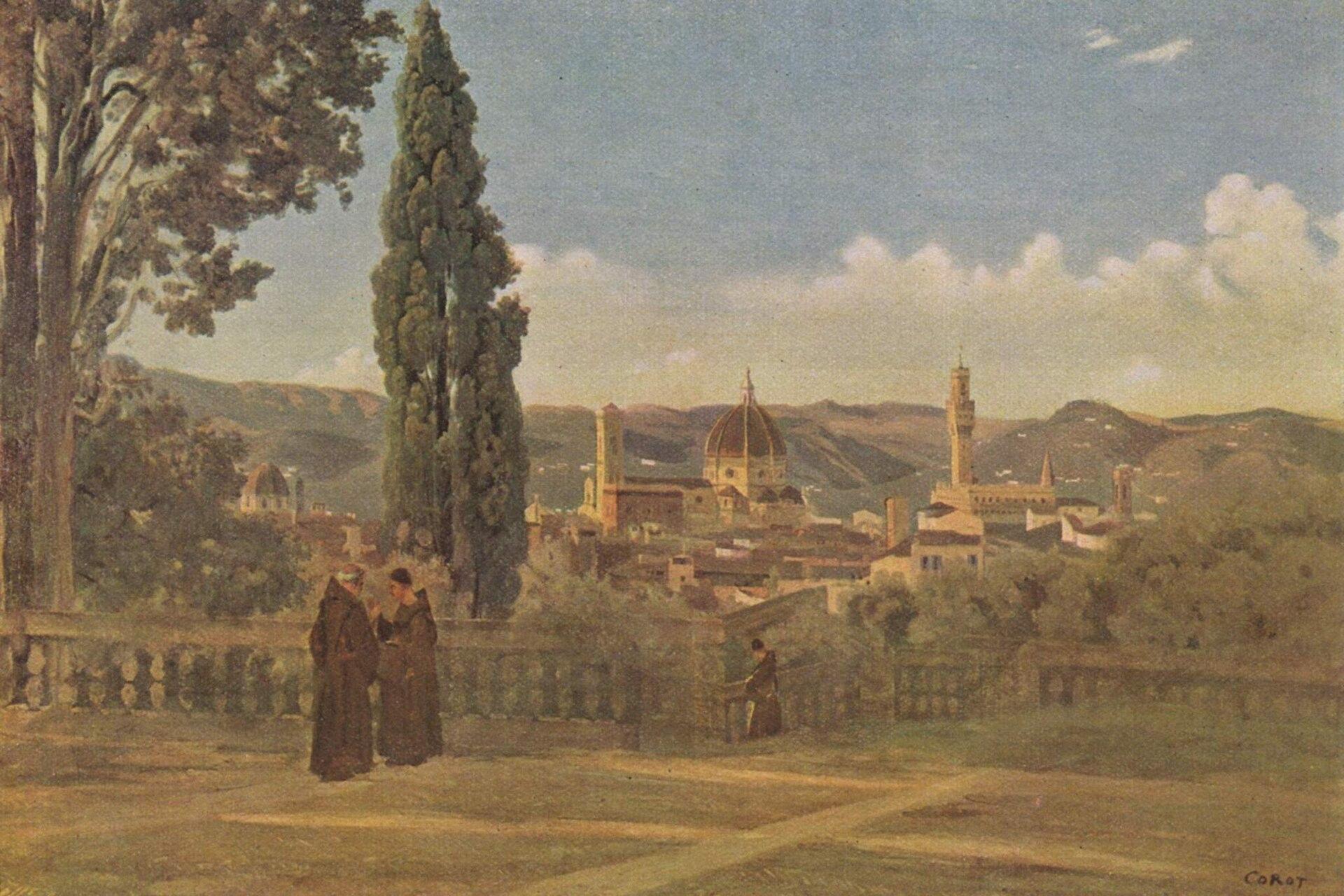

Giardino di Boboli
Boboli Gardens at a Glance
6 stops60
Six stops in about an hour: the Artichoke, the Amphitheatre, Abundance at the top, the Viottolone, the Mostaccini and the Isolotto. For those with little time who want to see the two axes that made the garden famous throughout the world.
Free short route. More stops in the full route: 9 Continue with the full route