Valley of the Temples in Brief
The six stops not to be missed if you are short on time: the temple at the top of the hill, the Concordia with the bishop and the two demons, Hercules, the stone giants and the Dioscuri. About an hour and a half along the Sacred Way, exiting through Gate Five.
Museum: Valle dei Templi
The Wrong Name, Temple of Juno
Stop for a moment and look at the valley below you. You are standing at the highest point of the hill, and the temple in front of you bears the wrong name. They call it the Temple of Juno, but no one knows to which deity it was dedicated. The name comes from a misreading. In the sixteenth century, a Dominican friar, Tommaso Fazello, visits these ruins in order to write the history of Sicily. He reads a passage by Pliny the Elder and applies it to this temple. But Pliny was speaking of another one, in Calabria, near Crotone. The temple is Doric, built around the middle of the fifth century Before Christ. It rests on four steps and has six columns on the short sides and thirteen on the long sides. In front, on the east side, the traces of the altar remain, with a stairway of ten steps. Look at the blocks: some have a reddened surface. Perhaps they are the marks of the fire set by the Carthaginians, who destroyed the city in four hundred six Before Christ. Perhaps: no one can say for certain. This city was called Akragas, and it had been founded around five hundred eighty Before Christ. The poet Pindar described it as "the most beautiful of all cities inhabited by men." The route begins here and goes west, from temple to temple. Walk down along the Sacred Way, without stopping at the arched niches in the rock, toward the most intact temple that you see at the bottom of the descent, the one with the long beam on top of the columns.
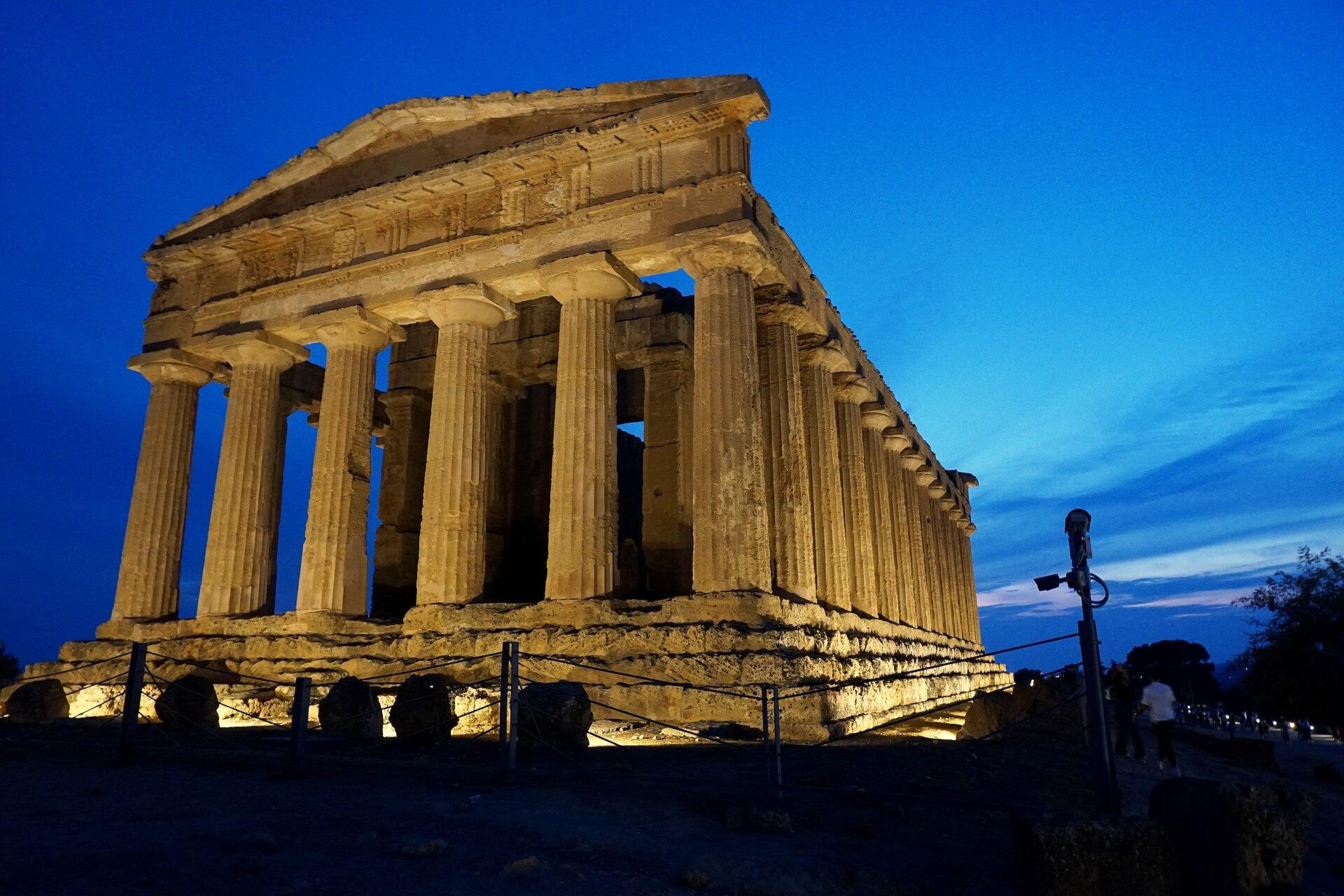
A Whole Temple, the Temple of Concordia
It looks as if it was built yesterday, and it is almost two thousand five hundred years old. And yet the name it bears is not its own. It is one of the best preserved temples of ancient Greece. Look at the long side: thirteen columns, and above them the beam. Here it is almost all still in place, together with the two pediments, the triangles on the short sides. No other temple in Agrigento keeps them like this. It is Doric, built around the middle of the fifth century Before Christ, on four steps. Six columns on the short sides and thirteen on the long ones. Try to imagine it as it was: inside and out it was covered in white stucco, with touches of color. And the name? It comes from a Latin inscription of the Roman period, with a dedication to the "Concord of the Agrigentines." It was found in the surrounding area, but it has nothing to do with the temple. In the sixteenth century Tommaso Fazello, the historian who is wrong about Juno too, linked it to these columns. Who it was really dedicated to, nobody knows: the evidence is missing, written or excavated. It remains one of the most beautiful temples of the ancient world, and it has no name. Walk around the short side of the temple, where between the columns you can see the large arched openings in the inner wall.
Two Demons, Temple of Concordia
Why has this temple come down to us so intact? Because for centuries it was a church. According to tradition, toward the end of the sixth century after Christ, the bishop of Agrigento, Gregory, settles here. He tells that two pagan demons lived inside, Eber and Raps. He drives them out, and consecrates the temple to the holy apostles Peter and Paul. To make it a church, the temple is changed inside: twelve arches are opened in the walls of the cella, and tombs are dug into the floor. Those arches you see between the columns are the sign of that time. And it is precisely thanks to the church that the temple has been preserved in such good condition. The two demons and the double dedication lead some scholars to think that the temple was dedicated to a pair of Greek divinities, perhaps the Dioscuri, Castor and Pollux. But there is no proof. In eleven seventy the church takes the name of San Gregorio delle Rape, perhaps from Raps himself, the demon who was driven out. In seventeen forty-eight it is deconsecrated. At the end of the eighteenth century, the Prince of Torremuzza has the last structures of the church removed and the temple restored. Continue downhill along the Sacred Way, past the large villa with the tree-lined garden, until at the end you see a row of columns that have been set upright again, next to a large stone base.
The Thieving Governor, Temple of Hercules
In seventy-three Before Christ, a Roman governor tries to carry off the statue of Hercules from this temple. And he finds a city armed with sticks. Cicero tells the story in the Verrine Orations. The governor of Sicily is Gaius Verres. In Agrigento, he has the famous statue of Apollo stolen from the sanctuary of Asclepius. Then he sends his men to take the Hercules as well. But the citizens, armed with sticks, stop them. The temple they were defending is the oldest of the Doric temples of Agrigento, from the end of the sixth century Before Christ. Its name is based on a passage of Cicero, which mentions a temple of Hercules. In front of you stand eight columns: the English captain Hardcastle set them upright again in the nineteen twenties. The temple is long and narrow, on three steps, with six columns on the short sides and fifteen on the long ones. The roof had gutters shaped like lions' heads. To the east, traces of the monumental altar remain. In Roman times the cella was divided into three rooms, and in eighteen thirty-five a statue of Asclepius was found there. Imagine the scene: the statue is here, Verres's men come closer, and the people of Agrigento find a stick in their hands. Carefully cross the modern road at the foot of the temple and walk toward the great esplanade of stone blocks. Look for the two large human figures made of stone, one standing on a dark column and one lying on the ground.
Stone Giants, the Telamones
Who are these giants? Perhaps they are the enemies defeated at Himera, turned to stone, holding up the temple of the victor. They are called telamones. The Greeks called them atlases, like Atlas, who in myth holds up the sky. There were thirty-eight of them, all outside the temple, one in each space between two columns: six on the short sides, thirteen on the long ones. Each one was about eight meters tall and was made of twelve blocks of local stone. Look at the faces, because they are of two types. One is mature, with a beard, a mustache and long hair. The other is young, beardless, with short, curly hair. Whom do they represent? The most widely accepted hypothesis says: the Carthaginians defeated at Himera, in four hundred eighty Before Christ. It is a hypothesis, not a certainty. Where they stood in the temple was understood by excavating some examples that had remained joined together after the collapse. The one standing in front of you was reassembled by the Park, with the German Archaeological Institute of Rome. The first telamon rebuilt almost in full, in the nineteenth century, by the archaeologist Raffaello Politi, is today in the Pietro Griffo Archaeological Museum, which has a separate entrance. Here, in its place, there is a concrete copy. Continue west along the Sacred Way, past the gap in the walls with the stone tower, as far as the four columns with a piece of beam on top, on a stone base.
A Famous Puzzle, Temple of the Dioscuri
This is the symbol of Agrigento, and it's a puzzle. Four columns with a piece of beam on top: it's the image of the Valley of the Temples that you see everywhere. But it's not a temple that remained standing. It's a partial reconstruction, made between eighteen thirty-six and eighteen fifty-two by the Commission of Antiquities of Sicily, with pieces from different periods and origins. Even the sculpted remains of the entablature, placed up there, did not belong to this temple. Leading the work is Domenico Lo Faso Pietrasanta, Duke of Serradifalco, first president of the commission, appointed in eighteen twenty-seven. He oversees most of the excavations and the reconstruction. Beneath the four columns lies the foundation of a true Doric temple, from the second half of the fifth century Before Christ: six columns on the short sides and thirteen on the long ones. And the Dioscuri? The name comes from a passage by the poet Pindar, who speaks of a cult and a festival for Castor and Pollux at Akragas. But it is far more likely that the temple was dedicated to Demeter and Persephone, the goddesses of the whole sacred area you have just crossed. Your short route ends here. Exit toward the ticket office at Gate Five. Thank you for listening to the Valley of the Temples.

Valle dei Templi
Valley of the Temples in Brief
6 stops90
The six stops not to be missed if you are short on time: the temple at the top of the hill, the Concordia with the bishop and the two demons, Hercules, the stone giants and the Dioscuri. About an hour and a half along the Sacred Way, exiting through Gate Five.
Free short route. More stops in the full route: 8 Continue with the full route