Miramare in 45 Minutes
Six stops in the Park, all free of charge: the anchor on the wall, the white castle seen from the esplanade, the sphinx on the pier, the little harbor from which Maximilian set sail, the parterre and the Castelletto. About forty-five minutes is all you need.
Museum: Castello di Miramare
The Anchor and the Pineapple, Holm Oak Avenue
Even before you see the castle, you come across a wall that introduces you to the master of the house. Stop in front of the relief coat of arms, here along the avenue. Do you see two designs? The first is an anchor with a crown above it: a sailor's object and a king's symbol, together. The second is a pineapple. He chose them himself, Maximilian of Habsburg, as his personal emblem. At twenty-two, in 1854, he was already a rear admiral and commander of the Austrian Navy. The anchor tells who he was. And the pineapple? For the museum it is a metaphor for wealth and prosperity, and a reference to the New World. A fruit that speaks of distant lands, placed at the entrance of a house by the sea. Keep them in mind. If you go into the castle, on the ground floor you will find them again on the wooden wall panels and on the fabrics, in rooms where the blue of the sea dominates. In the meantime, walk slowly. The avenue is about three hundred metres long, can also be travelled in a wheelchair, and leads into a twenty-two-hectare park. Continue along the avenue to the esplanade: the white castle appears in front of you, on the tip of the promontory.
Castle on the Cliff, Square in Front of the Façade
Eccolo. A house designed to look at the sea, and indeed it juts out: the castle stands on the tip of the promontory, sheer above the water. Stop in the square, in front of the white façade. The stone is Istrian stone. The design is by the Austrian engineer Carl Junker, and the works run from 1856 to 1860. The style is called eclectic: it mixes Gothic, medieval and Renaissance models, as in the residences that noblemen had built on the shores of mountain lakes and rivers. The first stone was laid on 1 March 1856. On Christmas Eve 1860 Maximilian and Charlotte move into the ground floor. Outside, everything is finished. Inside, it is not: the first floor is still being fitted out. And here lies the secret of this house: two floors, two lives. The ground floor is private, intimate and familiar. The first floor is the one for official functions, for guests. The interiors are the work of two craftsmen, Franz and Julius Hofmann. Now go down toward the little harbour, on the sea side, and reach the pier that closes it: at the top there is a sphinx.
Past and Future, The Pier with the Sphinx
Here it is. At the tip of the pier, like a cat in the sun, there is a sphinx. Look at the head: it is a woman's, with a placid, impenetrable gaze. The body is a lion's. It is made of pink granite, dates from the age of the Ptolemies, and comes from Egypt. It was Maximilian's most precious piece, and that is why he placed it here: the first thing guests saw when arriving by ship. Today it is the only survivor of his Egyptian collection. The rest is in Vienna, at the Kunsthistorisches Museum. In antiquity, sphinxes stood near the tombs of the pharaohs, to wish the king a serene life after death. Look at the block it rests on: it is made of grey sandstone, more recent. It has a winged sun disc, two serpents at the sides and two words in Greek: past and future. Giosuè Carducci dedicated an ode to this place, Miramar, and the sphinx seems to bid farewell to the departing couple. Listen to how the poet looks at the castle. O Miramare, to your white towers, weary beneath the rainy sky, dark with the flight of sinister birds, the clouds come. Go down the pier towards the little harbour and stop in front of the fountain in a niche, between the two staircases.
The Departure, Little Harbor and Ducal Bath
You are in the little harbour, in front of the fountain in the niche, between the two staircases that rise to the terrace. Arriving from the sea, one would see this fountain in front of them. The little harbour was the preferred route to reach the castle. From here, in April 1864, Maximilian and Charlotte set sail for Mexico, aboard the frigate Novara. Imagine a single toll of a bell, and the ship moving away. Do they return? He does, but not as he had imagined. In January 1868 the Novara, the same ship, docks at Trieste with Maximilian's remains, which will be buried in Vienna, in the Capuchin Crypt. Look at the fountain: above it stands a zinc statue, bought by Maximilian in Berlin from the firm Moritz Geiss. It is modelled on the so-called Humboldt Nymph. On the pier there is also a small building, the Ducal Bath, a bathing cabin. It bears the name of the Duke of Aosta, but the oldest documents are late nineteenth-century plans, dated 1899. It is not known whether Maximilian had already conceived it. Climb one of the two staircases up to the garden in front of the café, where the statues stand on columns and pedestals.
Statues from Berlin, Parterre in front of the Kaffeehaus
Stop in the garden in front of the Kaffeehaus, the café with the German name. The statues stand on columns and pedestals: it may seem strange to you. The reason is simple. Here, at the beginning, there were plants and shrubs of different heights, and the statues had to remain clearly visible. And there is a secret: many are not ancient. Most of the sculptures in the park come from the Berlin firm Moritz Geiss, and Maximilian buys them in Berlin. They are zinc copies of ancient or modern originals: the Venus of Capua and the Meleager, the Amazon, Ganymede and Danaid. Look at the two large cups facing each other in the centre: they are kraters, in zinc alloy, bought in Berlin in 1864. Then look for the Orant, the statue with arms raised in prayer that opens up the perspective of the garden. Its base bears an inscription and comes from Alexandria in Egypt, from the second or third century AD: a piece from Maximilian's Egyptian collection. The Orant, the Apollino and the Medici Venus are sent, between 1864 and 1865, to the island of Lacroma, near Ragusa, which Maximilian had bought in November 1859. In their place, here, there are bronze replicas. Climb towards the low buildings and the esplanade where the small castle in miniature stands: it is the Castelletto.
The Castelletto, Castelletto Square
In front of you is a miniature castle. It is called the Castelletto, and it imitates the exterior of the large castle on a reduced scale. Maximilian had it built in the park while the castle was still a building site. Maximilian and Charlotte lived in it from time to time, from 1859 to 1860, while waiting for the large house to be ready. Inside, the decorations on the first floor resemble those of Villa Lazarovich, Maximilian's first home in Trieste, rented in 1852, in via Tigor. Much of the furniture from that villa was brought here, at his wish. For Charlotte, this place has another story as well. Returning from Mexico, struck by a serious mental illness, she lived here between the autumn of 1866 and July 1867. The doctors watched over her closely. The news of Maximilian's death was kept from her for many years. In July 1867 the Queen of the Belgians took her back to Belgium. Charlotte would die at the age of eighty-six, on 19 January 1927. Today the ground floor of the Castelletto houses the bookshop. The upper floor can only be visited with a separate guided tour. Your short route ends here. To exit, follow the signs: the Porta della Bora, with the Avenue of Holm Oaks and the car park, is the main entrance; for Miramare station, exit onto via Beirut; for bus number six, there is the Grignano gate, near the new greenhouses. Thank you for walking with me.
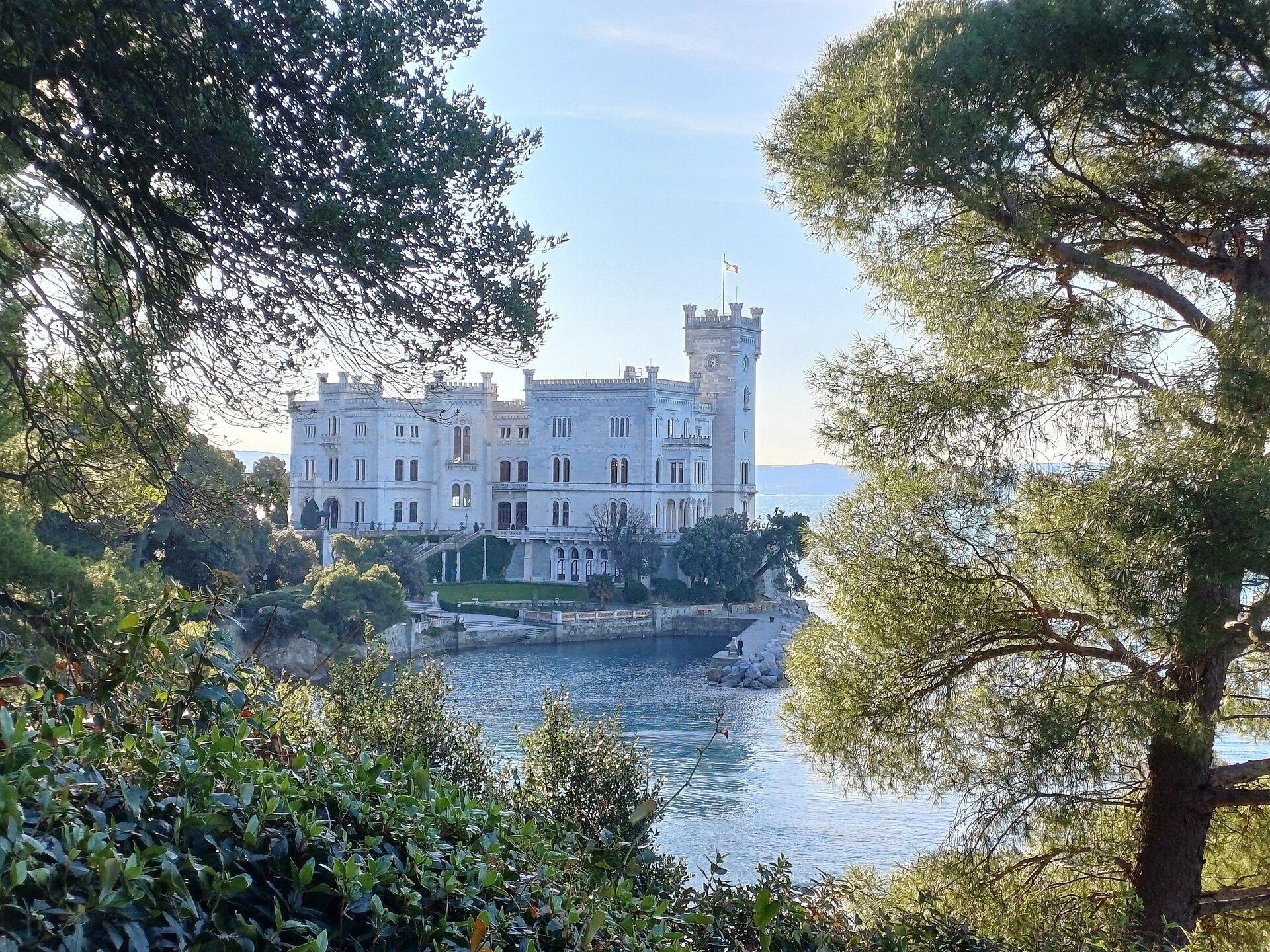

Castello di Miramare
Miramare in 45 Minutes
6 stops45
Six stops in the Park, all free of charge: the anchor on the wall, the white castle seen from the esplanade, the sphinx on the pier, the little harbor from which Maximilian set sail, the parterre and the Castelletto. About forty-five minutes is all you need.
Free short route. More stops in the full route: 13 Continue with the full route