The Bargello in Brief
Six stops in about 45 minutes: the courtyard of coats of arms, Michelangelo's Bacchus, Donatello's David, the rediscovered Dante in the chapel, the Lady with a Bouquet, and Costanza Bonarelli. For those short on time who want the works that define the Bargello.
Museum: Museo Nazionale del Bargello
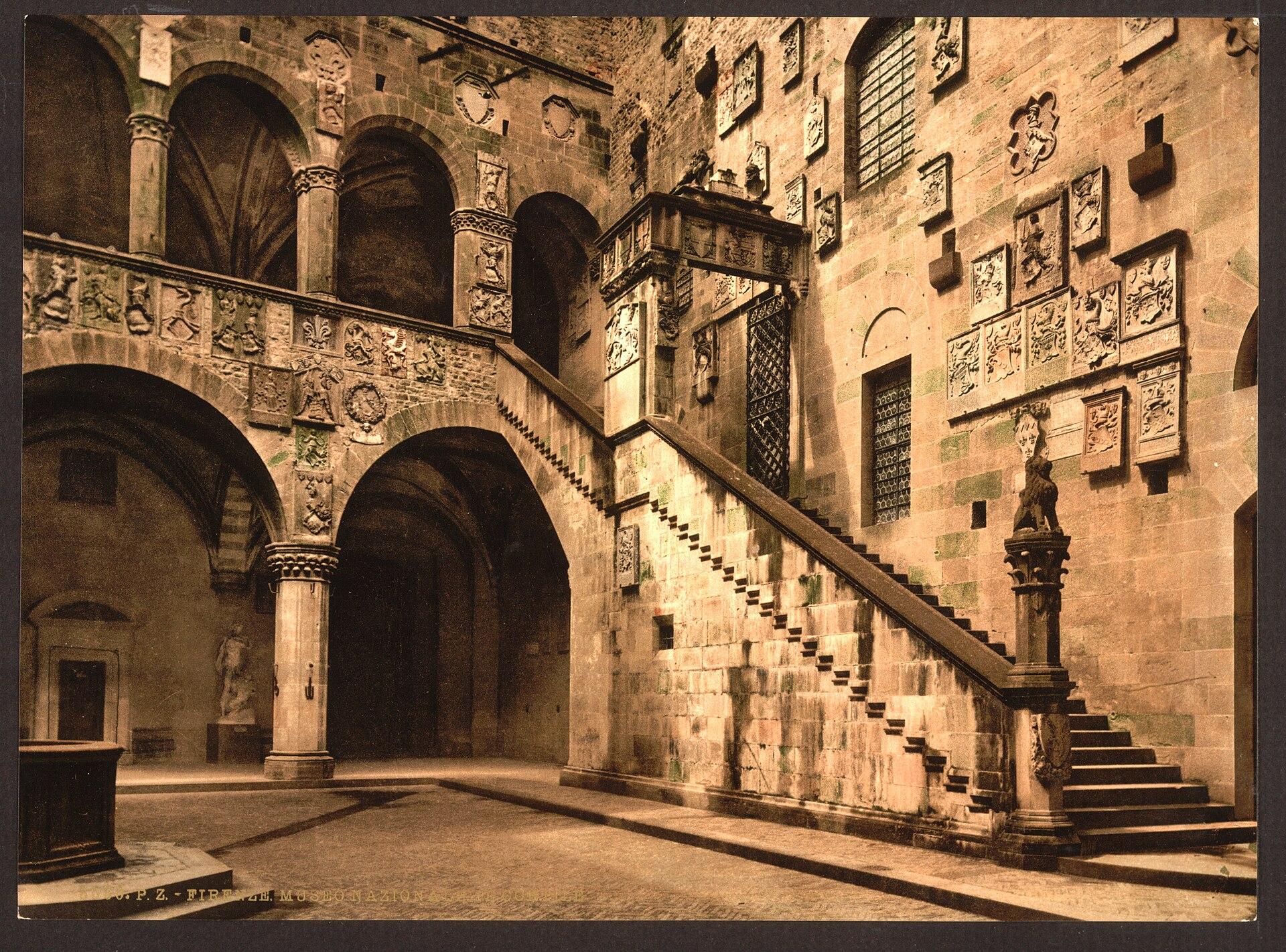
Wall of Coats of Arms, Courtyard
You are in the courtyard. Stop beside the well and look at the stone staircase: the parapet is covered with coats of arms. Each coat of arms stands for a ruler who is long gone. The podestà lived here, the magistrate who administered justice in Florence. When his term ended, his coat of arms remained on the wall, carved in stone. As each podestà gave way to the next, another coat of arms was added, until the walls were filled. The courtyard is porticoed on three sides, with round arches resting on octagonal pillars. The staircase, on the side without a portico, was built by Neri di Fioravante between 1345 and 1367. From 1574 the palace became the seat of the bargello: this was the name given to the chief of the guards, who arrested, interrogated and, when required, carried out sentences. For almost three centuries it was also a prison. The arches of the loggia were walled up, and the rooms were divided into cells. Then the prison was moved to the Murate. In 1859 it was decided to restore the palace: the architect Francesco Mazzei gave the building back its ancient appearance, and in 1865 the museum opened: the first National Museum of the Kingdom of Italy. Look for the sign reading Michelangelo Room. If you cannot see it, ask the gallery staff: the entrance is near the bookshop. Go in and stop in front of the marble youth holding a cup in his hand.
The Drunken God, Michelangelo Room
He is barely past twenty, he is in Rome, and he has to sculpt a god who cannot stand upright. Look in front of you: Bacchus, in marble, taller than a man. He sways, a cup in his hand and a vacant gaze. Behind him, seated on a tree trunk, is a little satyr. He takes advantage of the god's drunkenness to taste the grapes that Bacchus holds in his left hand. It was the detail that the sculptors of the time praised the most. Michelangelo carved it in a year, from July 1496 to July 1497, for Cardinal Raffaele Riario. But the cardinal did not like it. He rejected the statue, and the banker Jacopo Galli bought it and placed it in his garden. There it remained until around 1572. Then the Medici bought it for two hundred and forty ducats and brought it to Florence. In a sixteenth-century drawing it is called a "piece from an excavation": it looked ancient. It is one of the very few works by Michelangelo with a secular subject: no saints, just a god and his wine. Go back to the courtyard and climb the stone staircase with the parapet of coats of arms, up to the loggia on the upper floor. Then follow the signs to the Donatello Hall: at the center stands a bronze youth wearing a laurel hat.
The Laurel Boy, Donatello Hall
Here he is, in the middle of the hall: a bronze boy, nude, wearing a laurel hat and boots. Beneath his foot lies the head of a giant, Goliath. This is Donatello's David, and the museum calls it the first freestanding nude since the end of the classical age. No one knows for certain when it was made: the dating most widely accepted today is between 1435 and 1440. The first time we find it mentioned is in 1469, for the wedding of Lorenzo the Magnificent and Clarice Orsini. It stood in the courtyard of Palazzo Medici, on a column of colored marble. Then everything changes. The Medici are driven out of Florence. A year later, in 1495, the crowd takes the David from their home and places it in the courtyard of Palazzo Vecchio. It becomes the symbol of the Republic's freedom. A restoration, in 2007 and 2008, revealed that the bronze was gilded: traces of gold on the hair, the hat, the boots, and the wings and helmet of Goliath. After countless moves, including a spell above a fireplace at Palazzo Pitti, it arrived at the Bargello, where today it stands on a fifteenth-century marble base. Go back to the loggia and look for the door to the chapel, the one with frescoes on the walls. If you cannot enter, or if there are steps you cannot manage, skip ahead to the stop on the Lady with a Bouquet.
The Rediscovered Poet, Magdalene Chapel
You are in the palace chapel. For centuries it was the last room of those condemned to death: here they waited before going to the scaffold, assisted by the brothers of a religious confraternity. On the walls are frescoes from Giotto's workshop, dating from the 1330s: stories of Saint Mary Magdalene and of other sinners who repent. On the entrance wall is Hell, and on the back wall, Paradise. When the palace became a prison, after 1574, the frescoes were covered with whitewash and the chapel was divided into two floors. For centuries no one saw them. On 21 July 1840, a restorer, Antonio Marini, was searching for these paintings, following in the footsteps of Vasari. He removed the whitewash and found a face. In Paradise, among the blessed, a man with a book in his hand: Dante Alighieri. The museum calls it the oldest known portrait of Dante. The painting is from Giotto's workshop, perhaps based on a drawing by the master. Follow the signs to the Verrocchio Room: look for the marble bust of a woman holding a small bunch of flowers, and a bronze youth with a sword.
The Mysterious Lady, Verrocchio Room
Look at the marble bust of a woman, about sixty centimeters tall. Her hands, crossed over her chest, hold a small bouquet of flowers. No one knows who she is. This is the Lady with a Bouquet, by Andrea del Verrocchio, around 1475. For decades it was believed to be by Donatello: the first time we find it mentioned, in 1822, it is listed as his work. Only in 1882 did Wilhelm Bode attribute it to Verrocchio. It has been in the Bargello since 1873. Walk around it: it is worked on every side, as if you could view it from any angle. This was something new. The cut reaches down to the navel and the hands are visible, in a natural gesture. Before then, you would only find hands like these in the painting of Northern Europe. Who the woman is remains a mystery. Scholars have suggested Lucrezia Donati, Lucrezia Tornabuoni, Fioretta Gorini. There is no proof. In the same room you will also find his bronze David, from the fifteenth century. He is not nude, like Donatello's: he wears a page's tunic and has a cocky gaze. The Signoria purchased it in 1476. Follow the signs to the Baroque sculpture rooms, reinstalled in 2023: look for a marble bust of a woman with tousled hair.
Costanza, Baroque Rooms
A marble bust: a woman with her hair loose, her chemise open, her lips slightly parted as if she were about to speak. She is neither a princess nor a saint. She is Costanza Bonarelli, and Bernini did not sculpt her for a patron: he sculpted her for himself. Gian Lorenzo Bernini portrayed popes, cardinals and kings. This is his only known portrait of an ordinary person. Costanza was the wife of one of his assistants, Matteo Bonarelli, and in the workshop she handled sales and clients. The bust dates from around 1637-1638. Look at the hair and the rumpled garment: she seems caught in a fleeting movement, as she turns her head. Between her and Bernini there was a stormy affair, so much so that the earliest biographies discreetly call it the "portrait of Costanza Piccolomini". The museum tells the story in detail. In the days of the Medici the bust stood in the Uffizi, beside Michelangelo's Brutus: the same Brutus that is now here in the museum. Go down to the courtyard and follow the exit. If you wish, before leaving, look for Vincenzo Gemito's Fisherboy, which stands in the courtyard.

Museo Nazionale del Bargello
The Bargello in Brief
6 stops45
Six stops in about 45 minutes: the courtyard of coats of arms, Michelangelo's Bacchus, Donatello's David, the rediscovered Dante in the chapel, the Lady with a Bouquet, and Costanza Bonarelli. For those short on time who want the works that define the Bargello.
Free short route. More stops in the full route: 8 Continue with the full route