Paestum in Brief
The six stops not to be missed if you are short on time or arrive on a winter afternoon: the so-called Temple of Neptune, the Basilica, the Temple of Athena, the metopes of the Sanctuary of Hera, the Tomb of the Diver, and Marsyas. About an hour and a quarter, between the archaeological area and the museum.
Museum: Parco archeologico di Paestum
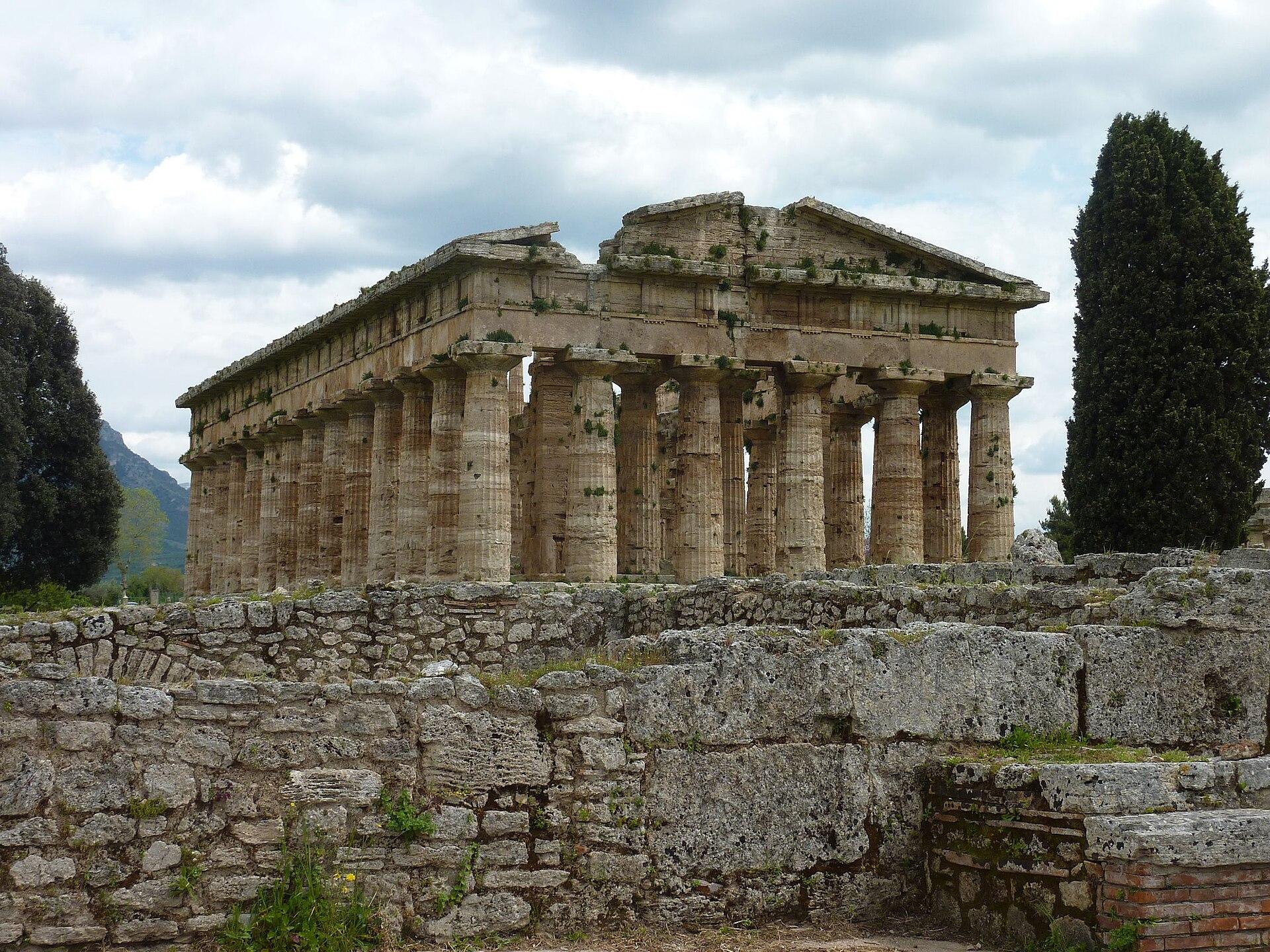
The Wrong God, the So-Called Temple of Neptune
Stop for a moment and look at this temple. For more than two centuries it has carried the name of a god who may have nothing to do with it. They call it the Temple of Neptune, but no one knows for certain to whom it was dedicated. The name is a mistake made by eighteenth-century scholars, who linked it to the Greek name of the city. Recent studies point to Hera or Apollo. And yet the effect is the same for everyone. In 1758 the art historian Johann Joachim Winckelmann arrived here. His encounter with these temples was decisive for his idea that Greek art is the origin of Western art. The temple was completed around 460 BC. Six columns on the short side, fourteen on the long side, and everything is travertine. Once it was also full of colour. In front of the façade there are two altars. The farther and larger one dates from the age of the temple. The other is Roman. One thing, before going on. Throughout the visit keep your headphones on, do not touch the stones, do not climb, and do not eat or drink in the area. This tour does not include the admission ticket. Walk past the horse covered in sand, without stopping, and look for the lower, wider temple, with columns that swell in the middle as if holding their breath: it is the Basilica.
The Wrong Court, Southern Sanctuary
This name is wrong too. Eighteenth-century scholars called this temple the Basilica, believing it to be a civic building, perhaps a courthouse. In reality it is a temple of Hera, wife and sister of Zeus, protector of marriage, motherhood and armed youths. It is the oldest stone temple in Poseidonia: it was begun around 560 BC and finished around 520. Look at the front. There are nine columns, an odd number, and on the long side there are eighteen. The odd number is due to a row of columns in the centre of the cella. The capitals are flattened, like cushions under a weight. In 1778 Giovanni Battista Piranesi and his son Francesco published the engravings of these temples. They are among the most famous images of Paestum. Of the roof, many painted terracotta pieces remain: lion-head gutter spouts and antefixes with lotus flowers. Hera was the goddess of women and also of young warriors. The inscriptions say so, as do the many objects offered to the goddess, found in the deposits near the temple. Leave the sanctuary and take the wide road paved with large pale blocks, towards the northern part of the city. At the top of the barely rising ground you will find the third temple. If it is already a winter afternoon and the northern part is closed, skip to stop 12: the museum stays open.
Athena and Ceres, Northern Sanctuary
For a long time this temple was attributed to a goddess who has nothing to do with it: Ceres. Archaeologists have found here many statuettes of a young woman with a helmet, shield and spear: she is Athena. It was built around 500 BC, on an artificial hillock, almost an acropolis. It has six columns on the short side and thirteen on the long side. The vestibule has a colonnade with Ionic capitals: it is perhaps the first building with two orders together, Doric and Ionic. Everything was stuccoed and painted in bright colors. Before that there was a smaller building, around 580, destroyed by a great fire. In 1937 the superintendent Amedeo Maiuri dug deep down and found the terracottas with which the oldest roof was reconstructed. Those who came here left weapons as gifts, often made unusable on purpose. A gift to a goddess, so that no one would use them anymore. Between late antiquity and the early Middle Ages the temple became a church. Walls rose between the columns, and the south side was used for burials. Leave the area and look for the museum, on the other side of the modern road: follow the signs. Go in and go up to the ground floor: look for the large sculpted slabs on the outer walls of a room shaped like a small temple.
The Slabs of Hera, Cella Room
Two archaeologists are searching for a temple that ancient sources mentioned and that no one had found. In 1934 Paola Zancani Montuoro and Umberto Zanotti Bianco announce that they have found it, at the mouth of the river Sele: the sanctuary of Hera. The Fascist regime made their work difficult. The slabs in front of you are the metopes of that sanctuary, carved in the sixth century BC. They tell episodes from myth: the deeds of Heracles and stories linked to Troy. Consider that the museum was born for them. It was designed in the 1930s by the architect Marcello De Vita, at the wish of the superintendent Amedeo Maiuri. The war postponed everything, and the museum opened in 1952. Look at the shape of the room: it recalls a temple, with three steps and pillars like columns. And the metopes are on the outside, on the walls. They have remained just as they were arranged then. There is another story here too: the painted slabs of a Lucanian tomb, excavated clandestinely, seized in the United States in 2022 and returned to Paestum in 2023. Look for a room dedicated to a single tomb, named after Mario Napoli, with five painted slabs. It is on the ground floor, on the way to the courtyard.
The Diver, Tomb of the Diver
A small tomb, and a young man in flight. On 3 June 1968, the superintendent Mario Napoli discovered this tomb at Tempa del Prete, about two kilometres south of the city. It dates to 480-470 BC. It is a stone chest: four side slabs and one covering slab. On the side slabs there is a symposium: wine, music, and the game of kottabos. On the lid there is the young man diving into a pool of water. It is the only tomb of the fifth century BC painted with figurative scenes, among those we know in the Greek world. Why a dive? The most widespread interpretation says that it is not a realistic image: it is a symbol. The passage from life to death, perhaps linked to mystery beliefs, to the hope that after death there is still something. With the deceased there were a lekythos, the vase for perfumes, and a lyre made from a tortoise shell. The same kind that some of the painted figures hold in their hands. In the courtyard in front of you, since 1972, there has been a work by Carlo Alfano: the first contemporary art installation in an Italian archaeological museum. Go up to the top floor, the second: the section of the Romans, where a bronze statue awaits you.
Marsyas Without Chains, Second Floor
A satyr without chains, in a city that was becoming Roman. Look at his ankles: heavy rings, but no chain. This is Marsyas, a silenus, and the bronze statue was found in the Forum. In Greek myth, Marsyas challenges Apollo to a music contest with the aulos. He loses, and the story ends badly. The Romans saw him in a different way: as an emblem of libertas, the freedom won by the plebeians. The statue was made after 273 BC, except for the head, which dates from the fourth century BC. The rings without chains suggest a freed Marsyas. For the Park, it could symbolise Paestum's passage from colony to municipium, with Roman citizenship. In 90 BC the city became a municipium. In 71 AD, under Vespasian, it became a colony again and received the veterans of the Misenum fleet. The section is named after the archaeologist Mario Torelli, who oversaw its first installation in 1999. Around you, you will find sculptures, inscriptions and coins. A statue to understand what it means to be free. This was the last stop. With the same ticket, valid for three days, you can come back to see the area again or go to Velia. There is also a bookshop in the museum. Thank you for listening to Paestum.

Parco archeologico di Paestum
Paestum in Brief
6 stops75
The six stops not to be missed if you are short on time or arrive on a winter afternoon: the so-called Temple of Neptune, the Basilica, the Temple of Athena, the metopes of the Sanctuary of Hera, the Tomb of the Diver, and Marsyas. About an hour and a quarter, between the archaeological area and the museum.
Free short route. More stops in the full route: 12 Continue with the full route