Castel Sant'Angelo in brief: six stories
Six people, one scene each: Hadrian's ashes, the plague and the angel, the besieged pope, Cellini's escape, the pope who had himself painted, Tosca on the terrace. For visitors short on time.
Museum: Castel Sant'Angelo
The Ashes, Hall of the Urns
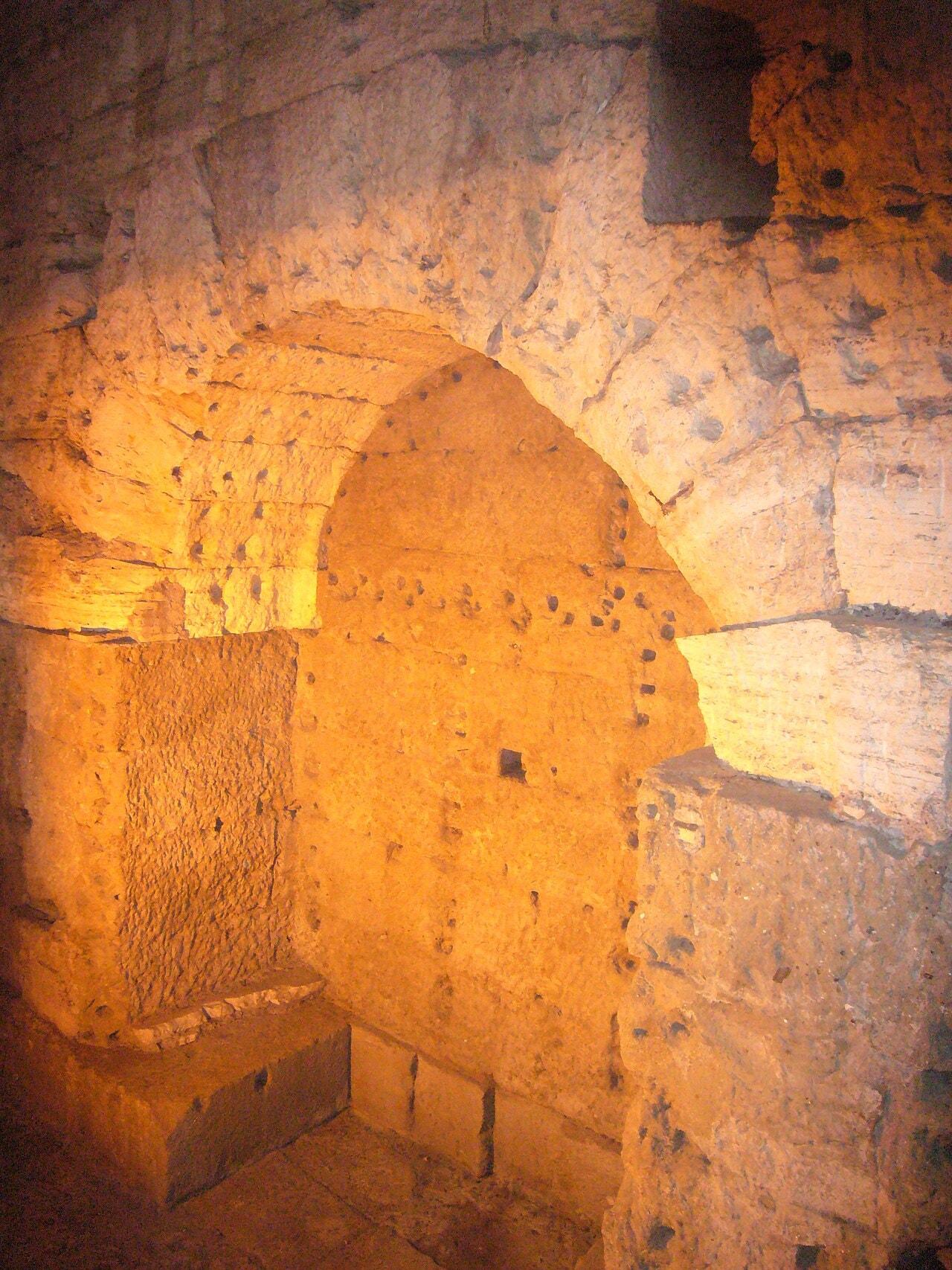
Where did an emperor's ashes end up? You are in the Hall of the Urns, the heart of the mausoleum and the destination of the whole climb. Hadrian and his wife Sabina rested here. Lucius Aelius, Hadrian's adopted son, was also buried in the same mausoleum. Other burials followed, for years. The last one on record is that of Caracalla, in 217. Then silence. In 410 the Visigoths arrived and sacked Rome. The urns were scattered, and the ashes with them. No one can say where the dust of a man who wanted an eternal tomb ended up. Look around: today the hall is bare. If you can find it, look for a niche with a plaque. It bears words attributed to Hadrian. They begin like this: little soul, lost and gentle. It is an emperor speaking to his own soul, as to something small and fragile. Read them slowly, and take a few seconds of silence. Then look for the exit to the open courtyard, where an angel awaits you.
Sword Sheathed, Courtyard of the Angel
Rome is on its knees. The plague is carrying off the people, and the pope, Gregory the Great, no longer knows what to do. So he organizes a procession of penance through the streets. The year is 590. According to tradition, when the procession arrives down here, Gregory has a vision. On top of this building he sees the archangel Michael putting his sword back in its sheath. For Rome, it is the sign that the plague is coming to an end. From that moment the place takes the name it still has today: Castel Sant'Angelo. Now look, in the courtyard, for a marble statue with bronze wings. It is the work of Raffaello da Montelupo, and it is an angel like the one in the vision. But it is not the one on top. The one on top is another: made of bronze, if you can make it out by looking up. It is today's angel, it arrives in 1753 and is the work of Peter Anton von Verschaffelt. A piece of advice: do not lose sight of it. You will find it again at the end of this visit, and it is the protagonist of the final scene. Now look for the route that climbs up towards the papal rooms.
The Besieged Pope, Rooms of Clement VII
While the pope flees, almost the entire Swiss Guard dies on the steps of St. Peter's. It is 6 May 1527, and the soldiers of Emperor Charles V are sacking Rome. This is the Sack of Rome. The pope is Clement VII. He runs along a fortified corridor that connects St. Peter's to this castle, and shuts himself in here. He resists, but cannot leave. At the beginning of June he surrenders. To be free again, he will have to pay 400,000 ducats. And months later he will flee once more, disguised as a vegetable gardener. Look around you: these rooms bear his name. If it is open, look for a small room with frescoes that have nothing sacred about them. It is the Stufetta, the private bathroom that Clement VII had built for himself in 1525. Two years later, in these very rooms, that pope was a besieged man. Keep in mind the corridor he came from. You will find it again at the end of the visit. Now go up to the floor of the courtyards, where a man is about to attempt something mad.
Cellini escapes, Cortile del Pozzo
Will he make it? A man is at the top of a castle wall, and all he has is some knotted sheets. His name is Benvenuto Cellini, he is a goldsmith and sculptor, and the year is somewhere between 1538 and 1539. He has been locked up here on a specific charge: having stolen goods belonging to Pope Clement VII at the time of the Sack of Rome. You are in the courtyard of the well, commissioned by Pope Alexander VI. Beneath you are the historic prisons. Whether you can see them or not, this is the scene. He tells it himself, in his Vita. He lowers himself from the wall with the rope of sheets, and falls. He breaks a leg. He manages to reach the house of Cardinal Cornaro. And the cardinal hands him back to the pope. Historians read Cellini with caution, because he knows how to portray himself very well. But the main points of the escape are confirmed by other documents. They put him back inside. He will only get out later, also thanks to another cardinal, Ippolito d'Este. One rumor says that in his cell he drew a risen Christ on the wall. Others see only cracks in those marks. Now cross the loggia that looks onto the river and look for the great hall painted with the stories of Alexander the Great and Saint Paul.
Alexander and Paul, Pauline Hall
Why does a pope have his hall painted with the deeds of a Macedonian king? Look up: you are in the Pauline Hall, the reception hall of Paul III. Under him, between 1534 and 1549, the castle lives its moment of greatest splendour as a residence of the popes. It is no longer just a place to hold out: it is a place to receive guests. This pope's baptismal name is Alessandro, Alessandro Farnese. Like Alexander the Great. And Paolo is the name he chooses as pope, like Saint Paul. So he has his two namesakes painted. On the vault and the large walls he looks for scenes from the life of Alexander the Great. Above the doors, in the roundels, he finds episodes from the life of Saint Paul, from conversion to martyrdom. A warrior and a saint: two mirrors for one man. The painter who leads the work is Perin del Vaga. A workshop secret: Perin conceives the whole project, but paints only part of the frescoes with his own hand. The rest is done by his collaborators, starting from his drawings. Now climb all the way to the top, to the terrace of the angel.
Tosca and the Angel, Angel's Terrace
At dawn, on this terrace, a man waits to be shot. His name is Cavaradossi, he is a painter, he is in love with Tosca, and he sings E lucevan le stelle. You are on the stage of the third act of Tosca, Puccini's opera. Puccini is a perfectionist. He comes to Rome specifically to measure the sound of the morning bells, as they are heard from the bastions of this castle. Then he tunes his music to the great bell of St Peter's. He looks in that direction, and imagines that sound. Now the scene. A little shepherd boy sings in the distance, the sky grows lighter. Tosca believes the shooting is a mock one. But the shots are real. Cavaradossi falls. And Tosca runs towards the parapet and throws herself into the void. A moment before, she had a hope. A moment later, she has only this edge. Now lift your head. Above you is the angel, with his sword in its sheath. Before him there were others: one destroyed during a siege, one struck by lightning, one melted down to make cannons in 1527, the year of the Sack. Hadrian wanted an eternal tomb. Clement VII was looking for a refuge. Cellini had a rope made of bedsheets. Tosca, only a last exit. And the angel saw it all. When you wish, go down towards the bastions.

Castel Sant'Angelo
Castel Sant'Angelo in brief: six stories
6 stops45
Six people, one scene each: Hadrian's ashes, the plague and the angel, the besieged pope, Cellini's escape, the pope who had himself painted, Tosca on the terrace. For visitors short on time.
Free short route. More stops in the full route: 9 Continue with the full route