The Sassi of Matera in Brief
Six stops for about an hour and a quarter of walking, with no ticket required: two cities in one as seen from the square, the alleys of the Sasso Barisano, the façade of the Cathedral, the emptied city, the Sasso Caveoso like a theatre, and the viewpoint over the Gravina.
Museum: Sassi di Matera
Two Funnels, Piazza Vittorio Veneto
Stop at the edge of the square and look down. Beneath you, the city splits in two. In a famous novel, Christ Stopped at Eboli, by Carlo Levi, the one looking is a woman: the writer's sister. She sees two half funnels side by side, separated by a spur of rock. To her they look just as Dante's Inferno was pictured at school. At the bottom stands a white church that seemed to be driven into the ground. Those two funnels are the Sassi: the Sasso Barisano and the Sasso Caveoso. The name is plural because there are two districts, not because a house is called a sasso. The spur in the middle is called Civita. The novel was published by Einaudi in 1945. From above, the plan of the ancient city resembles a letter of the Greek alphabet: the omega. And the square where you are standing? It acts as a watershed. Below, the houses of the peasants, carved into the rock. Up here, the Piano, where the middle-class families lived. Two cities in one. In 1993 the Sassi entered the UNESCO World Heritage list: the first site in southern Italy. Now you are the one looking at them. Go down from the square towards the entrance of the Sasso Barisano, where the terraced houses begin beneath you.
The Dead and the Stars, Sasso Barisano
Go down slowly. Feel the paving stones under your shoes: this is where the Sasso Barisano begins. In 1595 a chronicler from Matera, Eustachio Verricelli, wrote a sentence that is not easily forgotten: "In Matera the dead are above the living." Because sometimes the rooftops of the houses served as a cemetery. The Sasso Barisano faces north-west, along the road that led to Bari. Look for the carved portals and the friezes on the façades. These houses are not natural caves: they were dug by people into calcarenite, a stone that is easy to work. Inside, light comes in from above and the temperature stays around fifteen degrees. Once, vegetable plots and hanging gardens also looked out from the rooftops. And in the evening? The inhabitants lit lamps outside their homes. Seen from above, everything shone like a starry sky. For Verricelli, in Matera the sky lay beneath your feet. As you descend among the lanes and steps, you find monastic complexes carved into the rock: the monks' cells cluster around an underground church. Stop for a second: breathe, and look down. Climb back up towards the upper town and follow the signs for Via Duomo, to the square where the Cathedral shows its rose window.
Wheel of Life, Piazza Duomo
According to some, the perfect orientation of this façade and its bell tower along the cardinal points is due to a thirteenth-century astronomer from Matera: Alano. He spent his nights observing the sky from a small house on the castle hill. In front of you is the Cathedral of the Madonna della Bruna and Saint Eustace. It stands on the highest spur of the Civita, between the two Sassi. To let it dominate the two valleys, the rock base was raised by more than six metres. Look at the rose window: it has sixteen spokes and represents the wheel of life. Above, the archangel Michael crushes the dragon. From the pediment hang twelve little columns, for the twelve apostles. Look for the door with the two crouching stone lions. And the one with Abraham carved in the lunette: father of the three monotheistic religions, all present in the city when the church was built. On the bell tower, a Latin inscription says: "It was the year 1270 when the dwelling of wondrous appearance was completed." Stop for a moment. Imagine the bells descending upon the two Sassi. Go through the underpass at the end of the square and continue along Via San Potito to Via Muro, which descends toward the Sasso Caveoso. Stop at the first viewpoint from which you can see the whole funnel of houses.
Emptied City, Belvedere over the Caveoso
Stop here, in front of the whole Sasso Caveoso. Think of how many people lived here. In 1950 the Prime Minister Alcide De Gasperi visited Basilicata and saw for himself how people lived in the Sassi. He instructed a Lucanian member of parliament, Emilio Colombo, to study a law for their redevelopment. Carlo Levi's novel had brought those conditions to the attention of the country: it was an important first step. According to the sources, about fifteen thousand people lived in the Sassi: half the city. Many families lived in cisterns converted into a single room, together with mules and sheep. There were no sewers. Infant mortality was four times the national average. The evacuation began in 1952 and continued until 1965. The new neighbourhoods, designed by architects such as Quaroni, Aymonino and Piccinato, were more comfortable. The village of La Martella, designed by Quaroni, was built in those very years, between 1952 and 1954. But leaving one's home was painful. Since 1986 a new law has set the recovery of the Sassi in motion. What you are looking at is no longer an empty city.
Theatre over the ravine, Piazza San Pietro Caveoso
You are at the bottom of the funnel. The square sits right on the edge of a canyon: the Gravina. Look at the houses around you: they rise in steps, one above the other. The Sasso Caveoso is reminiscent of the cavea of a theatre, with its seats. And the square, below, looks like the stage. The Sassi too are children of water: they stand at the bottom of two valleys shaped by water, channelled into the so-called grabiglioni. The Gravina is a canyon carved over millennia by the erosion of water. On the other side is the Murgia, with its rock churches. In front of you is San Pietro Caveoso, the city's ancient parish. It is a medieval church, rebuilt in the eighteenth century: the façade and the bell tower date from then. Inside, a wooden polyptych from 1540 and statues of coloured stone. The Madonna and Child is attributed to Altobello Persio, the sculptor of the Cathedral's nativity scene. In the Sassi, life revolved around the neighbourhood: houses facing the same open space, with a well to share and an oven to share. Look for a flight of steps leading down towards the ravine and stop at the first viewpoint from which you can see the Gravina, with the Murgia opposite.
Stone Sky, Belvedere over the Gravina
You have reached the belvedere. In front of you, beyond the Gravina, the Murgia plateau. Two directors, forty years apart, chose this landscape to portray Jerusalem. In 1964 Pier Paolo Pasolini filmed The Gospel According to St. Matthew here. In 2004 Mel Gibson set the exteriors of The Passion of the Christ in the Sassi: for him, a perfect place. Then came Wonder Woman, in 2017, and No Time to Die, in 2021. Here in front of you, in the city and along the ravines of the Murgia Materana Park, there are about one hundred and fifty rock-hewn churches. In 1993 the Sassi and the park of the rock churches became part of UNESCO's heritage, the first site in southern Italy. The citation speaks of a balance between the inhabitants and nature that has lasted for over nine millennia. The Sassi have been defined as a cultural landscape: an exceptional example of how to use nature's resources, that is water, soil and energy. On 17 October 2014 Matera was designated European Capital of Culture for 2019. This is the last stop. To return to Piazza Vittorio Veneto, go back up toward the upper town: the square is at the top.
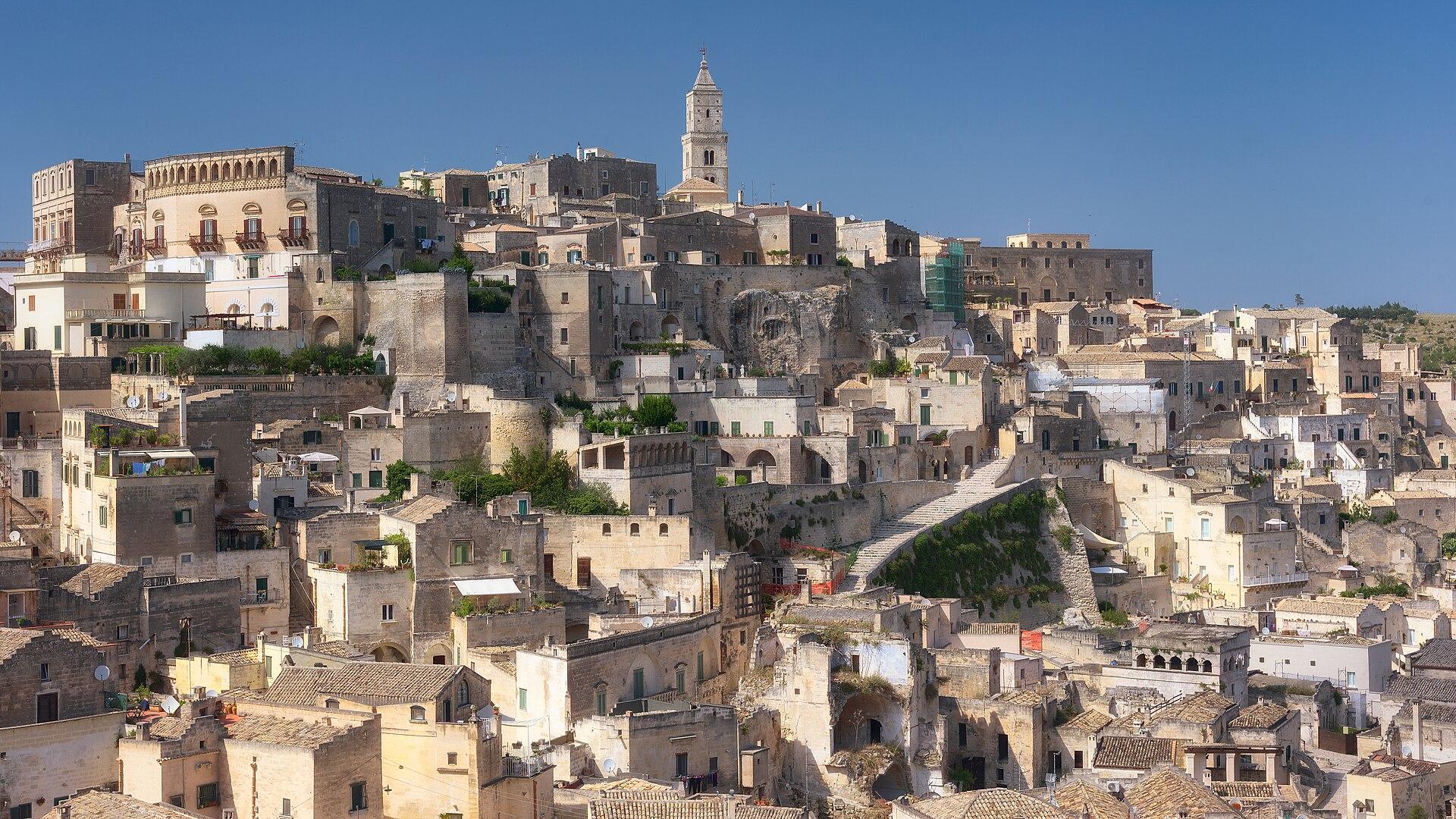

Sassi di Matera
The Sassi of Matera in Brief
6 stops75
Six stops for about an hour and a quarter of walking, with no ticket required: two cities in one as seen from the square, the alleys of the Sasso Barisano, the façade of the Cathedral, the emptied city, the Sasso Caveoso like a theatre, and the viewpoint over the Gravina.
Free short route. More stops in the full route: 11 Continue with the full route