The Vittoriano in Brief
Six stops for about an hour's walk: the erased neighborhood, the mammoth beneath the staircase, the Unknown Soldier, the hollow bronze horse, the monument on trial, and the view over the Forums from the Terrazza Italia. The Panoramic Terrace and the Central Museum of the Risorgimento are not part of this route.
Museum: Vittoriano (Altare della Patria)
An Erased Neighborhood, Piazza Venezia
Look at the white before you. To build it, Rome erased an entire neighborhood. Here, on the northern slope of the Capitoline Hill, there were houses and alleyways of medieval and Renaissance origin. There was the convent of Aracoeli with its library, and the Tower of Paul III, from the sixteenth century. There were streets with curious names: Via della Pedacchia, Via di Testa Spaccata, Via Macel de' Corvi, with its little square where Michelangelo had lived. Between the end of 1884 and 1899, expropriations and demolitions followed. It is estimated that more than nineteen thousand square meters were razed to the ground. As early as 1883, in Parliament, Ruggiero Bonghi had strongly attacked the project. The archaeologist Rodolfo Lanciani and the German historian Ferdinand Gregorovius were also opposed. But the royal commission approved: the monument to Victor Emmanuel II would rise right here. Then, between 1900 and 1906, the square was also widened, to give the monument the space it deserved. Stay here a moment and look at the façade. All this white has taken the place of a piece of the city. Move closer to the staircase and climb a few steps. Stop where you can look down, at your feet.
The mammoth, Staircase, beneath your feet
Look down. Beneath these steps lie a prehistoric animal and a wall from ancient Rome. In the 1880s, excavation for the foundations begins. They expected the tuff on which to rest the monument to be solid. They do not find it. They find clays, banks of sand, caverns, tunnels and ancient quarries: the subsoil of the hill had already been excavated by the Romans, but never so densely. And then, as they dig, two surprises emerge. A stretch of the Servian Walls, the first circuit of walls of Rome, which tradition links to the kings of Rome. And the remains of a mammoth. The project changes: two foundation piers are added to leave the finds free. Walls and mammoth are incorporated into the walls of the monument without being destroyed, and can be inspected. Only some parts of the animal end up at the University of Rome. Those caverns are still useful, many years later. Some become an air-raid shelter, and the VIVE website recalls that in the last years of the war the underground spaces protected Rome's civilian population. Climb up to the great statue of the goddess Roma, against a golden background, and look for the tomb located right beneath it, where the honor guard stands. Stop at a distance.
The Unknown Soldier, Tomb of the Unknown Soldier
Stop here, at a distance from the honor guard. Here rests a soldier whose name no one knows. The idea was born in 1920 from General Giulio Douhet: to honor an unknown body. When the law is approved, the Ministry of War instructs a commission to travel across the battlefields, from the Carso to the Altipiani, from the mouths of the Piave to the Montello. It collects eleven bodies impossible to identify, one for each of the war zones. The eleven coffins arrive in the basilica of Aquileia on the twenty-eighth of October 1921. One is chosen by a woman, Maria Bergamàs. Her son Antonio had fallen in combat, and his body could not be identified. The other ten coffins remain in Aquileia, in the war cemetery. The chosen coffin travels by train, on a gun carriage: Venice, Bologna, Florence, Rome. The train goes slowly, and along the route crowds kneel. In Rome it enters the church of Santa Maria degli Angeli, where on the door there is an epigraph that ends with three words: he is my son. On the fourth of November 1921 it rises to the Altare della Patria. One million people take part in the ceremony. Since then the tomb has been watched over by an honor guard and by two flames that never go out. The changing of the guard takes place every hour.
The Giant Horse, Equestrian Statue
More than twenty people held a reception inside the belly of a horse. A bronze horse: this one. Above you is the statue of Victor Emmanuel II on horseback, the first part of the monument to be completed. The commission went to the sculptor Enrico Chiaradìa in April 1889. Chiaradìa died in 1901, and Emilio Gallori finished the work. The bronze comes from the melting down of some cannons of the Royal Army. The horse is enormous, and hollow. During a visit by King Victor Emmanuel III, the authorities decided to offer a reception to a small group of guests, chosen from among those who had taken part in the project. They set it up in the belly of the horse, which held more than twenty people: period photographs say so. Sacconi, according to one source, reproached Chiaradìa for an excess of realism, which in his judgment clashed with the rigor of the complex. Meanwhile, the base of the statue was being covered with sculptures: between 1907 and 1910, fourteen noble cities, regarded as the noble mothers of unified Italy, were sculpted on it. Look for the square onto which the two gates of Liberty and Unity open, and stop there.
The Defendant, Piazzale del Bollettino
You are standing before a defendant. The monument itself is put on trial, for "aesthetic offence". Since the 1960s the Vittoriano has met with indifference, and often contempt. For many it is a cumbersome testimony to the past: to fascism, to colonialism, to the tragedies of the first half of the twentieth century. On the twelfth of December 1969, at around five thirty in the afternoon, two bombs exploded on either side of the propylaea, ten minutes apart, on the same day as the Piazza Fontana massacre in Milan. There were no victims at the Vittoriano. One of the two forced open the door of the Museum of the Risorgimento and broke the windows of the Basilica of Aracoeli. The monument closed to the public for years. The VIVE website also speaks of the monument's condemnation in a trial for aesthetic offence. At the end of the 1980s a movement of opinion proposed ruderization: letting it decay and then partly dismantling it. Then the wind changes. President Carlo Azeglio Ciampi relaunched it and called it the Forum of the Republic. On the twenty-fourth of September 2000, after a restoration, the Vittoriano reopened to the public. In 2019 it is among the most visited art sites in Italy.
Rome from here, Terrazza Italia
Stop and look towards the Imperial Forums. If you have climbed up to the viewpoint of the Terrazza Italia, you have two thousand years of Rome before you in a single glance. If you have stayed lower down, listen anyway: this is what can be seen from up there. Towards the east there is, first of all, Trajan's Column, almost thirty metres high, with a frieze that tells of the victorious campaign in Dacia. Behind the forum, Trajan's Markets, used for commercial and administrative activities. In the background, the Torre delle Milizie, built in the thirteenth century. To the south of Trajan's Forum lies the Forum of Augustus, with the remains of the temple of Mars Ultor. And at the far end, the Colosseum: its name, perhaps, comes from the gigantic bronze statue of Nero that stood nearby. In the foreground, the great road that leads all the way there, via dei Fori Imperiali, built in the Fascist era. Think back on what you have heard. The medieval district that was wiped out was here, beneath you; in front of you, the squares built by the emperors. A city that always builds on top of itself. If this is the highest point of your tour, your tour ends here. Thank you for listening to the Vittoriano, and enjoy your walk around Rome. The short tour ends here. With a ticket, the terrace and the museum await you on the full tour.
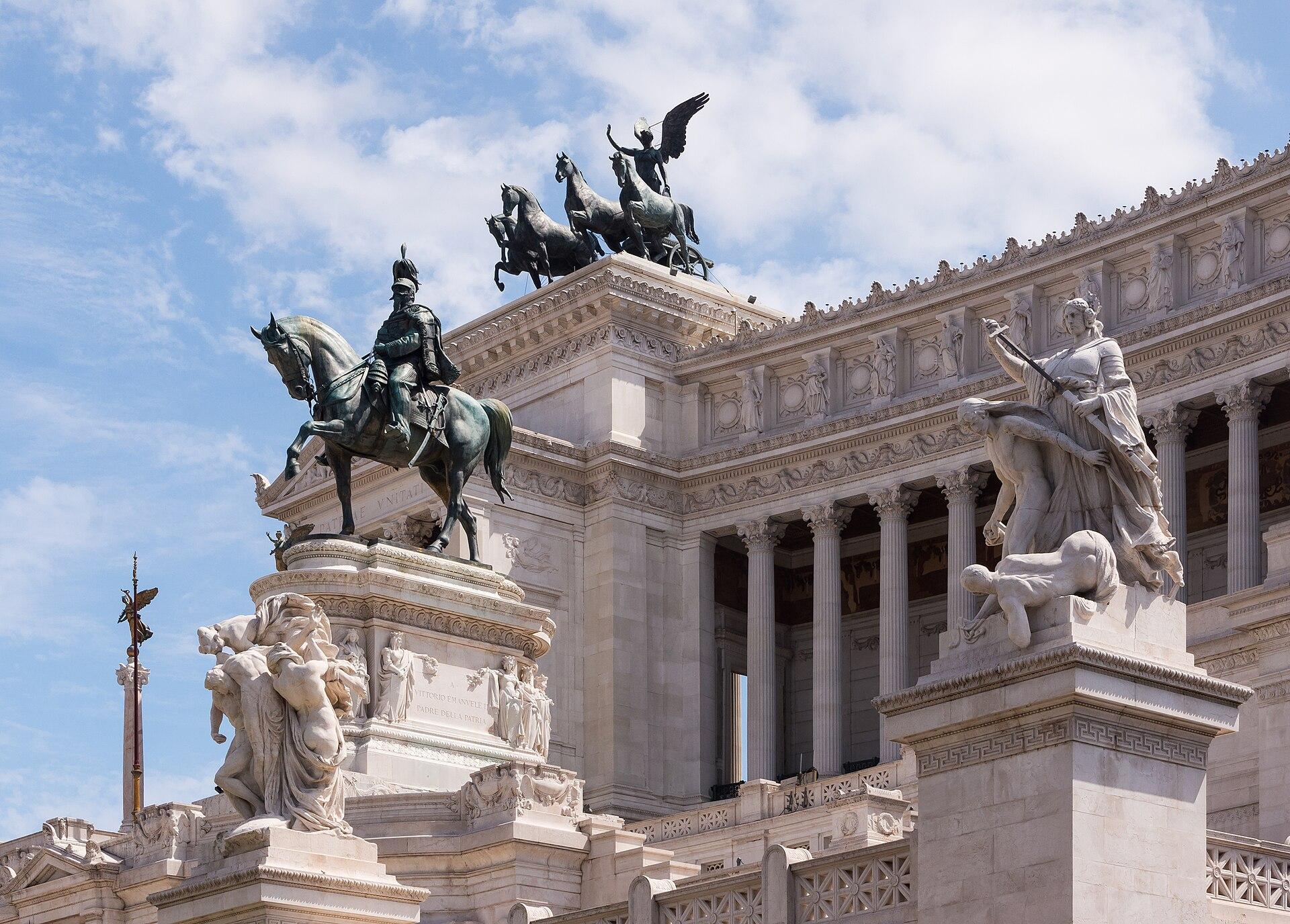

Vittoriano (Altare della Patria)
The Vittoriano in Brief
6 stops60
Six stops for about an hour's walk: the erased neighborhood, the mammoth beneath the staircase, the Unknown Soldier, the hollow bronze horse, the monument on trial, and the view over the Forums from the Terrazza Italia. The Panoramic Terrace and the Central Museum of the Risorgimento are not part of this route.
Free short route. More stops in the full route: 11 Continue with the full route