The Appian Way (Via Appia Antica) in Brief
The six stops not to be missed if you have just over an hour, all free and traffic-free: the Tomb of Cecilia Metella, the toll castle, the ancient paving, the traveler, the tower of Capo di Bove and the open-air museum. You start at Cecilia Metella and return to the starting point.
Museum: Via Appia Antica
Family Tomb, Mausoleum of Cecilia Metella
We know almost nothing about her. And yet, in front of you is one of the most imposing tombs along the road. Cecilia Metella was the daughter of Quintus Caecilius Metellus Creticus and, in all likelihood, the daughter-in-law of Marcus Licinius Crassus, the one from the first triumvirate with Caesar and Pompey. That's all. The tomb was built between thirty and ten B.C., at the third mile of the road. Look at the shape: a tall cylinder covered in slabs of travertine. The diameter is about thirty meters. Inside, the burial chamber is cone-shaped and opens at the top with a round opening, the oculus. Now look for the inscription and raise your eyes, just above it: there is a frieze with festoons of flowers alternating with ox heads, the bucrania. The name of the place comes from there: Capo di Bove. Next to the inscription there are scenes of war. They don't speak of her: they speak of her family. This tomb says to those passing by: look who we are. From outside you can see it without a ticket. To enter the tomb and the castle, you need a ticket, which is not included in this tour.
Castello dei pedaggi, Castrum Caetani
A Roman tomb becomes the tower of a castle. And those who pass by must pay. Between the late thirteenth century and the early fourteenth, the Caetani family, the family of Pope Boniface the Eighth, takes possession of these lands. It builds a castle with walls, a church, a palace and a large tower. The tower is the tomb itself, raised higher, with the battlements you see at the top. On the road, the Caetani impose heavy tolls on goods and travelers. According to the Archaeological Park, these tolls and the impassable stretch near Terracina are the reasons why, in fifteen seventy-four, Pope Gregory the Thirteenth has another road opened: the Appia Nuova. From then on, the Appia Antica becomes a country road. Again according to the Park, in fifteen eighty-nine Pope Sixtus the Fifth wants to demolish the tomb, in order to take the material to Villa d'Este, in Tivoli. The curator Paolo Lancellotti opposes it strongly, and the tomb is saved. The inhabited part of the castle today houses the Museum of the Appia: statues, sarcophagi, inscriptions and reliefs found along the road. The entrance is separate. If you don't go in, you won't lose the thread of the story.
Walking on History, Ancient Paving
Can you hear the sound of your footsteps? You are walking on history: these stones have been trodden by armies, merchants and pilgrims for more than two thousand years. In three hundred twelve B.C., the censor Appius Claudius, known as the Blind, had a road built from Rome to Capua, to move troops south quickly. It is the first great Roman road to take its name from the man who built it. The poet Statius would call it "regina viarum": the queen of roads. Look down. The dark stones are basalt paving blocks, made of lava. They come from a lava flow from the Alban Volcano, the Alban Hills, about two hundred sixty thousand years ago, which reaches as far as the tomb of Cecilia Metella. The quarries were right next to here. Beneath the paving blocks there are several layers, reaching a depth of a meter and a half: pebbles, then sand and gravel. And the surface is cambered, so the rainwater slides off to the edges. Where the stone is well preserved, you can still see the grooves left by the wheels of carts. In twenty twenty-four, UNESCO added the Appian Way to the World Heritage list. Watch your step: from here on the surface is uneven, and bicycles must be walked by hand.
The Traveller, Paved Among the Pines
Stop where the countryside opens up and the tombs seem scattered almost everywhere. Two travelers passed along this road, almost two thousand years apart, and both of them left us something. The first is the poet Horace. In thirty-eight B.C. he sets off for Brindisi with Maecenas and Cocceius, and he tells the story of the journey in a satire. Among other things, he complains about the mosquitoes of the Pontine Marshes. The second is an Englishman, Richard Colt Hoare, a Latinist and archaeologist. On the thirty-first of October, seventeen eighty-nine, he sets off to retrace Horace's journey. With him is the painter Carlo Labruzzi, who has to draw for him the monuments they come across. In the end, the drawings number two hundred and twenty-six. In those drawings you see a countryside with peasants working beside the ruins, paying no attention to their value, or resting in the shade of the walls of a mausoleum. And along the road, in Roman times, there was everything: posting stations, inns, taverns, small bathing facilities. They were run by officials, the curatores, who were responsible for keeping the connections with Rome open. If you find a little shade, sit down for a moment. Those peasants did it too.
Salvare l'Appia, Torre di Capo di Bove
This gate, with the number two hundred twenty-two, is the entrance to the Capo di Bove Complex. From the twenty-second of June, two thousand twenty-six, it is closed for works, and the reopening date has not been announced. If you find it closed, the story works just the same, from outside. In here, since two thousand eight, there is the archive of Antonio Cederna: archaeologist, journalist and urban planner, born in nineteen twenty-one and died in nineteen ninety-six. Four thousand volumes, manuscripts, newspaper clippings. He is considered the father of the environmentalist movement in Italy. To defend the Appian Way, Cederna wrote more than one hundred forty articles against illegal building and neglect. In one of them, "The Gangsters of the Appian Way," he describes it as a monument to be saved, religiously intact. Among the first, he imagines it as an open-air museum. After decades of battles by citizens and intellectuals, in nineteen eighty-eight the Appia Antica Regional Park was born. Here in front there is also a tower. In eighteen fifty-five the astronomer Father Angelo Secchi took measurements here to check the Italian geodetic network: from the top of this tower, Italy was measured.
Open-Air Museum, The Low Walls and the Pines
Look at the low walls on either side of the road: stone upon stone, without cement. They look like something from the countryside, and they are. But here they have a very specific purpose. They are called macere, the dry-stone wall typical of the Roman countryside. They were built by Luigi Canina, a Piedmontese architect and archaeologist, starting in eighteen fifty-one, commissioned by Pope Pius the Ninth. The idea is a stroll among the monuments, a bit like walking through the corridors of a museum. To achieve it, a strip ten meters wide on each side of the road was expropriated, enclosed with the macere, and the space inside was laid out as a lawn. The road surface was rebuilt, two gates were placed at the ends, and a guard was posted against vandals. And the trees? The first cypresses and pines were planted, toward the end of the nineteenth century, by Rodolfo Lanciani; later Giacomo Boni took charge of them. The landscape you see is more or less the one of a hundred years ago: not that of the Romans. Before Canina, until the middle of the nineteenth century, this was just a country road with a row of ruined tombs. The short route ends here. To return to the starting point, with the paving stones in front of you and Capo di Bove behind you, retrace your steps to the round tomb: there you will find the stops for buses one hundred eighteen and six hundred sixty. Enjoy your return.
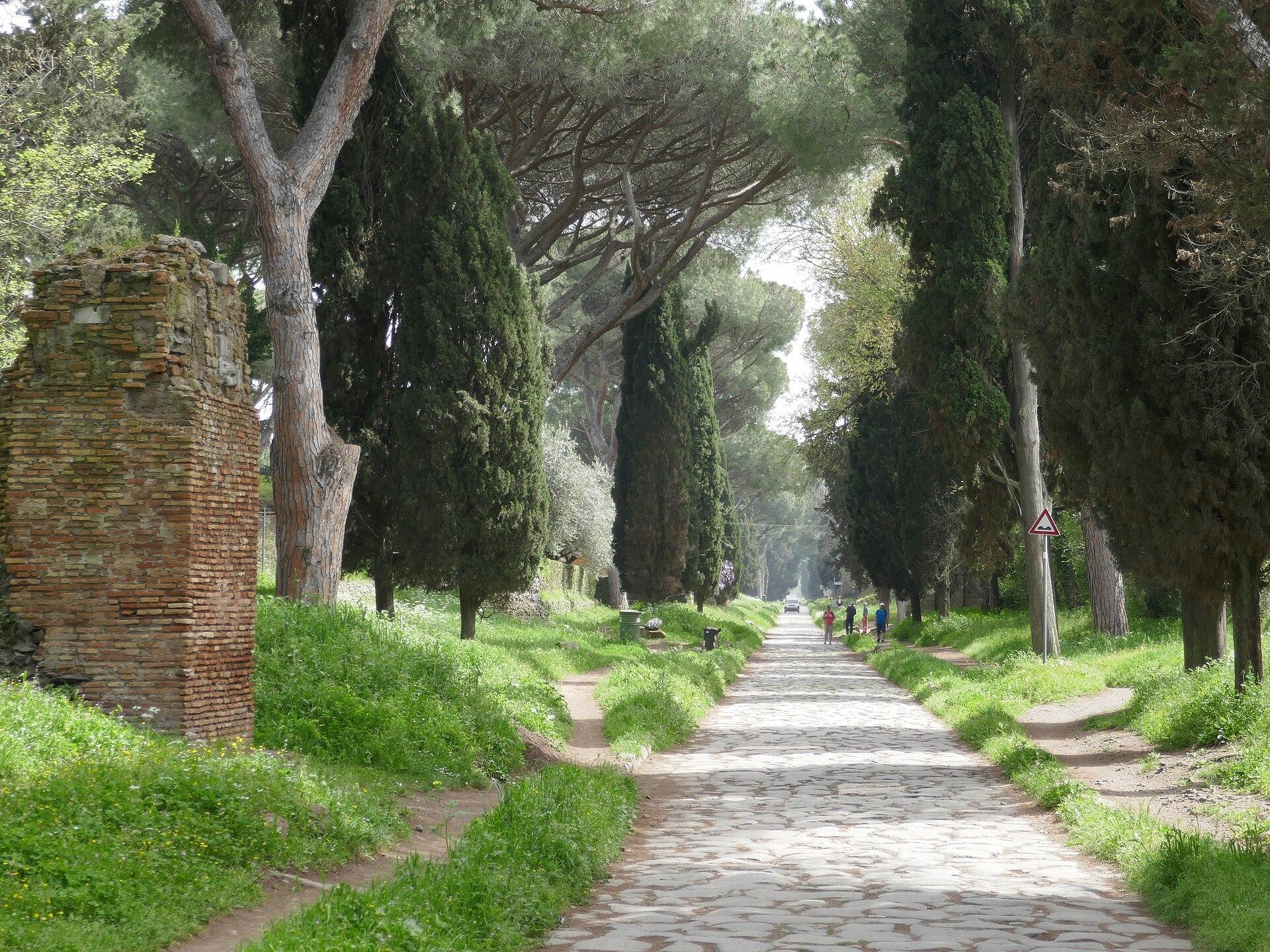

Via Appia Antica
The Appian Way (Via Appia Antica) in Brief
6 stops75
The six stops not to be missed if you have just over an hour, all free and traffic-free: the Tomb of Cecilia Metella, the toll castle, the ancient paving, the traveler, the tower of Capo di Bove and the open-air museum. You start at Cecilia Metella and return to the starting point.
Free short route. More stops in the full route: 10 Continue with the full route