The Baths of Caracalla in brief
The six stops not to miss if you have less than an hour: the emperor, the palaestra, the open-air pool, the cold room, the great hot room and the Farnese Bull. A quick walk to understand how one of Rome's largest public baths worked.
Museum: Terme di Caracalla
An Imperial Gift, Entrance Square
Stop for a moment, before you go in. What you are about to see is a gift, given by an emperor to his city. His name was Marcus Aurelius Antoninus, but everyone called him Caracalla. In 212, he does something enormous: he grants Roman citizenship to almost all the free inhabitants of the empire. Four years later, in 216, he inaugurates the baths that bear his name. They are the second largest bath complex ever built in Rome, after the one built by Diocletian. When he inaugurates them, the construction site is not finished. Caracalla dies in 217, and other emperors complete the precinct. But note this: people did not come here only to wash. They played sports, took walks, read, chatted. The baths were where people came to be together. They stayed in use until 537, for more than three hundred years. If you look near the entrance, you may see a long rectangular pool of water. It is new, from 2024, and it repeats the shape of the great pool you will come to further on. After so much time, water has returned inside the precinct. Now go in, without hurry. This building went up in just a few years, for thousands of people a day. Enter the precinct and approach the central building. Look, on one side, for a large open courtyard: it is one of the two palaestrae.
Oil and Sweat, A Palaestra
Before the water, the sweat. You are in one of the two palaestrae: one on each side, mirror images of each other. Here people did gymnastics, and also wrestling and boxing. It was where the young trained, but also a place to stroll. The courtyard was enclosed on three sides by a portico, with columns of giallo antico and a vaulted roof. On the side facing the precinct there was a large room with an apse, probably for indoor exercise. Before starting, the men rubbed themselves with oil. After exercising, they scraped off the oil and sweat with a tool called the strigil. Then they moved on to the baths. Above the porticoes there was an upper floor, for other activities: hair removal, massages. Wide corridors with mosaic floors ran above the courtyard. In some Roman baths, the palaestra courtyard also served as a notice board: announcements of shows and notices for everyone were posted. Imagine a sign announcing the gladiators, next to a man covered in oil. Stay a moment in the courtyard. Look at how much space there is: a place designed for moving, a whole crowd of people, all together. Go back toward the axis of the central building and look for the large roofless pool, with a wall of niches at the far end: this is the natatio.
The Great Pool, Natatio
Of the four granite columns that adorned this pool, the last one left intact is in Florence. You are standing in front of the natatio, the great pool. Imagine it full, about fifty meters long, and the noise of so many people in the water. Among the rooms of the baths, it was the only one without a roof, open to the sky. Two of the four entrances on the front of the building opened onto the porticoes at the sides of the pool. The water came from a branch of the Aqua Marcia aqueduct, built in 212 specifically for the baths. Look at the back wall. There were niches on two levels, in groups of three, and statues stood inside them. The pool was decorated with four enormous granite columns, each made of a single piece. In 1563, the last one left intact was taken away from here. Pope Pius IV gave it to Cosimo I de' Medici, who had it brought to Florence. Today it stands in Piazza Santa Trinita and is called the Column of Justice. A piece of this pool, in the middle of a Florentine square. Think back to the water at the entrance. It has the shape of this pool: an echo of it, many centuries apart. Enter the large hall that follows, the tallest one, with the enormous pillars.
The Cold Room, Frigidarium
Look up, and take your time. This is the most imposing hall of the baths. It was the frigidarium, the cold room, fifty-eight meters long and twenty-four wide. Three great cross vaults covered it, more than thirty meters high, supported by eight pillars with granite columns in front. What you see is the skeleton. Walls and floor were covered in marble, and there were pools for cold water. It was also a crossroads: from here you passed to the two palaestrae, to the porticoes of the pool and to the tepidarium. This hall became a model. In New York, the old Pennsylvania Station repeated its architecture: travelers at the beginning of the twentieth century walked inside a copy of this place. The baths were full of art, more than one hundred and twenty sculptures. Two large granite basins, believed to come from here, are today the fountains of Piazza Farnese, in Rome. Stop for a moment and speak in a low voice. Can you hear how the sound changes in such a large space? Walk along the axis of the building all the way to the end, where the plan becomes a large circle: it is the calidarium.
The Fire Room, Calidarium
Beneath your feet, a machine was at work, one you cannot see. You are in the calidarium, the hot room. It was round, more than thirty meters across, with a dome held up by eight great pillars. Between one pillar and the next there were large windows, facing the sun: more light, more heat. The floor rested on top of the furnaces. Hot air passed under the floor and inside the walls. This is called a hypocaust. Beneath the building ran service tunnels, wide enough for carts. About two kilometers of them remain. Hundreds of slaves and workers labored there, among stores of wood, furnaces and boilers. The man who tended the fires was called a fornacator, and in the plural, fornacatores. In this room there were seven pools, and six have come down to us. And there is a more recent memory: from 1937 to 1993, in the summer, people came to the central part of the baths to hear opera, among these ruins. Look up, where the dome is no longer there. Imagine that dome whole above you, and the light filtering in through the windows. Head back toward the sides of the building and look for the other palaestra, the one you have not yet seen.
The Marble Bull, The Other Palaestra
The largest piece in this place is no longer here. It weighs twenty-four tons, and it is in Naples. It is the Farnese Bull, carved from a single block of marble, about twelve feet, or three point seven meters, tall. It is the largest single sculpture ever recovered from antiquity. It is thought to have been found in one of the two palaestrae, probably the eastern one. It was brought back to light in 1546, during excavations commissioned by Alessandro Farnese, who was looking for ancient statues to embellish his palace. For centuries it was believed to be a Greek work, described by Pliny. Recent studies say otherwise: it would be a Roman copy from the third century, carved specifically for these baths. The scene is a myth: two brothers tie a woman, Dirce, to a wild bull. With the rest of the Farnese collection, in 1788 the Bull left for Naples, at the wish of King Ferdinand IV. Since 1826 it has been in the National Archaeological Museum. Hercules and Flora, two other great sculptures discovered in the baths, went with it. Look around you: the baths were full of statues, more than one hundred and twenty. Imagine every niche, every corner, inhabited by a marble figure. Your short route ends here. Follow the signs to the exit. Thank you for listening to the Baths of Caracalla.
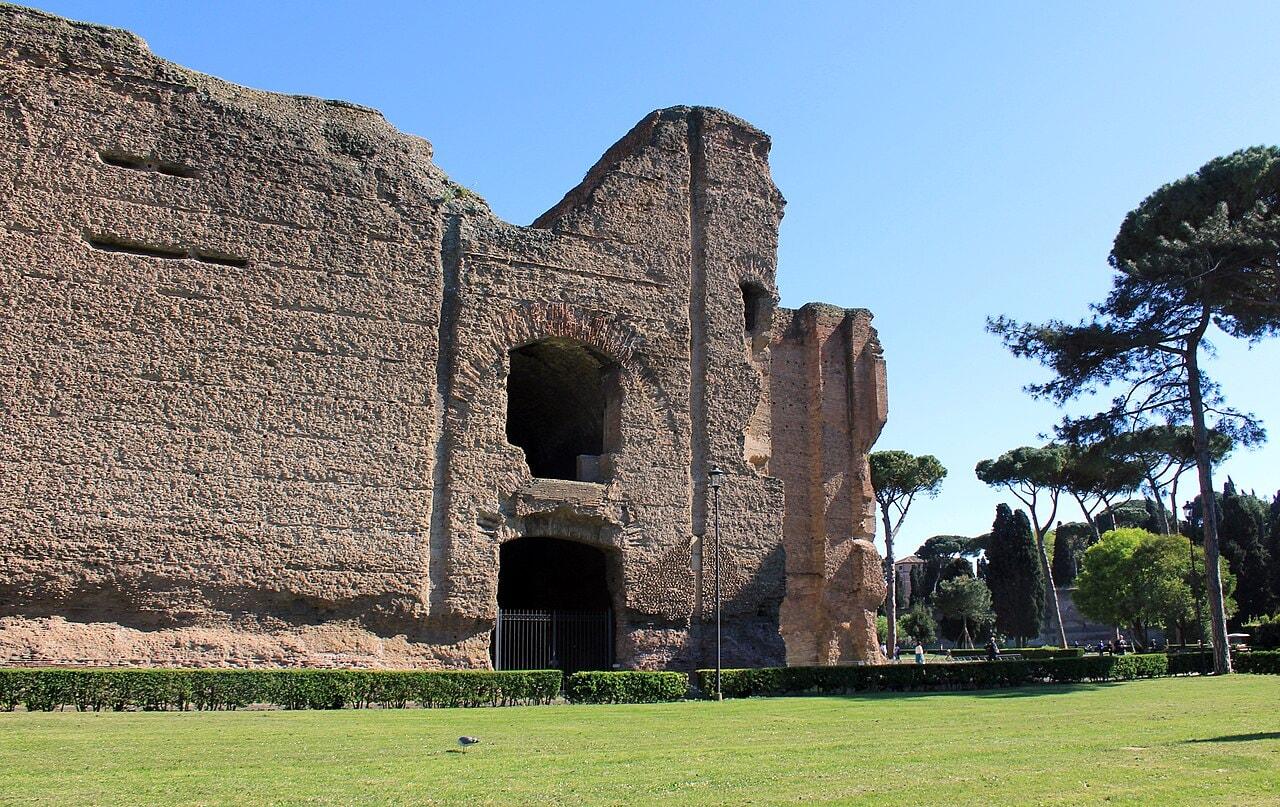

Terme di Caracalla
The Baths of Caracalla in brief
6 stops55
The six stops not to miss if you have less than an hour: the emperor, the palaestra, the open-air pool, the cold room, the great hot room and the Farnese Bull. A quick walk to understand how one of Rome's largest public baths worked.
Free short route. More stops in the full route: 6 Continue with the full route