The Royal Palace of Caserta in Brief
The six stops not to be missed if you are short on time: the façade, the Cannocchiale, the Grand Staircase with its hidden orchestra, the Palatine Chapel, the Throne Room and the queen's bathroom. All inside the Palace, about an hour and a quarter.
Museum: Reggia di Caserta
Four Empty Bases, Piazza Carlo di Borbone
Stop in the middle of the square and look at the Palace. It is two hundred and forty-seven meters long, and it is surprising for what it lacks. Look at either side of the central doorway: there are four empty bases. They were meant to hold four statues: Magnificence, Justice, Clemency and Peace. Above the doorway there was to be the king on horseback. They were never made: at a certain point the money ran out. The king is Charles of Bourbon. Born in seventeen sixteen, son of Elisabeth Farnese, in seventeen thirty-four he becomes King of Naples at the age of eighteen. In seventeen fifty he buys the fief of Caserta. On the twentieth of January, seventeen fifty-two, the day of his thirty-sixth birthday, he lays the foundation stone here. The project is by Luigi Vanvitelli. In his first design there were a dome at the center and towers at the corners. Charles and Queen Maria Amalia have them removed: they want a civil building, with nothing military or religious about it. A practical tip. The complete route takes a whole day, and in winter the Park closes in the early afternoon: if you want to see all of it, start in the morning. And now, go in. Enter through the central doorway with your ticket: ahead of you a gallery with three aisles runs through the Palace, and at the far end you can see the trees of the park.
The Cannocchiale, Lower Vestibule
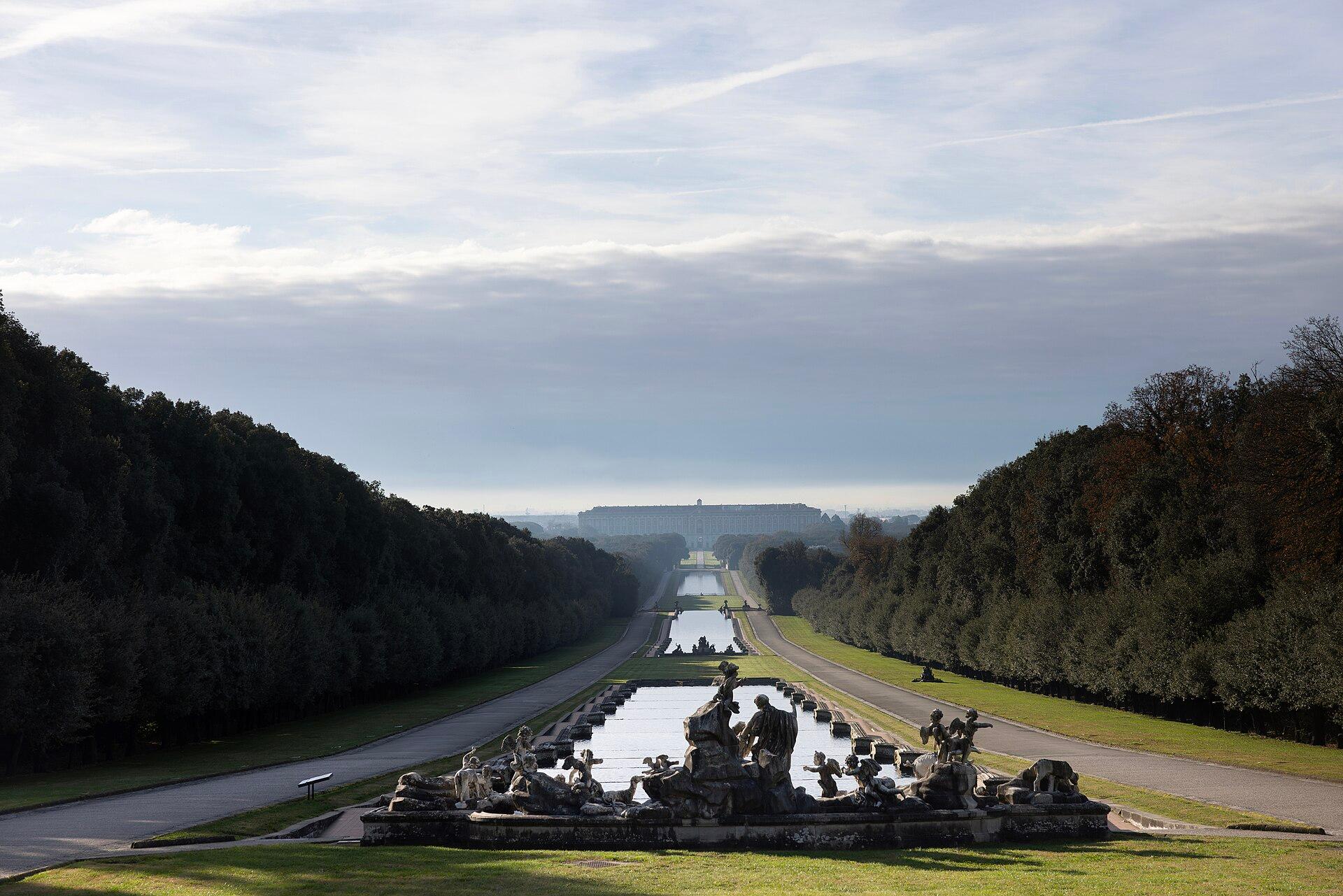
You are beneath the main archway, in the gallery with three aisles that runs through the whole Palace. It is called the Cannocchiale. Carriages passed through the central aisle, and people on foot used the side ones. Now look to the far end, toward the park. From here you can see the succession of fountains, one after another. It is a trick of perspective by Luigi Vanvitelli: the Cannocchiale takes its name from this effect, which links the Water Way of the park to Viale Carlo Terzo, the road that led to Naples. Think about what that meant. The Cannocchiale connected the inside with the outside: it was a dialogue, says the museum, between the royal family and its people. On one side the king, on the other his kingdom, and in between a single straight line. At the center of the gallery opens an octagonal atrium, the Lower Vestibule, from which you can see the four courtyards of the Palace. And in front of you stands an ancient statue three meters tall: Hercules at Rest. It comes from the Farnese Collection and originates from the Baths of Caracalla. Turn toward the statue of Hercules: the Grand Staircase opens right in front of him. Go up.
The Hidden Orchestra, Grand Staircase
Before going up, listen. Between the two vaults you see above you, hidden from view, an orchestra was stationed. It played to accompany the entrance of the royal procession. This is the special effect of Luigi Vanvitelli, and here you can see the engineer at work. The vault of the Grand Staircase is double. Through the outer one, painted with the four seasons by Girolamo Starace Franchis, you can glimpse the inner one, with The Palace of Apollo. Climb the steps: there are one hundred and sixteen. Two marble lions watch over the flight of stairs, and they represent the strength of reason and that of arms, which secure the king's possession of his territories. At the top of the flight, look at the three large sculptures. In the center is the Royal Majesty by Tommaso Solari: King Charles on the back of a lion. On either side, Merit by Andrea Violani and Truth by Gaetano Salomone. These are the qualities every guest had to have in order to be admitted into the king's presence. At the top you arrive in the Upper Vestibule, an octagonal atrium: the point where the central arms of the Palace intersect. You are in the octagonal atrium at the top: the entrance to the Palatine Chapel opens onto this vestibule. If you find it closed, move on to the next track.
Christmas 1784, the Palatine Chapel
We are in a church. On Sundays, Mass is celebrated here: silence your phone, lower your voice, and if you can, use headphones. Luigi Vanvitelli designed it at the request of Charles of Bourbon, on the model of the one at Versailles. But he judged the chapel at Versailles to be "bad, out of proportion in everything." So he departed from the model and placed it inside the Palace, with direct access from the Upper Vestibule. Vanvitelli did not see it finished. His son Carlo continued the work and took care of the decorations, and the church was inaugurated at Christmas of seventeen eighty-four, in the presence of Ferdinand the Fourth. King Charles did not want to spare any expense: he chose the most beautiful marbles from the quarries of the Kingdom of Naples and of Sicily, the fior di persico, the yellow, the gray, the verde antico. Now look at the altar: the Immaculate Conception by Giuseppe Bonito. It is the only canvas that survived the bombings of nineteen forty-three. The great paintings commissioned from masters such as Conca, Bonito and Mengs were almost all destroyed in the air raid of September of that year. Some columns still bear the marks. The altar too is a makeshift solution: the marble one planned by Vanvitelli was never made, and the temporary stucco altar has never been replaced. Go back to the vestibule and enter the Apartments. Pass through the first rooms without stopping and look for the large gilded room with a throne at the far end: it is the Throne Room.
Thirty-Four Years, the Throne Room
Look up: gold everywhere. You are in the Throne Room, the most important room in the Palace, and the last to be completed. It symbolized the grandeur and power of the Kingdom. Look at how long it took. The work begins in eighteen eleven, under Joachim Murat, and ends in eighteen forty-five, under Ferdinand the Second, on the occasion of the Seventh Congress of Italian Scientists. Thirty-four years, and two dynasties, for a single room. Already in the plans of Luigi Vanvitelli, it was the room for public audiences. Almost all the best Neapolitan artists of the mid-nineteenth century worked to decorate it, and the gold expresses the splendor of the court. At the far end, the throne in carved and gilded wood, upholstered in velvet. Look at the architrave: the medallions with the portraits of the kings of Naples. There are forty-four, from Roger the Norman to Ferdinand the Second. And now the vault. The fresco by Gennaro Maldarelli recalls the laying of the first stone of the Palace, in seventeen fifty-two: the scene you came across in the square, at the beginning of the visit. Head toward the queen's apartments: they are four small rooms, with stuccoes and mirrors.
The Queen's Bathroom, Maria Carolina's Boudoir
The air changes: stuccoes, mirrors, golden flourishes. You are in the most intimate spaces of Queen Maria Carolina: the boudoir, four interconnected rooms, for grooming and embroidery. They were created between seventeen eighty and seventeen eighty-two, under the direction of Carlo Vanvitelli. The style is rocaille, exuberant, and it makes a deliberate contrast with the severe neoclassical style of the king's rooms. The mirrors and stuccoes are by Gennaro Fiore and Bartolomeo Di Natale. On the vault of the Gabinetto da Toelette, Fedele Fischetti paints The Toilette of Venus, to pay homage to the queen. But the real surprise is the bathroom. Maria Carolina wanted every comfort. The tub has taps for hot and cold water. In a niche there is one of the first bidets in Italy, in mahogany and gilded bronze. In the neighboring Gabinetto there were marble hand basins and a real toilet with a flush: today only the plumbing remains. This is the eighteenth century, but here the comforts are those of a modern home. And the queen was no ordinary woman: Maria Carolina was the sister of Marie Antoinette, the queen of France. The Palace ends here, and with it this tour. Go back down the Grand Staircase to the Cannocchiale: if you like, cross it and stroll in the park. Thank you for listening.

Reggia di Caserta
The Royal Palace of Caserta in Brief
6 stops70
The six stops not to be missed if you are short on time: the façade, the Cannocchiale, the Grand Staircase with its hidden orchestra, the Palatine Chapel, the Throne Room and the queen's bathroom. All inside the Palace, about an hour and a quarter.
Free short route. More stops in the full route: 15 Continue with the full route