The Basilica of San Francesco in Brief
Six stops in about 50 minutes: the Hill of Paradise, the tomb of Francis, his face painted by Cimabue, the climb to the Upper Church, and two scenes attributed to Giotto, the cloak and the night at Greccio. For those with little time who want to see what brings them here.
Museum: Basilica di San Francesco d'Assisi
Paradise Hill, Lower Square
Stop here, in the square, and look up. Above you stands an enormous wall, and behind the wall a hill that has changed its name. It is said that here, on the edge of the city, condemned prisoners were once buried. For this reason the hill is supposed to have been called Collis inferni, the Hill of Hell. Then a man named Simone di Pucciarello donated it to the friars, and the name changed: Collis paradisi, the Hill of Paradise. Francis died in 1226. In July 1228, less than two years after his death, Pope Gregory IX proclaimed him a saint. In the same year, construction began on this basilica, which would be consecrated in 1253 by Pope Innocent IV. An enormous church, for a saint who had chosen poverty. Historians regard it as a clear departure from Franciscan austerity. Now look at the stones of the Sacro Convento above you. They come from Mount Subasio, and they glow pink in the sunlight. Since 2000, the entire complex has been a UNESCO World Heritage Site. Enter through the portal of the lower church and look, halfway down the nave, for the two flights of stairs that descend to the crypt. It is a place of prayer: keep your voice low and dress modestly. If you hear a Mass in progress, skip to stop four.
Brother Jacopa, Crypt
Step softly. This is a place of prayer, and many have come from far away simply to stand here in silence. Francis's tomb is a plain stone sarcophagus, set into the pillar beneath the high altar. His body arrived in the basilica on 25 May 1230, brought from the church of San Giorgio. Then, according to tradition, it was hidden so that no one would steal it, and was found again only in 1818, beneath three slabs of travertine. After that discovery the crypt came into being; it was rebuilt between 1925 and 1932. Pause between the two staircases, where they meet. A woman rests here: Jacopa de' Settesoli, a Roman noblewoman. Francis called her "Brother Jacopa," using the title he gave to his friars. In the niches at the corners rest four of his first companions: Leo, Masseo, Rufino and Angelo. A lamp burns before the tomb. The oil is donated each year by a different Italian region, for the feast day of the fourth of October. In 2026, eight hundred years after his death, Francis's remains were shown to the faithful for a month in the lower church, until 22 March. It was the first extended public display. Today you can stay here only for a moment, as everyone does. Climb back up the stairs and walk toward the far end of the church, where the arms of the cross open out: look for a large Madonna enthroned, with angels.
Face of Francis, Transept
Look at the Madonna enthroned, with the Child in her arms and four angels around her. And at her feet, small, a friar: it is Francis. Cimabue painted it around 1280. The basilica presents it as one of the oldest and most reliable portraits of Saint Francis in existence. No one can tell you that it is his true face. But it is a face painted about fifty years after his death. Look at the edges: the fresco has been partly cut away to make room for other paintings. Yet its success convinced the patrons to entrust Cimabue with the choir and the transept of the upper church as well, where you will go shortly. Today you see it so bright because it has been restored. A team led by Sergio Fusetti worked for a year, starting in January 2023, with the support of Ferrari. Fusetti himself oversaw the restoration of the Chapel of Saint Martin, the one you have just left. A small portrait, in a corner, at the foot of a large image. The saint of poverty, once again, is in the humblest place. Leave the church, return to the square and climb toward the upper square, where the entrance to the upper church is. If you hear a Mass in progress, stop four is just the one for you.
Ascent to the Light, Upper Square
You have made it to the top. Breathe: here the air is open, and before you stands the facade of the upper church. Look at it. It is simple, gabled, with a large rose window at the center, surrounded by the symbols of the four Evangelists, and a double portal below. Beside it stands the bell tower. Down below, in the church of the tomb, there was half-light. Up here, everything is light: tall windows, blue vaults, painted walls. It is a Gothic church, recalling the French churches, but with simple, luminous lines and colors, in the Italian manner. It was completed in 1253 by Pope Innocent IV, the same pope who had ordered the frescoes in the church below. It has a single nave, divided into four bays, with a wide transept and a polygonal apse. In 2000, together with other Franciscan sites, it was inscribed on the UNESCO World Heritage List. Not far away stands the Sacro Convento, built of the pink stone of Mount Subasio. When you enter, lower your voice: here too, people pray. Enter through the portal and walk along the nave toward the altar, looking at the lower walls: look for the first scene, a man spreading his cloak on the ground before a young man.
Cloak of Francis, Giotto Cycle: First Scenes
You are standing before the first of the twenty-eight scenes that tell the life of Francis. A simple man of Assisi spreads his cloak on the ground before a young man. Next to it, the second: Francis meets a knight who is noble but poor and shabbily dressed. Moved to compassion, he gives him his cloak. Does it remind you of someone? The soldier Martin, in the chapel below: the same gesture, many centuries later. Look at the horse and the columns: they were white, and the damp has turned them black. The third scene is a dream: a palace full of weapons marked with the cross. The twenty-eight scenes follow the Legenda maior, the biography of Francis written by Saint Bonaventure. Each one measures about 2.3 by 2.7 meters. And now the open question: who painted them? Tradition says Giotto. Some scholars, however, suggest a painter of the Roman school, perhaps linked to Pietro Cavallini. The basilica's own label reads: attributed to Giotto and his workshop. The dates are at the end of the thirteenth century. The first scene, for many, is not by Giotto's hand. Whoever's hand it was, see how the simple gesture of a cloak opens up an entire life. Follow the scenes as far as the thirteenth and look for the friars standing on the choir stalls singing, an altar with a cradle, and some women looking on from the doorway.
Night at Greccio, Giotto Cycle: The Nativity Scene
Christmas in 1223. At Greccio, in the province of Rieti, Francis reenacted the birth of Jesus in a sacred performance. According to the biographies, during Mass a knight saw a real baby Jesus in place of the one the saint had brought. But look at where Giotto set the scene: inside a church. Scholars recognize it: it is the lower church of Assisi, the one you have just come from. Look for the details. A screen between the nave and the presbytery, a crucifix seen from behind, a pulpit, a lectern, and the friars standing on the choir stalls, singing. Outside the door, some women who are not allowed to enter look on. And the nativity scene? It is said that Francis invented it. That is not quite the case. The basilica itself explains that the idea is a modern misinterpretation: there is no trace of it in the Middle Ages. It was a Spanish Franciscan who stated this explicitly, in 1581. The caption beneath the scene speaks of hay, an ox and a donkey, and a sermon on the poor King. Here the short tour ends. Leave quietly through the door by which you entered. If you would like more, the Treasury Museum is open by donation and keeps its own hours; and for any questions about the basilica you can write to the amuseapp chatbot. Thank you for walking with us.
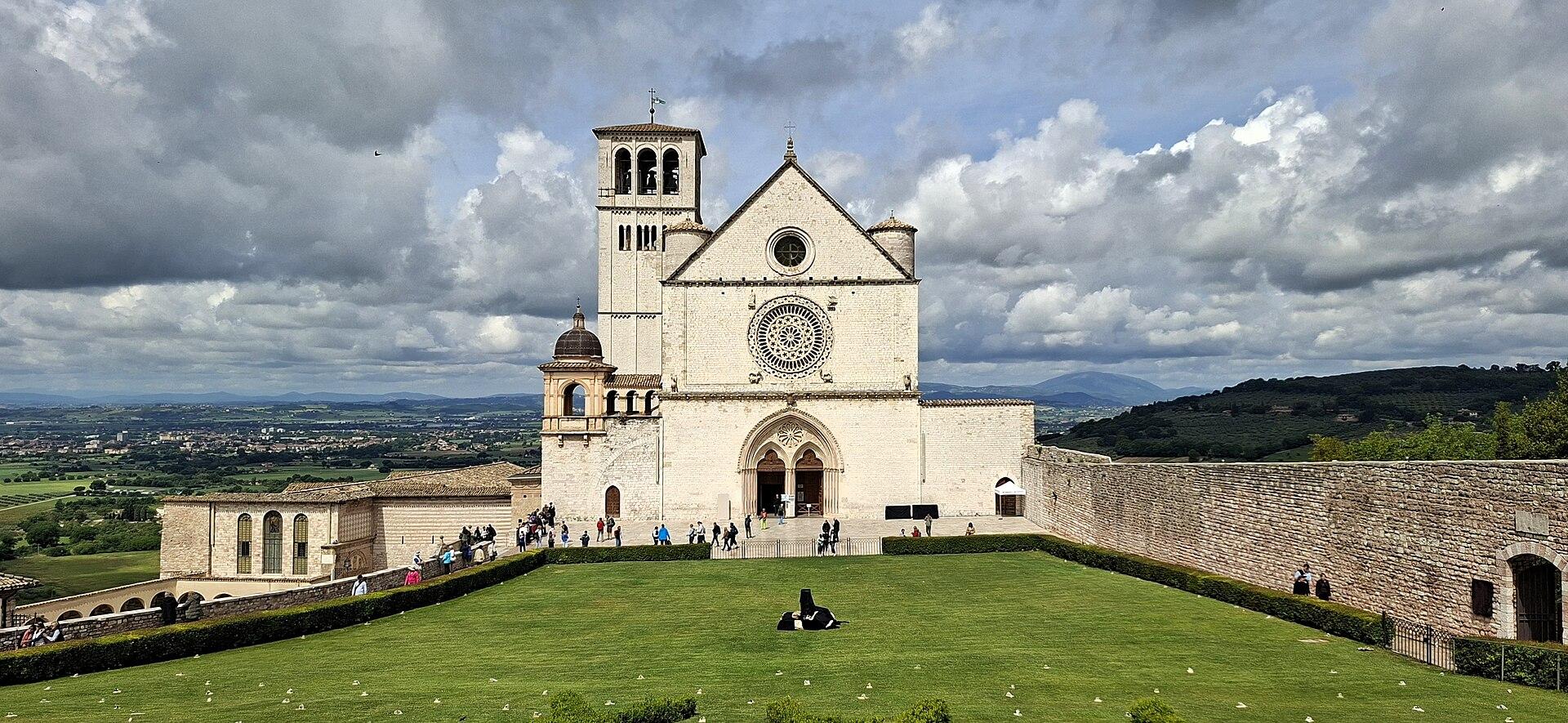

Basilica di San Francesco d'Assisi
The Basilica of San Francesco in Brief
6 stops50
Six stops in about 50 minutes: the Hill of Paradise, the tomb of Francis, his face painted by Cimabue, the climb to the Upper Church, and two scenes attributed to Giotto, the cloak and the night at Greccio. For those with little time who want to see what brings them here.
Free short route. More stops in the full route: 8 Continue with the full route