Treasure Hunt in the Basilica
A journey designed for families and children to discover the secrets of St. Peter's Basilica.
Museum: Basilica di San Pietro
Attention: Possible change in the itinerary of the visit.
Welcome to St. Peter's Basilica, the spiritual heart of Christianity and a universal symbol of the Catholic faith. This itinerary will guide you through the discovery of its history, its majestic architecture, and the artworks that make it one of the most visited sites in the world. Please note that, during the Jubilee Year, access to certain areas might undergo changes or temporary restrictions. We recommend checking for any updates at the official information points or on the Vatican's website to best plan your visit.
Introduction
Introduction
Welcome to the majestic St. Peter's Basilica, the vibrant heart of Christianity and one of the most extraordinary places in the world! This gigantic church is not just a building, but a history and art book that we will leaf through together today. Imagine that here, beneath our feet, rests St. Peter, the first Pope, and that for centuries, the greatest artists like Michelangelo and Bernini have worked to make this place so special. During the Jubilee of 2025, the Basilica becomes even more significant: it is a moment when millions of pilgrims arrive from all over the world to cross the Holy Door and receive the plenary indulgence. Today, we will explore the hidden treasures of this incredible place, ready to embark on an adventure amidst art, history, and faith.
St. Peter's Square
"Our journey begins here, in St. Peter's Square, a place so vast it seems infinite. But don't let the size deceive you! This square was designed by another genius, Gian Lorenzo Bernini, centuries after I left my mark on Rome. He wanted to create a space that would embrace pilgrims like a mother's hug. Look at the columns: there are 284 of them, arranged in four rows. They seem like a lot, don't they? But there's a secret. If you approach the fountains, those two marvels that spray cool water, you'll notice white marble discs on the ground. These are magic spots! Stand on them, one at a time, and look at the columns. You'll see that they align perfectly, as if they were a single row. It's an optical illusion, a trick Bernini created to amaze visitors. Try moving a little to the right or left: the columns seem to move, don't they? It's like a game, a dance of stone. And then, look at the obelisk in the center: it's a piece of ancient Egypt, brought to Rome by the emperors. It's older than the basilica itself! A tip: try to imagine this square filled with people, carriages, horses. Once upon a time, festivals, processions, even bullfights were held here! Now, prepare to enter the basilica. Walk towards the entrance, but be careful: you have to look for the Holy Door. Looking at the facade of the Basilica, the Holy Door is the last door on the right. That's right, the last one, the one closest to the right colonnade of the square. Hold hands, and don't be afraid to ask the guards for help, they are there for you."
The Holy Door
The Holy Door
Here we are, before the Holy Door. It's not a door like any other, you see? It's special, sacred. Normally, it remains closed, walled up. But every 25 years, and on extraordinary occasions like this Jubilee of 2025, the Pope opens it with a silver hammer. It's a solemn, moving moment. Crossing this threshold is a symbol of rebirth, of forgiveness, of a new beginning. It's like entering a new world, leaving behind the burdens and mistakes of the past. Think of how many people, from every corner of the world, have come here to perform this act! Kings, queens, saints, ordinary people... all united by a desire for peace and hope. But what makes it special besides being opened only on rare occasions? The Holy Door you see now was made in 1949. It is a gift from the Swiss community, as thanks for being spared from World War II. It's made of bronze, and if you look closely, you can see sculpted scenes: they represent stories from the Bible, of sin and redemption. Vico Consorti, the artist who created it, worked on the theme "Man in sin, with God in forgiveness." Do you feel its weight? It's a symbolic weight, the weight of history, of faith, of hope. And now, with a light heart and full of joy, let's cross this threshold together! As soon as you enter, turn immediately to your right. There, protected by glass, is a work that will make your heart skip a beat.
The Pietà: A Heart of Marble
The Pietà: A Heart of Marble
Be silent for a moment... We are standing before one of the most precious treasures of the basilica: Michelangelo's Pietà. The artist was only 24 years old when he carved this marvel from a single block of marble. Look at how it seems soft, almost alive! The sculpture depicts Mary holding Jesus after the crucifixion. Although it is a moment of great sadness, notice how the Madonna's face does not show despair, but a dignified calmness. It is like when a mother comforts her child even though she is sad: the power of love surpasses everything. There's a secret about this statue: it is the only work Michelangelo ever signed! If you look closely at the sash crossing Mary's chest, you can read his name. Do you know why he signed it? Because one day he overheard some visitors saying it had been created by another sculptor, and he was furious! Many wonder why Mary appears so young, almost like a girl. Michelangelo explained that purity and goodness keep you forever young. What a beautiful idea, isn't it? Now let us continue our journey! Walk along the central nave, the largest and most majestic one. Advance slowly, lifting your gaze: there are hidden treasures in every corner.
The Baldachin: A Golden Throne
The Baldachin: A Golden Throne
Raise your eyes, up, up, toward the center of the basilica! Do you see that imposing structure, all gilded, that seems to touch the sky? It's the Baldachin of St. Peter, an extraordinary work by Bernini. It's like a giant throne, a nuptial canopy, a tribute to the greatness of God and the Church. It's almost 100 feet tall, like a ten-story building! And imagine, it was made using bronze taken from the Pantheon, another incredible building in Rome, a pagan temple transformed into a church. Bernini melted down that ancient bronze and transformed it into these twisted columns, decorated with laurel leaves, bees (the symbol of the Barberini family, to which the Pope of the time belonged), and playful cherubs. Beneath the Baldachin is the papal altar, a sacred place where only the Pope can celebrate Mass. And beneath the altar, even further down, is the tomb of St. Peter, the first Pope, the founder of the Church. It has been a place of pilgrimage for centuries, a point of reference for millions of faithful. But the Baldachin is not just a work of art; it's also a symbol of power. It represents the strength of the Church, its wealth, its authority. But it is also a symbol of faith, devotion, and hope. Look at the statues of the angels, which seem to fly around the columns. Listen to the murmur of prayers, the sound of footsteps, the scent of incense. You are in a special place, a place that speaks to the heart. A tip: try to imagine this place lit only by candles, without electricity. It must have been an even more evocative, mysterious, almost magical sight. "And now let's prepare for another marvel. Let's go toward the back of the main altar and walk around it: another throne awaits us, even older."
The Cathedra of St. Peter: A Thousand-Year-Old Throne
The Cathedra of St. Peter: A Thousand-Year-Old Throne
Here we are before the Cathedra of St. Peter, another hidden treasure of the basilica. Don't let appearances deceive you: this wooden chair, encased in a gilded bronze structure, is much more than a simple piece of furniture. Legend has it that this chair belonged to St. Peter himself, the first Pope, the one who received the keys to the Kingdom of Heaven from Jesus. In reality, studies tell us it's a bit more recent: it dates back to the 9th century and is a gift to the Pope from Charles the Bald, an emperor of the Holy Roman Empire. But this doesn't diminish its symbolic value. The Cathedra represents the authority of the Pope, his role as guide of the Church, as successor to Peter. It's a symbol of continuity, of tradition, of faith. Bernini, again, created this magnificent bronze structure to protect and celebrate the Cathedra. Look at the angels, the clouds, the rays of light: it almost seems as if the chair is flying, ascending to heaven! And above the Cathedra, do you see that stained-glass window? It represents the dove of the Holy Spirit, which illuminates and guides the Church. It's an image of hope, of peace, of love. A tip: try to imagine the Pope seated on this chair during solemn ceremonies. It must have been a powerful, impressive, almost divine image. "Now, let's return to the central nave and prepare to look up, way up. A challenge awaits us, but it will be worth it."
The Dome: A Painted Sky
The Dome: A Painted Sky
Look up! We are beneath the dome, the heart of the basilica, the masterpiece I bequeathed to the world. I designed it, taking inspiration from Brunelleschi's dome in Florence, but striving to surpass it in beauty and grandeur. It's so tall that the entire Pantheon could fit inside it, dome and all! And if you have the courage and the strength, you can climb to the very top, ascending 551 steps. It's quite a climb, but the view from up there is priceless. You'll see all of Rome at your feet, the Tiber winding through the rooftops, the hills rising on the horizon. But even from here, you can admire the beauty of this dome. Look at the mosaics: they look like paintings, but they're made of tiny pieces of glass, stone, and gold. Millions of tesserae, inlaid one by one, to create these figures, these scenes, these colors. They depict stories from the Bible, of saints, of angels. It's like looking at a starry sky, but made of light and color. And if you look even higher, towards the center of the dome, you will see an inscription in Latin: 'TV ES PETRVS ET SVPER HANC PETRAM AEDIFICABO ECCLESIAM MEAM ET TIBI DABO CLAVES REGNI CAELORVM' (You are Peter, and upon this rock I will build my church, and I will give you the keys of the kingdom of heaven). These are the words Jesus spoke to Peter, and they are the foundation of the Catholic Church. A word of advice: if you suffer from vertigo, don't look up too much! But if you feel up to it, try closing your eyes for a moment and imagine yourself suspended in the void, between heaven and earth. It's a thrilling experience, almost mystical. "To continue our journey, you'll have to go back towards the entrance of the basilica, then head towards the right side aisle. There we'll find the last important point of this itinerary."
The Statue of St. Peter: A Foot to Kiss
The Statue of St. Peter: A Foot to Kiss
Here we are at the last stop on our journey inside the Basilica, but not the end of our treasure hunt. We're standing before the statue of St. Peter, a very ancient bronze sculpture, perhaps from the 13th century. This statue depicts St. Peter seated on a throne, with the keys to the Kingdom of Heaven in one hand and a blessing in the other. It's an image of authority, wisdom, and strength. But look at his right foot: it's worn down, smooth, almost transparent. Do you know why? Because for centuries, the faithful who come here from all over the world have kissed that foot, touched it, caressed it. It's a gesture of devotion, respect, and affection. It's a way to ask for St. Peter's protection, to feel closer to him, to connect with the history of the Church. If you want, you can do it too. Don't be afraid; it's not a superstitious gesture. It's a gesture of faith, hope, and love. It's a way to feel part of a community, a family, a millennia-old history. A word of advice: if you decide to kiss St. Peter's foot, do it with respect and a sincere heart. And remember to wash your hands afterward, for hygiene! "And now let's go outside, back into the open air, and continue our journey! The square awaits us; once outside, head towards the obelisk in the center."
The Vatican Obelisk: A Silent Witness
The Vatican Obelisk: A Silent Witness
We're back in St. Peter's Square, and at the center, imposing and mysterious, stands the Egyptian obelisk. It's a monolith of red granite, over 80 feet tall, not counting the base and the cross on top. It arrived in Rome over 2000 years ago, brought by Emperor Caligula, who wanted to embellish his circus, a place for games and spectacles. This obelisk has no hieroglyphs; it's completely smooth. It's like an unwritten book, a silent witness to so many events. It saw the martyrdom of St. Peter, who, according to tradition, was crucified right here nearby. It saw the construction of the first basilica, commissioned by Emperor Constantine. It witnessed the coronation of emperors and popes, festivals, processions, wars, and revolutions. And imagine, for centuries this obelisk stood upright, solitary, amidst the ruins of Nero's circus. Then, in 1586, Pope Sixtus V decided to move it here, to the center of the square. It was an incredible undertaking, requiring months of work, hundreds of laborers, dozens of horses, and an ingenious machine designed by the architect Domenico Fontana. A word of advice: try to imagine how difficult and dangerous it must have been to move such a large block of stone without cranes and modern technology. It was a true challenge, a feat that made history. Now, approach the fountains at the base of the obelisk.
The Twin Fountains: A Play of Water
The Twin Fountains: A Play of Water
On either side of the obelisk, like two silent guardians, are the twin fountains. One is the work of Carlo Maderno, the architect who completed the facade of the basilica, and the other is by Bernini, who added his signature to the square. They are like two sisters, similar but not identical. They gush fresh, crystalline water, creating a play of light and reflections. In the summer, it's pleasant to cool off here, to hear the sound of the flowing water, to see children playing and birds drinking. But the fountains are not just beautiful to look at; they are also useful. Once upon a time, they served to quench the thirst of pilgrims, to wash horses, and to clean the square. Today, they are a symbol of welcome, refreshment, and life. A word of advice: if you have a coin, you can toss it into the fountain and make a wish. It's a tradition that brings good luck and helps to fund the maintenance of these monuments. "Now, look at the Basilica from here, and on the left, you'll notice a road stretching out, with a covered passage that seems suspended."
The Passetto di Borgo: An Escape Route
The Passetto di Borgo: An Escape Route
With the basilica behind you, look to the far left, above the rooftops, and you will spot a secret passage, an elevated structure that seems suspended in the void: it is the Passetto di Borgo. This fortified corridor, about 800 meters long, connects the Vatican to Castel Sant'Angelo, an imposing fortress that was once the tomb of Emperor Hadrian. The Passetto was built in the Middle Ages to allow popes to escape in case of danger, siege, or revolt. It is a mysterious, fascinating place, full of history. Imagine the popes running along this passage, pursued by enemies, while below them the city is ablaze. Imagine soldiers defending the walls, prisoners languishing in the cells, treasures hidden in the subterranean depths. Today, the Passetto is open to the public only on special occasions. But if you are lucky, you might have the opportunity to visit it, to walk this secret path, to feel a part of history. A tip: if you visit Castel Sant'Angelo, inquire about the Passetto. You might discover extraordinary opening hours, guided tours, and special events.
Conclusion
Conclusion
Our treasure hunt ends here, but the treasures of St. Peter's and Rome are infinite. I hope I've made you fall a little in love with this magical place, where art, history, and faith blend into a single, extraordinary experience. Remember: beauty is everywhere; you just have to know how to look for it, with your eyes and with your heart. Farewell, young and old friends, and may your lives always be full of discoveries and wonders!
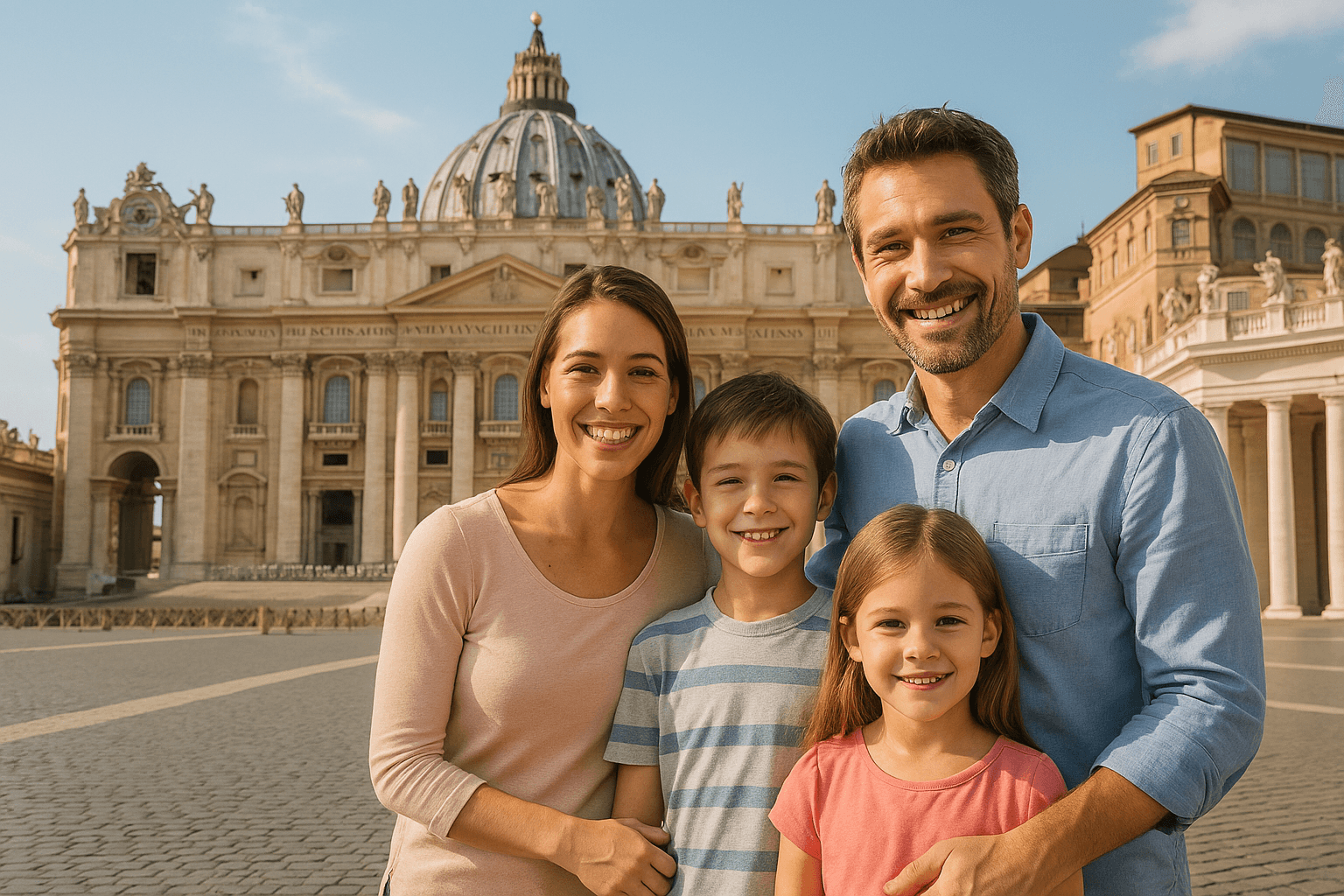

Basilica di San Pietro
Treasure Hunt in the Basilica
13 stops60
A journey designed for families and children to discover the secrets of St. Peter's Basilica.