Milan Cathedral in Brief
Six stops to grasp the essentials when you're short on time: the pink marble in the square, your first glimpse of the nave, Leonardo's tiburio, the Nail and the Nivola, the Visconti sun, and Saint Bartholomew with his skin. About fifty minutes with your Duomo ticket is all you need.
Museum: Duomo di Milano
The Pink Marble, Piazza del Duomo
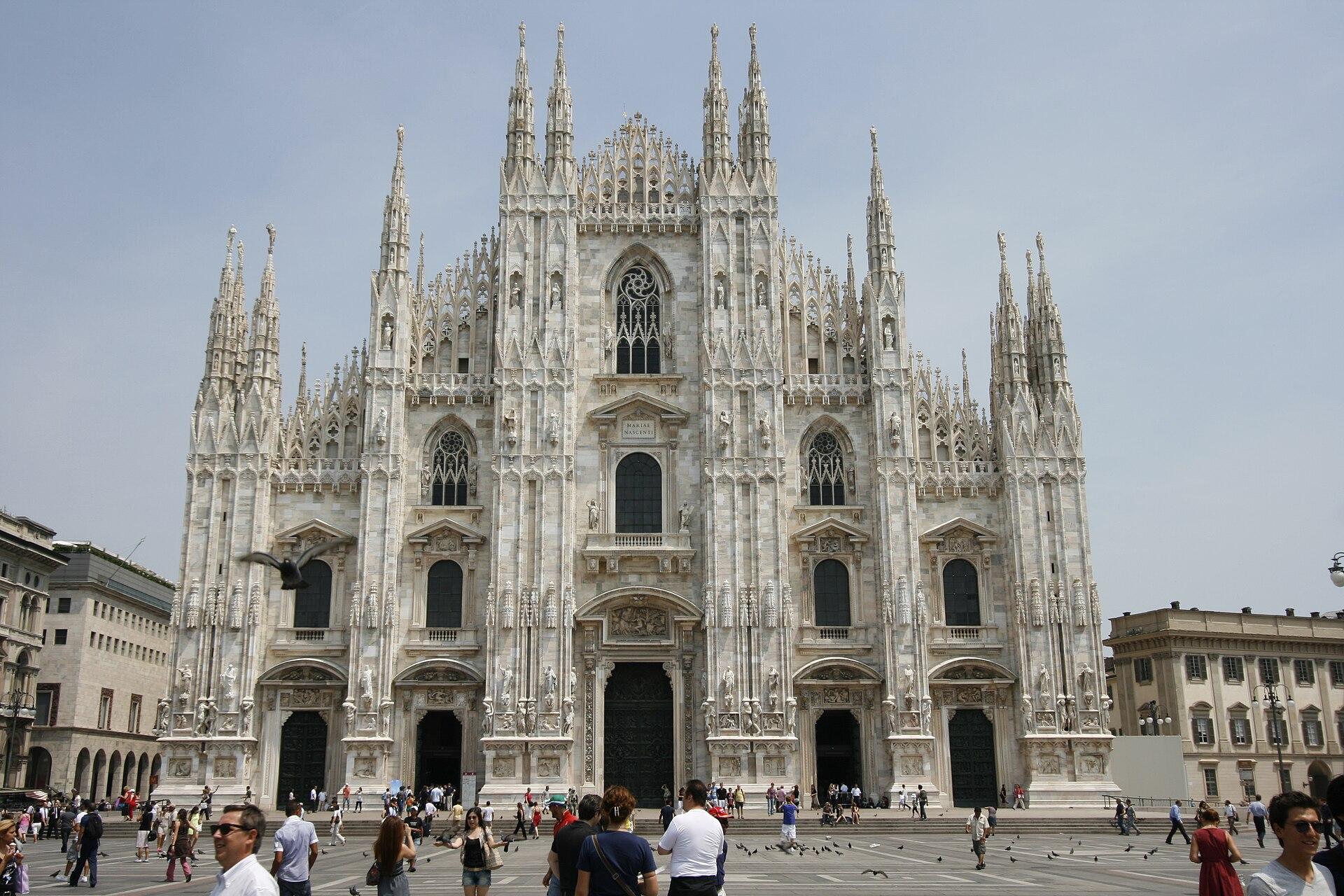
Stop here, about twenty paces from the façade, and look at all of it. It is not white. If the light is good, you see a pale pink with grey veins. It is Candoglia marble, and it made a very long journey to get here. In 1386 Milan decided to build its new cathedral here, where two older churches once stood. Gian Galeazzo Visconti, the lord of the city, wanted marble, not simple bricks. On 24 October 1387 he handed over to the Fabbrica del Duomo his quarry at Candoglia and granted free transport. That marble travelled on water: from the River Toce to Lake Maggiore, then along the Ticino and the Naviglio Grande, to a few hundred metres from where you are. On the barges you could read the letters A U F: ad usum fabricae, meaning for the use of the Fabbrica. The boatmen displayed them so as not to pay the duty. Transport on the water continued until 1920. And the quarry, even today, belongs to the Fabbrica del Duomo. Know also that this square is much younger than the church: it was opened by Giuseppe Mengoni between 1865 and 1873. Before, the façade was squeezed between houses and medieval alleys. Today you have in front of you the largest church in Italy, and you can look at it from a distance, as was not possible for centuries. Join the queue for the checks and enter with the Duomo ticket. As soon as you are inside, stop in the nave, before moving forward towards the altar.
The Stone Forest, Nave
Stop right here, before you walk. Look to the far end, into the distance, as far as the altar. You are in a forest of stone: five aisles, and pillars twenty-four metres high that look like tree trunks. Above, the vaults reach forty-five metres. Beneath your feet, the church measures more than eleven thousand square metres. Now raise your eyes to the vaults. They seem carved in a fine embroidery of stone, but they are painted: it is a false Gothic tracery, begun from the apse in the mid-fifteenth century and redone up to the nineteenth century. Who built it? Not a single architect. Masters and sculptors came from all over the continent, and the official website calls it the most European of the Gothic cathedrals. No one can say whose design it truly is. Look at the pillars: at the top of the large capitals, niches open with statues of saints, and higher up, in the pinnacles, there are prophets. The side aisles descend in height, and so leave small windows in the upper part. Keep your voice down: here we walk in silence. Walk toward the altar, to the great space where the nave crosses the transept. Stop beneath a very high opening, shaped like an octagon.
The Tiburio, Crossing of the Transept
Look up. Above you opens a very tall octagon, fifty metres above the ground. Outside it is sixty-eight metres high. It is called the tiburio, and it is the heart of the Duomo. At the end of the fifteenth century, the best architects of the time set about designing it. Among them was Leonardo da Vinci, consultant for the tiburio in the late 1480s. A model of his was presented and then withdrawn. It was built by Giovanni Antonio Amadeo, together with Gian Giacomo Dolcebuono. In the cavity between the vaults, where visitors cannot go, there are three bells. You cannot see them from below, but they are there, and they sound three different notes. Along the arches, sixty statues of prophets and sibyls look down. In the pendentives, the four corners, you will find roundels painted with the Doctors of the Church: they are the great masters of the Christian faith. The tiburio rests on four pointed arches. Work began in 1490, and Amadeo carried it on until 1500: ten years to close the highest crossing of the cathedral. Move closer to the high altar and look up, at the vault above the altar: look for a small red light shining very high up.
La Nivola, High Altar
Look up, above the altar, in the vault of the apse: a small red light. It is there for a reason. It marks a tabernacle, and inside it a very ancient object: the Holy Nail. According to tradition it is a nail from the cross of Christ, recovered by Saint Helena. The oldest mention we have dates from 1389. It hangs very high up, and the light makes it visible from all over the cathedral. To retrieve it you need the Nivola: an elevator, and what an elevator. It is a large sheet-metal basket, covered with canvas, with angels and cherubs wrapped in clouds, painted by Paolo Camillo Landriani in 1612. Today it is moved by an electric winch and rises to forty metres. Every year, on 14 September, the archbishop rises with the Nivola, takes the nail and shows it to the faithful. The rite was instituted by Carlo Borromeo, who in 1576, during the plague, carried it in procession. One detail: the Nivola is not a modern invention. Elevators too have a long history, and this one is already four hundred years old. People still pray here: look, without disturbing. Pass behind the altar, into the corridor that goes around the apse. Look for three very tall large windows and, in the centre, a large sun.
The Sun of the Visconti, Ambulatory
Stop in the corridor behind the choir and raise your eyes to the central window of the apse. At the centre there is a giant sun with its rays. It is the "razza", the emblem of Gian Galeazzo Visconti. The three windows of the apse are the oldest and largest stained-glass windows. The central one, the Vision of the Apocalypse, was commissioned in 1416, and at the top it still preserves about fifty pieces from the fifteenth and sixteenth centuries. A few years later, on 16 October 1418, Pope Martin V, returning from the Council of Constance, consecrated the high altar here. On that day the use of the new cathedral officially began, even though the building site would continue for centuries. The corridor where you are is the ambulatory. The marble retro-choir, designed by Pellegrino Tibaldi, has an upper order with thirty-two caryatids in the form of angels, and seventeen stories of Mary. Look once more at that sun: inside a church, it is the emblem of a lord. Continue along the corridor, to a bronze monument of a condottiero and a large statue of a saint with a skin over his shoulders.
The Skin as a Stole, South Transept
Look at the statue of a man standing, with his own skin thrown over his shoulders like a stole. This is Saint Bartholomew, and for many he is perhaps the most famous statue in the whole Cathedral. Marco d'Agrate sculpted it in 1562. On the base he wrote, in Latin: Praxiteles did not sculpt me, but Marco d'Agrate. An artist who measures himself against the most famous sculptor of ancient Greece. Beside the saint there is an altar in polychrome marbles, designed by Pirro Ligorio and donated by Pope Pius the Fourth to his nephew Carlo Borromeo. Opposite is the bronze monument to Gian Giacomo Medici, known as the Medeghino. It is by Leone Leoni, from 1560-1563, commissioned by the Medeghino's brother, Pope Pius the Fourth. The Medeghino was a condottiero, a leader of soldiers. The pope commemorated him in bronze right here, in front of a saint. Pause for a moment in front of the two: a saint sculpted in marble, a condottiero cast in bronze. Nearby there is also the chapel of Saint John the Good, with his body in a crystal case. Follow the signs for the exit. Outside, in the square, look up once more: above all the spires there is a golden statue, the Madonnina. Thank you for walking with us.

Duomo di Milano
Milan Cathedral in Brief
6 stops50
Six stops to grasp the essentials when you're short on time: the pink marble in the square, your first glimpse of the nave, Leonardo's tiburio, the Nail and the Nivola, the Visconti sun, and Saint Bartholomew with his skin. About fifty minutes with your Duomo ticket is all you need.
Free short route. More stops in the full route: 13 Continue with the full route