The Arena in Brief
Six stops in about 50 minutes: the square, the sixty-four steps, the gladiator Glaucus, the Wing and the devil, the 1913 Aida, and the farewell in the square. For those with little time or who enter in the afternoon. The admission ticket is purchased separately.
Museum: Arena di Verona
Stone Ship, Piazza Bra
September 1786. A German traveler enters this square and stops, mouth agape. His name is Johann Wolfgang von Goethe, and before him is the first great monument of antiquity he has seen in his life. He is right to stop. This is the Arena: a Roman amphitheater built in the first century, before the Colosseum, outside the walls of the Verona of that time. In size it is among the largest in Italy and in the Empire. It measures one hundred and fifty-two meters by one hundred and twenty-three: it looks like a stone ship that has landed in the square. Goethe is surprised by one curious thing: that inside, people do not play football, the city's popular game. Today, in the Arena, people sing. In summer, opera arrives; by day, you arrive. Look at the ground too. In 1820 the square was lowered by about seventy centimeters, to give the monument back its proportions. And the outer façade, the real one, as tall as a palace? Almost all lost. Only one fragment remains standing: four arches, called the Ala. A practical note. This guide is not official and does not include the ticket, which is purchased separately from the Musei Civici di Verona. Bring an ID document with you. If you have your ticket, go in, cross the gallery and look for one of the staircases that climb towards the light. Stop at the foot of it.
Sixty-Four Staircases, Annular Gallery
A Roman step, found here, bears an inscribed code: wedge one, step four, seat one. It is the seat of a spectator we do not know. His name has not come down to us. Like your ticket, his seat also had a number. The Arena is built for this. Three galleries, one inside the other, support the whole cavea, that is, the tiers of seating. Above the outermost one stood another, which supported the portico. Beneath the floor of each gallery ran an annular drain, to carry away rainwater: three hidden channels, one for each gallery. From these galleries rise sixty-four staircases, which the ancients called vomitoria. They are all still there. One staircase for each wedge, and each staircase comes out onto the tiers. In antiquity the Arena could hold about thirty thousand spectators. Today it holds about half of that. Now it is your turn. Choose a staircase and climb. Listen to the noise growing, one step after another. Climb the staircase up to the tiers, find a place to sit and look at the arena floor.
Glaucus and Nemesis, Steps above the Arena Floor
A gladiator from Verona has left you a piece of advice, written on stone: do not trust Nemesis too much. His name was Glauco, and he was a retiarius: he fought with a net and a trident. On his tombstone are the weapons he used. He had made a vow to Nemesis, the goddess most revered by gladiators, in order to save himself. It did not bring him luck, and so he warns whoever reads: a gladiator's life depends on skill, but also on the whims of fate. The tombstone was paid for in part by his fans. He was a gladiator of good quality. Here duels, the munera, and animal hunts, the venationes, were held. We know little about them. The only literary document is a letter from Pliny the Younger. A friend of his promised the people of Verona a spectacle in honor of his dead wife. He wanted to show some African panthers, bought in large numbers. But bad weather stopped them, and they did not arrive in time. Other tombstones commemorate other gladiators from Verona. Such as Generosus, a retiarius who came from a school in Alexandria in Egypt. He fought twenty-seven times, without ever being defeated, and died of natural causes. Climb a few more rows, until you can clearly see the four large arches at the top, and stop where you can see them best.
The Devil's Night, With a View of the Ala
In the Middle Ages, no one knew any longer who had built the Arena. So a story was invented. It was said to be the house of King Theodoric. Or that the devil had made it. A Veronese gentleman, condemned to death, promises the city's leaders to build an immense building in a single night, with the help of demons. At night the devils set to work. But he repents, and prays to the Madonna until dawn. The sun rises two hours early, and the demons vanish underground, leaving the work unfinished. That is the Ala, they said. The true story is less magical. Under Theodoric, between 493 and 526, part of the outer ring was dismantled to build the city's second walls. Proof of this has been found: inside those walls there was a block from the Arena with the number sixty-three carved on it. Then, until the Renaissance, the Arena remained a stone quarry. The final blow came on 3 January 1117. An earthquake brought down the outer ring, and only the piece you are looking at remained standing. An empire built it, a king dismantled part of it, the earth brought it down. And in the Middle Ages there were those who swore it was the work of the devil. Climb or descend to a high tier from which you can see the ellipse before you, and sit down.
Aida, Upper Tiers
Tenth of August 1913. The Veronese tenor Giovanni Zenatello gambles his own money. With the impresario Ottone Rovato, he brings Aida to the Arena, for the hundredth anniversary of Giuseppe Verdi's birth. If it goes badly, he pays. It goes very well. Outside, people are fighting to get in. Inside, the amphitheater is full: there are Americans, Argentines, Russians, many Germans. And among the audience sit Giacomo Puccini, Arrigo Boito and Pietro Mascagni. Tullio Serafin conducts, Aida is Ester Mazzoleni, Radames is Zenatello himself. The sets by the architect Ettore Fagiuoli are not painted: they are three-dimensional, a novelty for that time. Since then, opera has been staged here almost every summer. In 1947, Maria Callas made her Italian debut in Verona, with La Gioconda. The elliptical shape and the tiers make voices and music resound without artificial amplification. If you see the stage set up today, it is the opera stage. Now imagine the finale. The silence, and then the applause of an entire Arena. For more than a hundred years, in this place, it has ended like this. Go down the stairs and follow the exit. We will meet again outside, in the square.
Comet Star, Piazza Bra (exit)
Every Christmas, in this square, a giant star rises from the Arena. Since 1984, a steel comet star, designed by the architect Rinaldo Olivieri, has stood seventy meters high and eighty-two meters long, with its tail resting inside the amphitheater. In January 2023, during dismantling, a part fell and damaged some of the tiers. Since Christmas 2024, only the head is assembled, with beams of light in place of the tail. The Arena, meanwhile, remains a theater for great occasions: on 22 February 2026 it hosted the closing ceremony of the Milano Cortina Winter Olympic Games. You have crossed almost two thousand years: a gladiator warning you, a siege, a devil, a rhinoceros, an Aida. If you want to continue, right next door, in Piazza Bra, the Museo Lapidario Maffeiano preserves an inscription that suggests a gladiators' barracks. The few sculptures remaining from the Arena are in the Archaeological Museum at the Roman Theatre. They have their own tickets. And in summer the Arena returns in the evening, with opera: it is a different show and a different box office. Safe travels, and thank you for listening to the Arena.
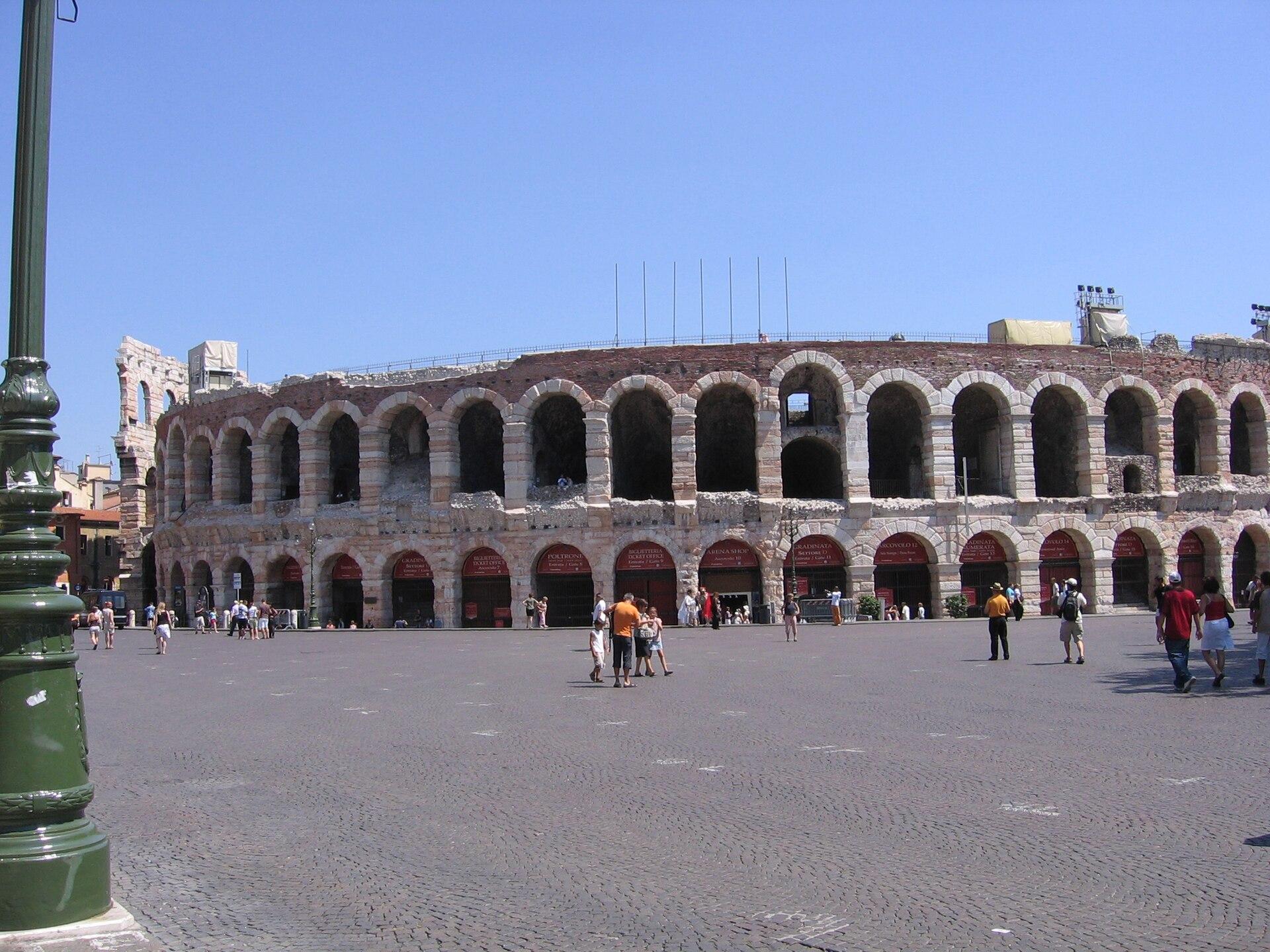

Arena di Verona
The Arena in Brief
6 stops50
Six stops in about 50 minutes: the square, the sixty-four steps, the gladiator Glaucus, the Wing and the devil, the 1913 Aida, and the farewell in the square. For those with little time or who enter in the afternoon. The admission ticket is purchased separately.
Free short route. More stops in the full route: 7 Continue with the full route