The Borghese Gallery in brief
Six moments for anyone short on time: Canova's Paolina, Bernini's Apollo and Daphne and Abduction of Proserpina, Caravaggio's David, Raphael's Deposition and Titian's Sacred and Profane Love. About an hour, even for the shortest entry slots. Admission not included: the ticket with a reservation is bought on the Musei Italiani state ticket office.
Museum: Galleria Borghese
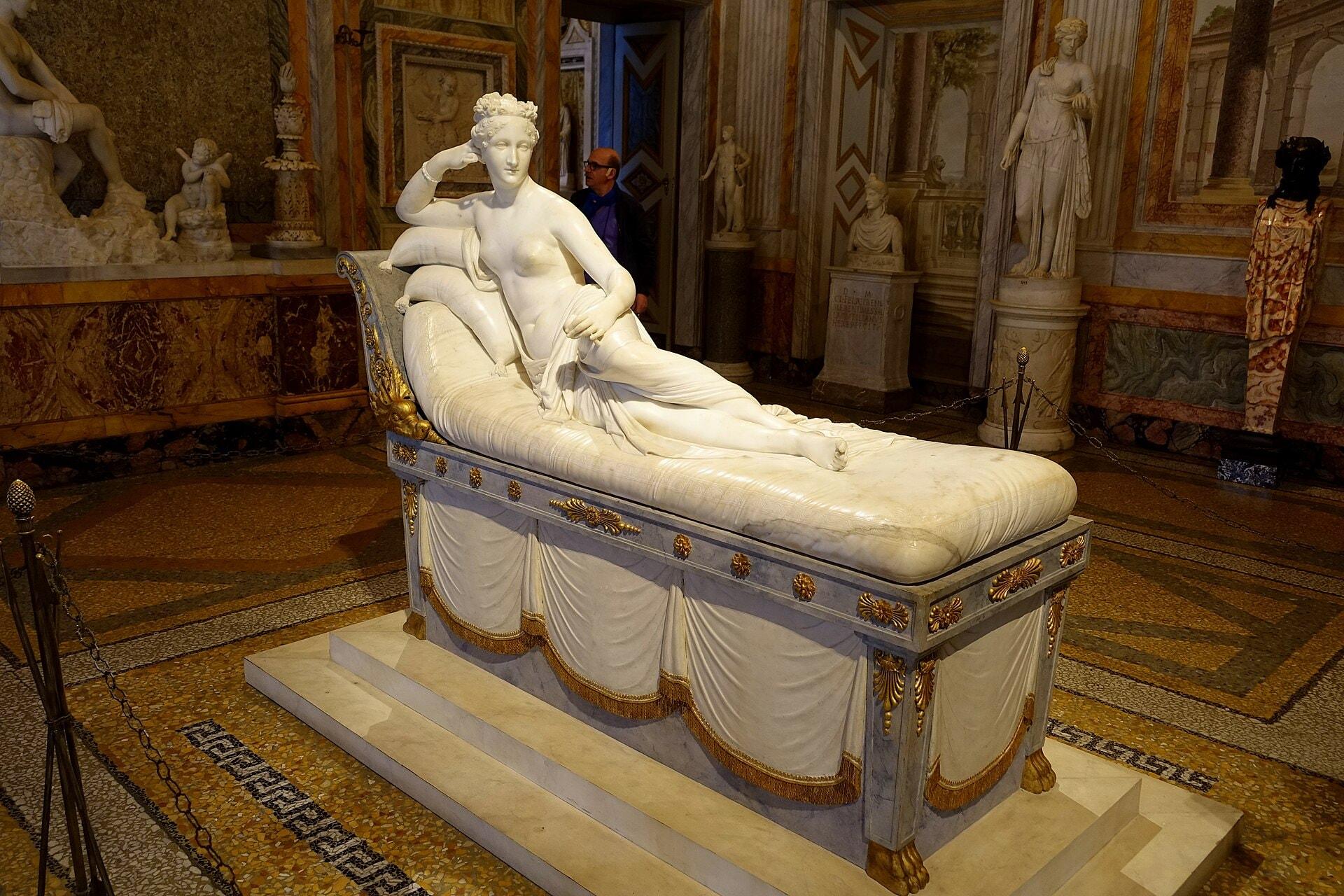
Venus Victorious, Room 1, Room of Paolina
A woman reclining on a couch, with an apple in her hand. She is Paolina Bonaparte, Napoleon's sister, and the sculptor Antonio Canova portrayed her as a goddess. In 1803, Paolina married Prince Camillo Borghese in Paris. She was twenty-three and already a widow. In 1804, Camillo asked Canova for a portrait of his wife, and the statue was finished in 1808. Paolina is Venus, winner of the judgment of Paris: the apple is the prize for the most beautiful of the goddesses. In Rome the nudity caused a scandal, and there was plenty of gossip. But the museum is clear that this is an ideal portrait. Look at the mattress: it seems to sink under the weight of the marble. Canova borrowed the idea from another sculptor, Bernini, who had carved a mattress like it for a statue belonging to Cardinal Scipione. In those very years that statue was leaving for Paris, sold to Napoleon along with hundreds of other works. Canova had fought the sale with all his strength. And under the couch there is a hidden mechanism: it lets the statue turn all the way around, a full three hundred and sixty degrees. Now look for Room 3, the Room of Apollo and Daphne.
Laurel, Room 3, Room of Apollo and Daphne
A moment ago, Daphne was running. Now her fingers are branches. The god Apollo is struck by a golden arrow and falls in love with Daphne. She, struck by a lead arrow, rejects him. She flees and begs her father, a river god, to change her shape. Apollo catches up with her and seizes her, but under his hands there is no longer skin: there is bark. Her feet become roots, and her hair and hands fill with laurel leaves. Bernini is not yet thirty years old. He bought the block of marble on 2 August 1622, and finished in 1625, for one thousand scudi in all. He worked the fingers and the hair with the drill, the bark with the claw chisel. To protect the thinnest parts, he wrapped them in little pads of plaster: this was discovered during the restoration of 1997. Walk around the group. It originally stood against a wall, but in 1785 it was turned to the position it has today. On the base there are moralizing verses by Cardinal Barberini. The laurel, after this story, becomes dear to the god and a symbol of artists and poets. Now look for Room 4, the Room of the Emperors: here another god abducts a girl.
The Abduction, Room 4, Room of the Emperors
Look at Pluto's fingers: they sink into Proserpina's flesh. And yet it is marble. The god of the Underworld carries the girl off to his kingdom. She struggles and pushes his face away with her hand. Behind him, Cerberus, the three-headed dog, stands guard. Scipione ordered it from Bernini in 1621. In June he paid him three hundred scudi, for a statue of Pluto abducting Proserpina and for a bust of Pope Paul V. The group was finished in 1622. But Scipione did not keep it. In February of 1621 a new pope had been elected, Gregory XV, and for the Borghese family the climate in Rome had changed. So he gave the masterpiece to the new cardinal-nephew, Ludovico Ludovisi: probably a move of political prudence. The statue passed to the Ludovisi family, and only in 1908 did the Italian State buy it and bring it to this room. Today's base dates from 1911. The original is lost, and it carried two lines of verse that made Proserpina speak: you who gather flowers, bent down to the ground, look at me, carried off to the kingdom of cruel Dis. Now head for Room 8, the Room of Silenus, the last one on the ground floor. On the way you will pass other rooms, with more works by Bernini and Egyptian statues: do look at them, but do not stop for long.
The Last Gift, Room 8, Room of Silenus
Look at Goliath's head, in David's hand. It is a self-portrait: Caravaggio gave the defeated giant his own face. Rome, May 1606. Caravaggio was one of the most talked-about painters in the city, and he had already been in trouble with the law. After a quarrel over a game of pallacorda, an early kind of tennis, at Campo Marzio, he fatally wounded Ranuccio Tomassoni. He was sentenced to death and fled Rome, under the protection of the Colonna family. Only the pope can cancel the sentence. The pope is Paul V, Scipione's uncle. Look at David: he is not triumphant, he is sad. On the sword there are some letters, which scholars read as a Latin phrase: humility kills pride. The museum offers, as a plausible theory, that Caravaggio sent this painting to Scipione, so that he would get it to the pope and win a pardon. We do not know whether it worked. Caravaggio died on 18 July 1610, at the age of thirty-eight, while trying to return to Rome. The pope was preparing the pardon, but there is no proof that it had already been sent. This is the last room on the ground floor. If you still have to go upstairs, look on the first floor for Room 9, the Room of Dido. If you are coming from the picture gallery, the tour is over: follow the signs to the exit.
The Stolen Panel, Room 9, Room of Dido
It is the night between the eighteenth and 19 March 1608, in Perugia, in the church of San Francesco al Prato. Someone removes a panel from the altar and carries it away, with the complicity of the friars. That panel is in front of you: Raphael's Deposition, signed and dated 1507. In fact, it shows Christ being carried to the tomb. Atalanta Baglioni had ordered it for the family chapel, where her son Grifonetto was already buried, killed in a struggle for power over Perugia. For a hundred years it had stayed there. The theft reached Rome by the twentieth of March. Pope Paul V gave it to his nephew Scipione. He knew Perugia well: he had studied there. To make up for it, Scipione sent the church a copy and five silver lamps. A copy of the painting is today in the Galleria Nazionale dell'Umbria. The panel still had a long way to go: in 1809 it went to Turin and to Paris, and it came back to Rome only in 1816. It is more than five centuries old. Look at it up close and find the signature at the bottom left: Raphael Urbinas, 1507. Continue to Room 20, the Room of Psyche, the last one on the route. On the way you will pass through other rooms of the picture gallery: look at them, but do not stop for long.
Two Women, Room 20, Room of Psyche
Two identical women, seated on either side of a basin. One is dressed in white, the other holds a lamp. Titian painted them around 1515, and even today nobody can tell you for certain who they are. It was commissioned by a Venetian, Niccolò Aurelio, secretary of the Council of Ten, for his marriage to Laura Bagarotto. His coat of arms is on the sarcophagus, turned into a fountain. At the center, a winged child puts his hand into the water and stirs it. In this way, scholars say, the god renews everything: the tomb becomes a fountain, death becomes life. The title you know appears only in 1693, in an inventory. Scholars have read two Venuses, one heavenly and one earthly. Today a simpler reading is preferred: she is the bride. Dressed, in her public dignity. And nude and in love, as she will appear to her husband. How it came to be here is another mystery. But already around 1620 it was in the Borghese home, and since 1902 it has belonged to the State. Here the visit ends: a cardinal, a passion, and everything he gathered together, one way or another. This is the last room of the route. If you have already seen the ground floor, the visit ends here: follow the signs to the exit. Outside is the park of Villa Borghese, and if you like, listen to the audio guide Villa Borghese, a journey through art, history and nature. If you started from this floor, go down to the ground floor and look for Room 1, the Room of Paolina, where your route begins. Thank you for listening to the Galleria Borghese.

Galleria Borghese
The Borghese Gallery in brief
6 stops60
Six moments for anyone short on time: Canova's Paolina, Bernini's Apollo and Daphne and Abduction of Proserpina, Caravaggio's David, Raphael's Deposition and Titian's Sacred and Profane Love. About an hour, even for the shortest entry slots. Admission not included: the ticket with a reservation is bought on the Musei Italiani state ticket office.
Free short route. More stops in the full route: 7 Continue with the full route