Villa d'Este in Brief
Six stops if you have an hour: the cardinal's portal, the first view of the garden from the loggia, the Fountain of Neptune, the dragons, Rome in miniature and the Hundred Fountains. The garden without the palace.
Museum: Villa d'Este
The Disappointed Cardinal, Piazza Trento
Stop for a moment, before going in. The portal in front of you was the entrance to a convent. The man who turned it into a villa dreamed of something quite different: sitting on the throne of Peter. His name was Ippolito the Second d'Este. He was the son of Lucrezia Borgia and the grandson of a pope, Alexander the Sixth. Yet he saw other men elected pope. At every conclave, that is, at every election, someone else won: Julius the Third, Pius the Fourth, Pius the Fifth, Gregory the Thirteenth. Never him. In fifteen fifty he arrives in Tivoli as governor. He finds an old, uncomfortable residence: a convent of friars, next to the church. For a man used to the courts of Ferrara and Rome, it is a second choice. But Ippolito does not give up. The villa's official website says that here he revived the splendors of the courts of Ferrara, Rome and Fontainebleau. He will die in fifteen seventy-two, with the villa almost finished. He never became pope, but he left behind a place where the water sounds, sings and flows down by itself. If it is late and you have little time, choose the short route. Otherwise, come in: the cardinal is waiting for you. Go in, cross the courtyard and continue to the loggia at the back of the palace: it is the point from which you can see the whole garden.
The First Glimpse, Loggia over the Garden
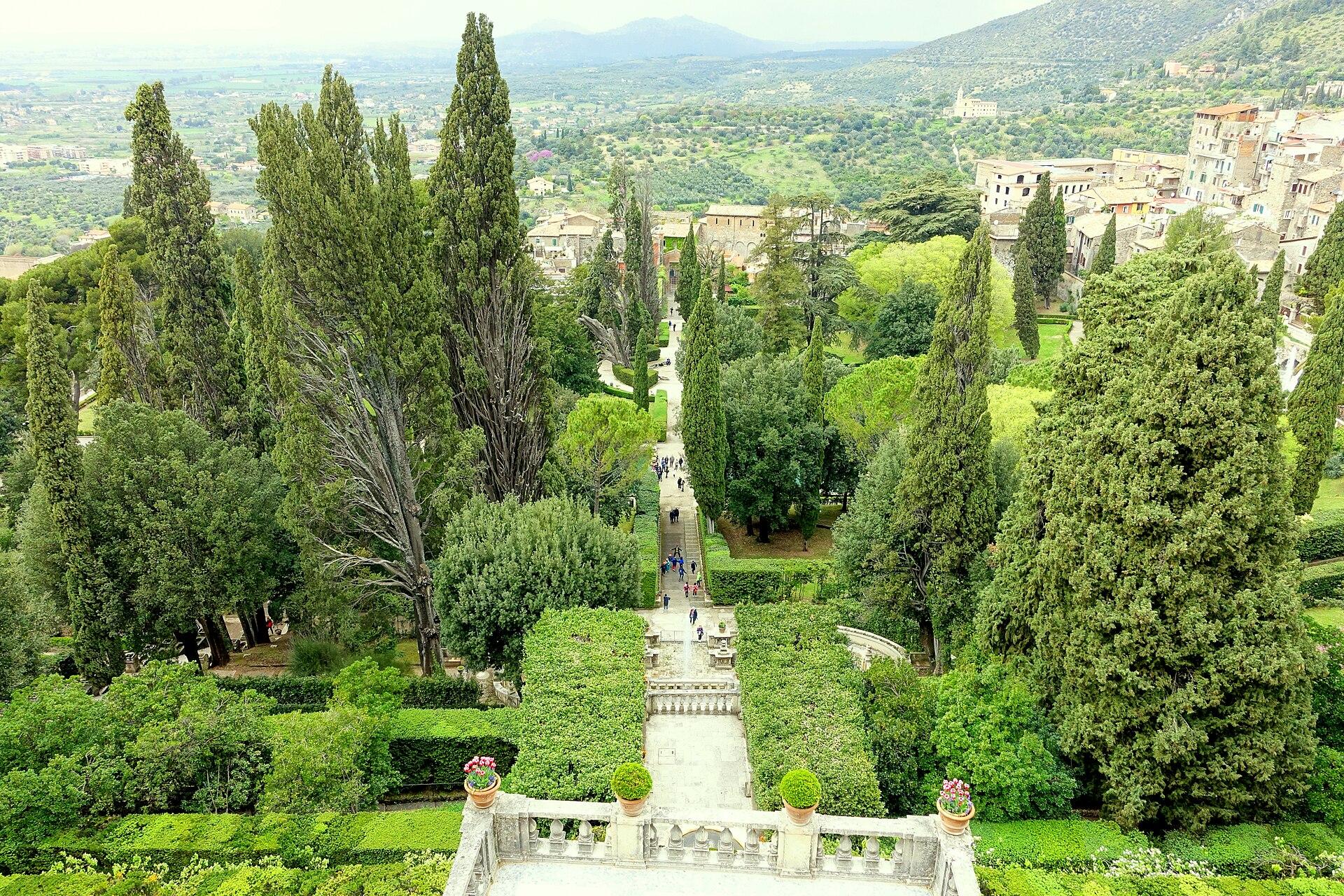
Stop. Before you go down, look. In front of you the garden opens out, in terraces, all the way down to the bottom. Now, a trick. All this water comes from a river, the Aniene, partly diverted through a tunnel beneath the town of Tivoli. And it flows down all by itself. The fountains work by natural pressure, using the principle of communicating vessels. There are more than fifty of them, and not one needs a pump. The director of all this is Pirro Ligorio: painter, archaeologist and architect. He dreamed of a garden like an ancient city. The court architect, Alberto Galvani, builds it. In the sixteenth century, guests entered from below and climbed up toward the palace. You, instead, arrive from above, from the point where the cardinal showed off his masterpiece. Imagine Ippolito, right here, watching the face of a guest who is seeing it all for the first time. Take a minute. There's no hurry: the water is already there, waiting for you. Go down the staircase and then the steps: below you see three long pools and a fountain with a great waterfall.
The Water Theatre, Neptune Fountain and Fishponds
Stop at the edge of these three long pools, the Fishponds. Here freshwater fish were raised for the cardinal's table. Ippolito did not go to the market: he had his fish in the garden. In front of you is the Fountain of Neptune. It is the most imposing in the villa, for the amount of water and for its very high jets. And do you know something? It is also the most recent. It was built in nineteen twenty-seven by the architect Attilio Rossi, with the engineer Emo Salvati. Before, in its place, there was a waterfall designed by Bernini. After about two centuries of neglect, it was largely in ruins. Rossi restores it and reorganizes the levels. Bernini's design is known from the engravings and from the drawings of Fragonard, and it was so successful that it inspired eighteenth-century fountains, as far as the Royal Palace of Caserta. If you have taken the Caserta tour, you have already seen its descendants. In the nymphaeum at the center there is a sixteenth-century bust of Neptune. It was meant to stand in a Fountain of the Sea, on the other side of the pools. It was never built: the cardinal had too many money problems. Go back up toward the center of the garden: you can see a large fountain surrounded by two curved staircases.
A Dragon for the Pope, the Fountain of the Dragons
September of fifteen seventy-two. Do you hear that noise? It's horses. The Pope, Gregory the Thirteenth, is arriving, and the cardinal cannot get anything wrong. Look at the fountain: four dragons spouting water, and in the center a very high jet. They still allude to Hercules and the dragon Ladon. But here there is a second meaning. The dragon is also the symbol of the Pope's family, the Boncompagni. A calculated tribute, to flatter the guest. Look for the two curved ramps that surround it: the water runs down along the parapets, comes out of the chests of two sphinxes, and passes through the mouth of a sculpted frog and of a salamander. It is said that the fountain was finished in a single night. It is probably a legend. Its first name was "the Fountain of the Girandola," after the girandola of Castel Sant'Angelo, the fireworks of Rome. Here the water imitated bursts, cannon thunder, and arquebus shots, all in a very rapid sequence. The reception cost more than five thousand scudi, and the cardinal pawned his silverware. A few months later, on the second of December, he died, with the villa almost finished. Follow the avenue toward the far end of the garden and climb the staircase to the terrace with the basin and the statue of an armed woman.
Rome in Miniature, Fontana della Rometta
Stop in front of this basin. It looks like a small water garden, but it is an entire city in miniature: Rome. A channel with water is the Tiber. A boat with an obelisk in place of a mast is the Tiber Island. The snake passing under the little bridge recalls Aesculapius, the god of medicine. At the center stands the statue of victorious Rome, with helmet, breastplate and spear, and beside it the She-Wolf nursing Romulus and Remus. Once there was much more: miniature buildings of ancient Rome, such as the Arch of Titus, Trajan's Column, the Pantheon and the Colosseum. Over time most of them have disappeared. The designer is once again Pirro Ligorio, the man who had studied for years the ruins of Hadrian's Villa and of other Roman sites in the area. For him, Rome was an open book. Here the symbolism of the rivers comes to a close: the Tiber is Rome, and to Rome lead the streams that flow down from the mountains of Tivoli. Are you wondering where those streams come from? The avenue just behind here shows you. Behind the fountain begins a long avenue with a wall full of small jets of water: walk along it all the way to the end.
Three Rivers, Avenue of the Hundred Fountains and Ovato
Here you are on the Avenue of the Hundred Fountains, about one hundred meters long. Take a good look at it: it is a map. At one end there is the Rometta, that is, Rome. At the other is the Ovato, a large semicircular fountain, which represents the Tivoli mountains. In between, three small channels, one above the other. They are three rivers: the Albuneo, the Aniene and the Ercolaneo. They flow down from the mountains and merge into the Tiber, that is, in Rome. The jets take the shape of lilies, eagles, obelisks and little boats. They are the symbols of the Este family and of the papacy. The eagles were added in sixteen eighty-five by Francesco the Second of Modena. Notice that each jet comes out of a small stone mouth, in two rows, one above the other. The Ovato, at the end, is called the queen of fountains. You see the Sibyl Albunea with little Melicertes, and two rivers, the Aniene and the Ercolaneo, coming out of grottoes. All of this was a map drawn with water. An idea of Pirro Ligorio, an antiquarian with a lot of imagination: even invented inscriptions appear in his manuscripts. The tour ends here: you can go back up toward the palace by the double-ramp staircase.

Villa d'Este
Villa d'Este in Brief
6 stops75
Six stops if you have an hour: the cardinal's portal, the first view of the garden from the loggia, the Fountain of Neptune, the dragons, Rome in miniature and the Hundred Fountains. The garden without the palace.
Free short route. More stops in the full route: 11 Continue with the full route