Siena Cathedral in 45 Minutes
Six outdoor stops, all free and with no ticket required: the churchyard with the She-Wolf, the lower and upper façade, the bell tower, the never-completed New Cathedral, and the Baptistery beneath the choir.
Museum: Duomo di Siena
The She-Wolf, Churchyard
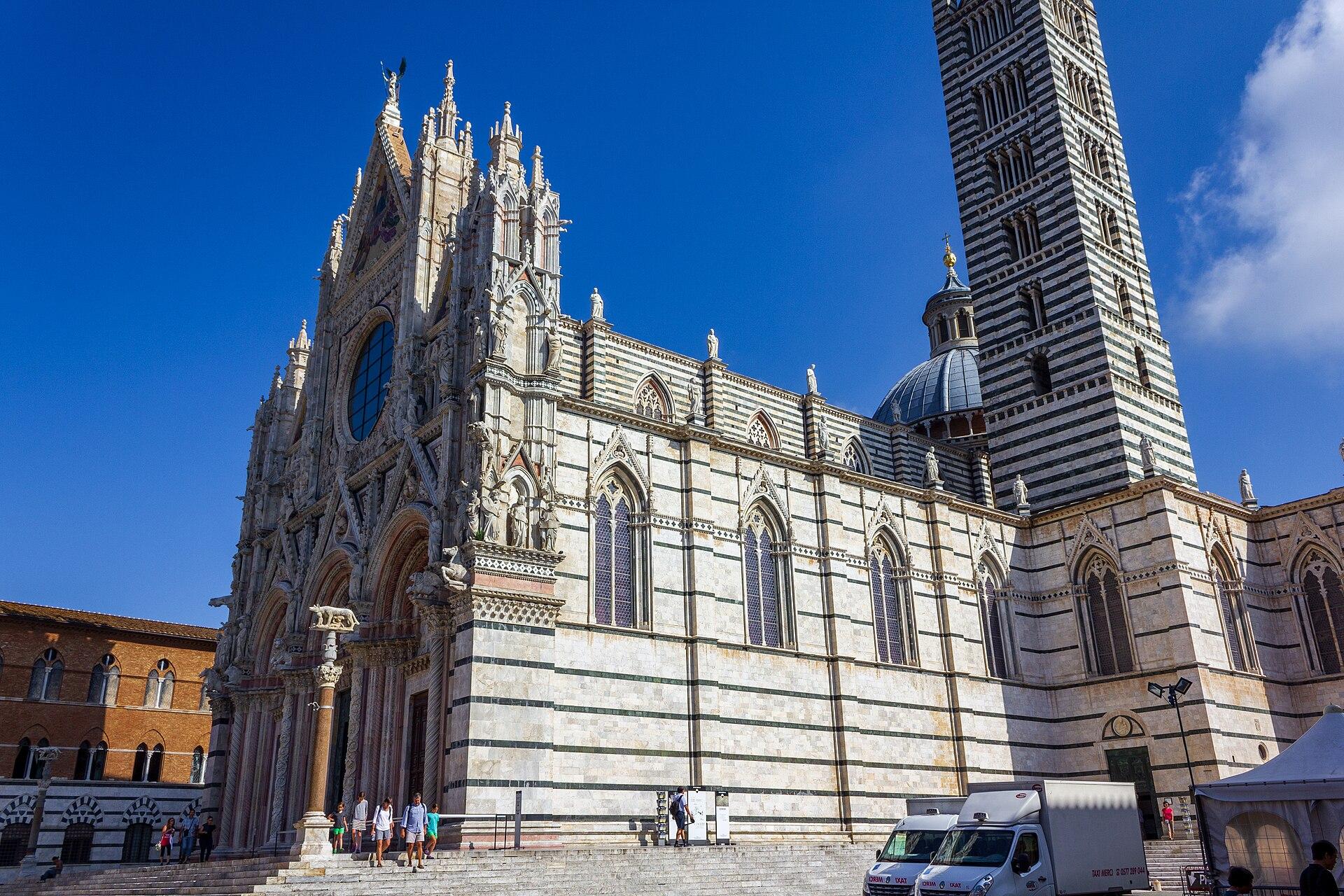
Look down, at your feet. Those marble designs set into the churchyard seem very ancient, but they are copies. The originals were made in 1450 by an artist called Nastagio di Gaspare. They told of the ceremonies by which one became a priest. You are in Piazza del Duomo, in front of the central portal. Stop on the paving stones and breathe. Raise your eyes: on a column stands the Sienese She-Wolf, the symbol of Siena. At the corners of the staircase, then, you see two she-wolves with the twins. These too are copies: the originals, by Giovanni Pisano and Urbano da Cortona, are sheltered in the Museo dell'Opera. Now turn your gaze towards the staircase and the building in front of you. It was a great hospital, Santa Maria della Scala. Its name comes from these very steps, the staircase of the Madonna. Keep one thing in mind. This cathedral is immense, and yet the Sienese wanted it to be even bigger. I will tell you how it went, step by step. And I will show you what remains of their dream. Stay in front of the central portal and look at the statues around the doors: they are the next stop.
Copy Statues, Lower Façade
The statues you see around the portals are copies. The real ones are sheltered inside the Museum. And the man who designed them left Siena suddenly. His name is Giovanni Pisano. From 1284 to about 1297 he is the master builder of the Opera, that is, he runs the building site. He builds the lower part of this façade, with the three portals. Then he leaves the city, probably because of the city council's criticism of waste and of the disorganization of the building site. But first he leaves us something new: a cycle of Gothic statues. They are fourteen figures of prophets, patriarchs, pagan philosophers and prophetesses. They have a precise program: all of them, willingly or not, announce the coming of Christ. Look among them for Plato, Moses, King David, Aristotle. Then look below the statues: there are animal figures sculpted in the marble. Higher up, on the architrave, the four evangelists. And notice the bronze door of the central portal. It is not ancient: it dates from 1958, by Enrico Manfrini, and it tells of the glorification of Mary. Stay where you are and raise your eyes still higher, above the portals, to the great rose window and the three golden peaks at the top.
The Flaw, Upper Façade
Look for a flaw. Just one, and no one has ever hidden it. Look at where the lower and upper parts meet: the pillars on either side of the great rose window do not coincide with those on either side of the central portal. They are not aligned. It is the sign of a long construction, carried out in two stages. The lower part is by Giovanni Pisano. The upper part, in Flamboyant Gothic style, was completed by Camaino di Crescentino between 1299 and approximately 1317. He was the father of another famous sculptor, Tino di Camaino. Raise your eyes to the three spires at the top. Around the rose window there are thirty-four half-length busts: they are the ancestors of Jesus. These too are copies; the originals are in the Museum. The three gilded mosaics, on the other hand, date from the nineteenth century. They were made in Venice in 1878, from a design by Alessandro Franchi. They tell the story of the Presentation of Mary at the Temple, her Coronation and the Nativity of Jesus. The rose window has a stained-glass window of the Last Supper, from 1549, by Pastorino de' Pastorini. It can be seen better from inside. Shift your gaze beyond the side of the Cathedral, to the black-and-white striped tower: it is the bell tower.
The Bell Tower, Piazza del Duomo
A name, only a name. Rosso Padellaio. He was a craftsman, and around 1263 a payment register records him for a job at the top of the dome: a great copper apple. Now look for the dome, and look all the way up. It measures forty-eight metres, with the cross. At the top, Rosso's copper apple. Think: a name that has remained on paper for over seven centuries, thanks to an apple. Beside it you see the bell tower, with white and black bands. It was completed in 1313 and is about seventy-seven metres high. To raise it, part of the old Bisdomini tower was incorporated, towards the end of the thirteenth century. In the nineteenth century a fire destroyed the outer dome, which was made of wood, and part of the roof of the nave. They were rebuilt. White and black recur everywhere, inside too. They are the colours of Siena's coat of arms. Now look at the dome from here: it was among the largest of its time. And think of the effort: the entire building is about eighty-nine metres long. Walk along the side of the Duomo, the one with white and black stripes, as far as the neighbouring square, where a great wall with arches rises into the emptiness: it is Piazza Jacopo della Quercia.
The New Cathedral, Piazza Jacopo della Quercia
On 23 August 1339, the General Council of Siena votes. Two hundred and twelve yes, one hundred and thirty-two no. They have decided to build a cathedral even bigger than this one. Look at the wall with the large arches in front of you. It is the façade of the New Cathedral, the one they call the Facciatone. The first stone had been laid on 2 February, even before the vote. The church you know would have become the transept, the transverse part of the new one. The project moves forward. Directing the works, from December 1339, is Lando di Pietro, a goldsmith who can do everything. Then the work passes to Giovanni d'Agostino. In 1348 the plague arrives, and in some places the construction has structural problems. In June 1357 it is decided to stop. The unstable parts are demolished. One fragment remains: the façade and the right aisle. As you go down the steps, look for a portal in the nave of the New Cathedral. The historian Enzo Carli called it the most beautiful portal in all of Sienese art. Today it is a passage between the square and via di Monna Agnese. With the Pass you can climb the Facciatone and look at everything from up there. Go down the large staircase toward piazza San Giovanni, and look along the way down for the portal I told you about.
Under the Choir, Staircase of San Giovanni
A church built beneath another, to support its floor. It is the Baptistery, and you are looking at it from the outside. In 1317 the Opera decides to extend the choir of the Duomo by two bays. But behind the choir the hill slopes steeply down. To support the new bays, an entire building is constructed underneath: the new baptistery. It was completed in 1325 by Camaino di Crescentino, the same man as the upper façade. The marble façade in front of you was begun between 1355 and 1382 by Domenico di Agostino. It was left unfinished: the upper part is not completed, and the finishing touches are missing. Look at the whole: the Baptistery stands right beneath the last bays of the choir, like a ground floor on which the apse of the Duomo rests. Look at the pavement in front of the portals. There are sgraffito and marble-inlay designs, now worn down by footsteps. The theme is baptism. Along this staircase is also the entrance to the Crypt, beneath the choir. Here the short route, entirely outdoors, ends. Inside the Cathedral, in the Museum, in the Crypt and in the Baptistery, the full route awaits you, with an admission ticket. Thank you for walking this far.

Duomo di Siena
Siena Cathedral in 45 Minutes
6 stops45
Six outdoor stops, all free and with no ticket required: the churchyard with the She-Wolf, the lower and upper façade, the bell tower, the never-completed New Cathedral, and the Baptistery beneath the choir.
Free short route. More stops in the full route: 11 Continue with the full route