Hadrian's Villa in Brief
The six stops not to be missed if you are short on time: the Pecile, the Small Baths, the Canopus, the Serapeum, the Piazza d'Oro and the Maritime Theater. About an hour and a half of walking and listening.
Museum: Villa Adriana
Seven Laps, the Pecile
After dinner, a distinguished Roman would take a walk. Here, this is how people walked: seven laps around a wall. Look at the wall in front of you. It is nine meters high, and it has remained standing to its full height. On either side ran a portico, with a gabled roof: you can still see the large holes for the roofing. The columns are gone, and the box shrubs pruned into cylinders mark their place. You are in the Pecile: an enormous rectangular garden with a large pool at its center, enclosed by porticoes. The name comes from the painted portico of Athens, the city Hadrian loved most. Seven laps around the wall make about three kilometers, two Roman miles. It is said that this was the right length for a walk after meals, according to Roman medicine. And then there is the silence. The high walls hid the rest of the villa, and whoever walked here was left alone with their thoughts. It was a place made for meditation. We cannot say that Hadrian took those laps every evening. We can say that this space is made for going slowly. Try it yourself: ten steps along the wall, without hurry. Leave the Pecile and follow the signs towards the Small Baths and the Canopus. Look for the building with a facade of small net-pattern blocks and three niches: it is the entrance to the baths.
The Hidden Fire, the Small Baths
Despite the name, the Small Baths are one of the most luxurious buildings of the villa. Stop in the eight-sided room: the walls are not straight, they curve in and out, and they were covered with precious marbles. It is thought that people undressed here. From this room one passed to the bathing rooms: the sweating room, the hot room, the warm one and the cold one. Different marbles, different shapes. A bath conceived as a spectacle. But how was a marble floor heated? Hot air passed beneath the floor, produced by furnaces lit in hidden rooms: the praefurnia. To reach them there were small staircases, and those who climbed them were the slaves who kept the fire burning. The bather felt the heat rising from the feet. He never saw where it came from. Look at the façade that faces the outside: it is made of small blocks arranged in a net pattern. A sign that Hadrian reused a building that already existed. And in this bath a famous statue was found: the Doryphoros, the athlete with the spear. In Roman baths, one bathed after exercise. Continue along the path towards the Canopus, where the valley narrows and a long stretch of water appears with a row of arches.
Nile of Tivoli, Canopus
In front of you is a long, narrow canal, with still water and a row of statues along the edge. Imagine being here at night, at a party. This is the Canopus. The name comes from an Egyptian city, famous for its night-time festivals, which a canal linked to Alexandria. Hadrian did not want to copy it: he wanted to evoke it. A narrow valley, partly artificial, transformed into a great basin of water. Look at the statues along the edge. Those women acting as columns are the caryatids, copies of those of the Erechtheion in Athens. And they are not looking at you: they are looking at the water, and are reflected in the canal. They are copies in reinforced concrete: the originals were placed under shelter in a museum, which you will encounter shortly. In the 1950s the archaeologist Salvatore Aurigemma brought the basin and most of the statues back to light. It was such a rich discovery that it was decided to protect the originals in the villa itself. It seems that here a hydraulic mechanism, with a large cistern and a cascading fountain, reproduced the flooding of the Nile, the one that brought life every year. Look at the water and imagine the sound of a swelling waterfall. Keep your eyes on the canal as you walk to the far end. There is the place where dinners were held. Walk along the basin to the end, where a large domed niche closes off the canal.
The Summer Dinner, Serapeum
You are at the end of the canal. In front of you is a large niche with a dome. Look at the floor, in the center: a semicircular masonry bench. It was a banquet bed, called a stibadium. Hadrian and his guests dined like this, reclining in a semicircle, in summer, in the cool of this grotto. The building is called the Serapeum, after the temple of Serapis in the Egyptian city of Canopus. But it was not a temple: it was a summer dining room. Try to hear the clinking of the plates. Then add the water: jets, small waterfalls and water features around the diners, which turned dinner into a spectacle. A recent discovery. In 2021, archaeologists from the Pablo de Olavide University found in the Imperial Palace a summer dining room with niches that seems like a smaller model of this one. A sign that the idea of dining with water was tried out, and then repeated. The whole of the Canopus, from the pool to the Serapeum, was conceived as a single great banqueting place. A place to be together, not to pray. Go back along the pool, toward the center of the villa, and follow the signs for the Piazza d'Oro: look for a large open rectangle with a long corridor of columns and a vestibule with a dome.
The Square of Gold, Piazza d'Oro
Why is it called Piazza d'Oro, the Square of Gold? Not because of gold. Because of the wealth of statues, marbles and decorations found here, and carried off starting in the sixteenth century. What you see is a large peristyle: a rectangular garden with a long pool in the center, surrounded by a portico with two aisles. The columns alternated: one of cipollino, one of Egyptian green granite. On the palace side, you entered through an eight-sided vestibule, with a segmented dome, like an umbrella. On the opposite side there was a large hall with a grotto-style nymphaeum: the impression was that of a cave with water flowing down. It was probably a summer dining room. The water ran along the pool and then disappeared underground, before the vestibule. And then there is the aftermath. In this wing of the villa, portraits were found of Vibia Sabina, Hadrian's wife, and of emperors who came much later than him: Marcus Aurelius and Caracalla. It means that the villa was not forgotten when Hadrian died. The emperors continued to use it at least until the third century. Look at it for a moment all together: the marble, the columns, the sound of the water. A place designed to leave you open-mouthed. Follow the signs for the Maritime Theater and look for a curved wall with a colonnade: it is a large circular enclosure.
The Island, Maritime Theater
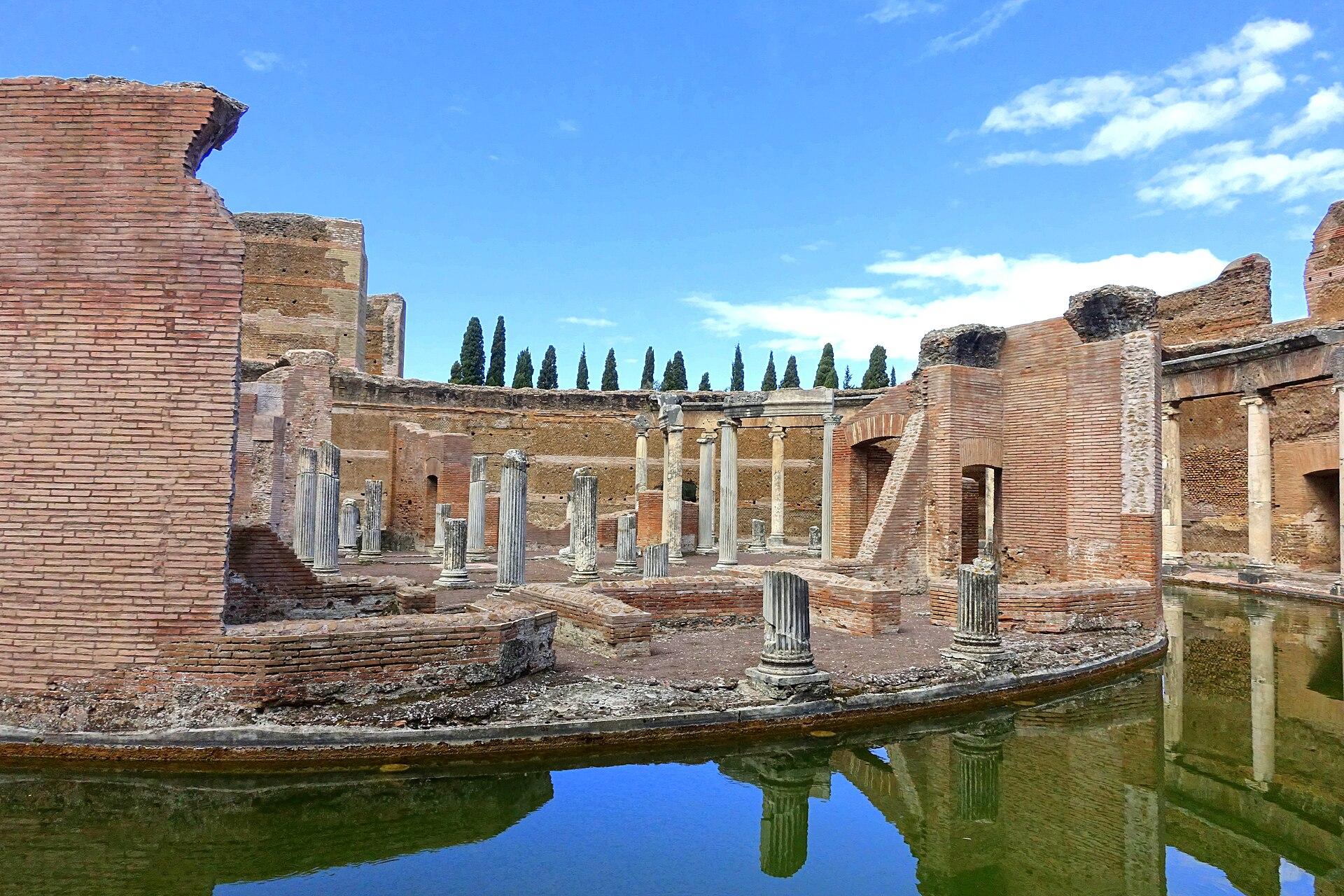
Stop here, at the water's edge. In front of you is a ring of columns, a ring-shaped canal and, at the center, an island with a small house. A house all for himself, enclosed by water on every side. The name Maritime Theater is modern, because of its shape and the friezes with tritons and nereids. It is not a theater. It is a circular enclosure with a portico of Ionic columns, a canal and, on the island, a complete house: atrium, library, dining room, baths. It was one of the first buildings of the villa, begun in 118. Some scholars consider it Hadrian's first provisional residence here, or the private part of the palace. The island was connected to the mainland by two movable wooden bridges. Look at the ground: the grooves in the marble where they slid are still there. Today there is a masonry bridge, of late date. It is said that Hadrian liked to swim in the canal, back and forth. No one can prove it: a guidebook says so. But close your eyes and imagine it: the still water, the columns reflected, no one watching you. Many statues from this villa are now in the museums of Rome and Europe. The island is not: it is still here. Take a minute, alone, without saying anything. When you are ready, follow the signs to the exit. Thank you for walking with us.

Villa Adriana
Hadrian's Villa in Brief
6 stops90
The six stops not to be missed if you are short on time: the Pecile, the Small Baths, the Canopus, the Serapeum, the Piazza d'Oro and the Maritime Theater. About an hour and a half of walking and listening.
Free short route. More stops in the full route: 10 Continue with the full route