The Colosseum in short: six moments
Nero's lake, your first view of the arena, the great awning of the sailors, the tricks beneath the floor, the emperor's box and the Arch of Constantine: the Colosseum in one hour, for visitors short on time.
Museum: Colosseo
Nero's Lake, Piazza del Colosseo
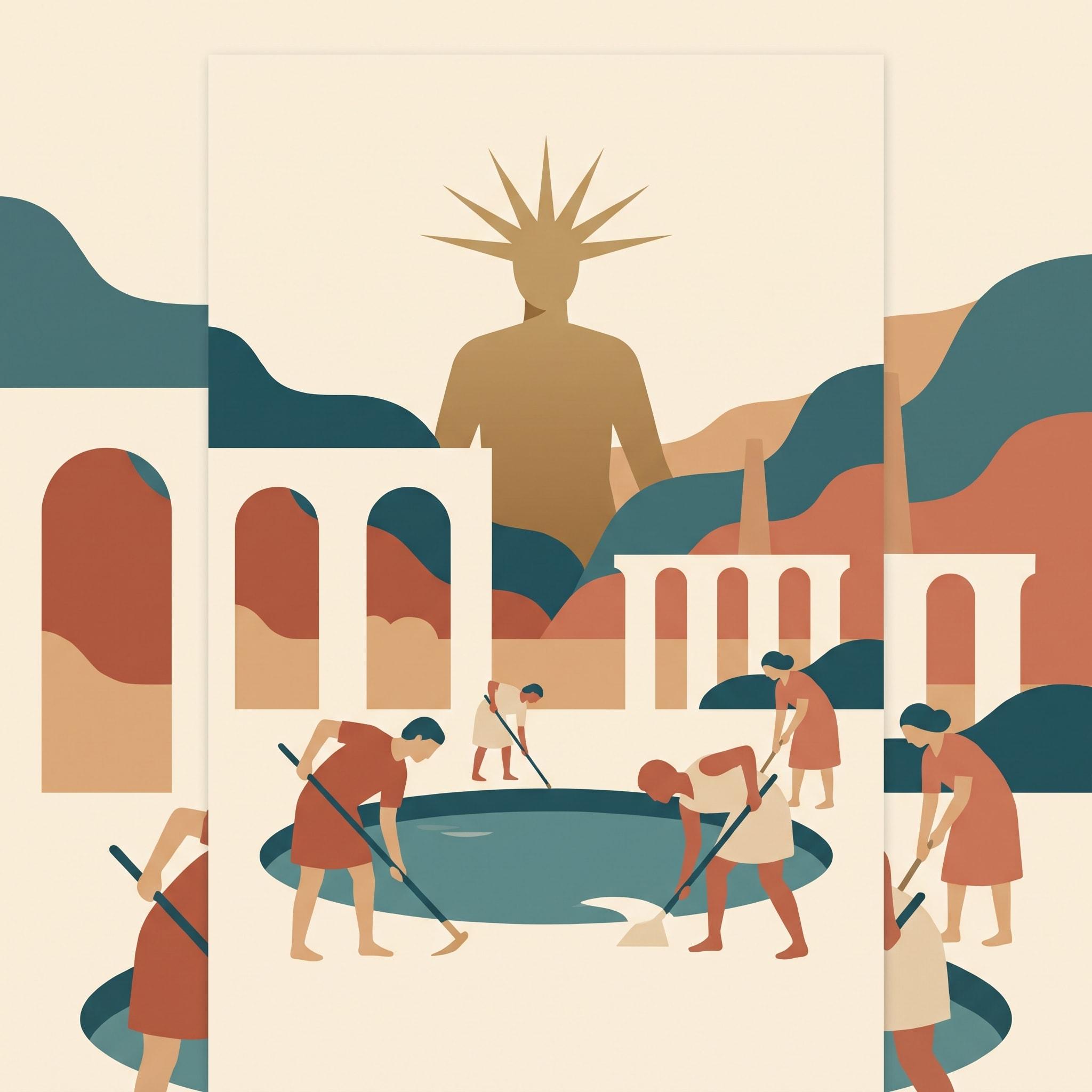
Stop for a moment, before you join the queue. Breathe, look at this square. Where you are standing, two thousand years ago, there was water. A small lake, partly artificial, in the garden of one lonely man: the emperor Nero. Nero had taken a piece of Rome and made it his home. They called it the Domus Aurea, the Golden House, and it stretched across three hills. At its center was that pond. The writer Suetonius describes it as large as a sea, surrounded by buildings that looked like cities. Try to imagine it: still water, gardens, no noise of crowds. Then Nero dies, and those who come after him erase that whim. Vespasian has the pond drained. Between 70 and 72 he begins to build an amphitheater here: a building for the whole city, in place of a garden for one man alone. Vespasian dies in 79. It will be his son Titus who inaugurates the work, in 80. And the name? Nearby, at the entrance of the Golden House, stood Nero's colossus: a bronze statue about thirty-five meters high. Later Hadrian has it moved. In the Middle Ages it was remembered that the name Colosseum came precisely from that giant. The other name, Flavian Amphitheater, comes instead from the family of Vespasian and his sons: the Flavians. Now raise your eyes to the wall in front of you. It was not born as a monument of power. It was born as a gesture of repair: one emperor had taken a piece of the city, and another gave it back to the people in exchange. A practical tip, before you enter. With the standard ticket you can stay inside the monument for a maximum of seventy-five minutes. This guide is designed for that time: listen to it calmly, without rushing. Join the queue for the security check and enter through the Valadier Spur, near the Arch of Constantine. Follow the route of the first tier until, from a corridor, you see the arena opening up before you. Stop there.
The Opening, First Tier
The corridor ends, and the Colosseum opens up before you. An ellipse of stone, the tiers of seating rising all around, and the arena at the center. Close your eyes for a second, and listen. It is the twenty-first of April, 80. The Flavians have recently taken power, and this is their great gift to Rome. Titus inaugurates the amphitheater before the entire city, and the games will last one hundred days. Around you, estimates say, there were between fifty thousand and eighty-seven thousand people. A seat in here was a precious thing. If you want to take a photo, take it now. Then put your phone away: for a few seconds, look with your own eyes. The historian Cassius Dio tells us that in those days nine thousand animals were killed, both domestic and wild. About ten years of construction work, to arrive at this. And the celebration will not end soon: the last gladiator fights are documented in 437, and the animal hunts continue until 523. More than four centuries of games, in this very place. Now choose a spot on the tiers. Just one, among them all. There, a person took a seat, having come to see something they had never seen before. An ordinary spectator, open-mouthed like you. Think about the contrast. Outside, the city. Inside, a building constructed to make each person feel part of an enormous crowd: a spectacle watched all together, and remembered for a lifetime. And there is another story, which still has no explanation. Cassius Dio again tells us that, on the last day, Titus bursts into tears before all the people. After one hundred days of celebration, the man who gave the Colosseum to Rome weeps in public, and everyone sees him. Go up to the second tier following the route signs, and look for a spot from which to look up, toward the edge of the building.
The Great Awning, Second Tier
How do you shade an entire city? With a fleet. Look up, towards the edge of the building. Try to find the stone corbels that jut out, all lined up along the edge. There were two hundred and forty of them, and they were used to slot in the masts of a great awning. It was called the velarium. In all, three corbels for each bay of the façade. Who operated it? A detachment of sailors from the fleet of Misenum, the great Roman naval base. Men used to sails and ropes, called to Rome for the purpose. An enormous sail, made of fabric, stretched over the seating tiers to shelter the public from the sun. How much did it cover? According to one reconstruction, about two thirds of the arena. But the question remains open: scholars still debate whether it covered only the seating tiers or the entire arena. Think of the effort. Sailors climbing onto the edge, at a dizzying height, to pull the ropes, while below the spectators take their seats. It was not an awning to be set up in a hurry. It was an operation for sailors, every day of the shows. Think of the effect on those below. A cool shade, while outside it is summer, and a different light falling on the stone: a luxury for everyone, even for those seated high up. Today the roof is gone. But if you find the corbels, they tell you something simple: even shade, here, was a spectacle. Lean out on the arena side and look down, where the walls can be seen.
The Arena You Can't See, Second Tier
What you see below you is not just a floor. It is the roof of a factory. Look at the arena. In one part the floor has been rebuilt, but elsewhere you see walls, corridors, traces of rooms. This is the hypogeum, the underground levels of the Colosseum, which cover about half a hectare. Fourteen corridors on either side of a central one, and at the ends the maneuvering chambers, with the great lifts. At Titus's inauguration the underground levels were made of wood. Domitian, who ruled after Titus, transformed them into masonry. In 217 a fire, perhaps caused by lightning, brought down the upper structures. The Colosseum remained closed until 222, and the underground levels were rebuilt. The Park also recalls a curious detail: for the inauguration, when the arena was made of wood, naval battles are documented. With the masonry, water shows came to an end. Imagine the noise. Men and animals appeared suddenly from the trapdoors of the arena, raised by the lifts with a complex system of winches. Creaking wood, taut ropes, a stifled roar. For those on the tiers of seats, it was magic. No one, from above, knew which trapdoor the surprise would come from. A beast appearing out of nowhere, a man emerging from an opening in the floor. Below were those who pulled the ropes, in the dark, unseen by anyone. Stop for a few seconds, without speaking. Look at the floor again. The real scene was down here, and no one, from above, ever saw it. Continue along the edge of the arena to the side of the Arch of Constantine, where the emperor's box was located.
The Emperor's Box, Second Tier
An emperor who fights in the arena and who, according to one account, risks dying here. Look at the end of the ellipse on the side of the Arch of Constantine. Here, at the southern end of the minor axis, stood the pulvinar, the box reserved for the highest offices of the empire. Below, a hidden gallery led out of the Colosseum, away from the crowd. The corridor does not run straight: it has three arms, with openings above to let in light and air. The walls were covered in marble, and traces of it still remain. It was dug after construction, between the last years of Domitian and the reign of Trajan. Today it is called the Passage of Commodus. Commodus, emperor from 180 to 192, loved combat. According to the sources, he went down into the arena as a gladiator and demanded to be paid. Cassius Dio recounts that Commodus was the target of an assassination attempt in a dark place in the amphitheatre. A conspirator lunged at him, shouting that the Senate was sending him a dagger. He failed, and Commodus reigned for several more years: he died in 192, assassinated, not in the arena but in the baths, so tradition says. But the Park cautions: that it happened in this very passage is far from certain. Since 2025 the Passage can be visited, with a separate ticket, on set days. On the vault there are stuccoes with Dionysus and Ariadne. In the niches, boar hunts, bear fights, acrobats. A passage reserved for a few, and a name about which no one is truly sure. Your short route ends here. Follow the signs for the exit, near the Arch of Constantine, and stop in front of the arch.
Constantine, Arch of Constantine
The arch in front of you is made, in part, with pieces from other emperors. The Senate dedicates it to Constantine for the victory over Maxentius at the Milvian Bridge, on the twenty-eighth of October, 312. It is inaugurated in 315, for the ten years of his reign. It is about twenty-one metres high, with three passageways, and stands along the ancient triumphal route, between the Palatine and the Caelian. Look at the reliefs. The slabs with the wars in Dacia are from Trajan. The roundels above the side arches are from the time of Hadrian. The panels in the attic, with the wars against the Quadi and Marcomanni, are from Marcus Aurelius. They are older than the arch by one or two centuries. The heads of the emperors were recarved as portraits of Constantine. Why? It is not known for certain. But the effect can be seen: the new emperor placed himself beside the great figures of the past. In the third line of the inscription, on the attic, the Senate says that Constantine won "by the inspiration of the divinity". Scholars still debate it. Which divinity is it speaking of? And there is a legend, which is only a legend. Eusebius of Caesarea tells that Constantine swore to him that he had seen in the sky, before the battle, a luminous sign with an inscription in Greek: "with this, conquer". However, his Ecclesiastical History, written earlier, does not tell it. You have seen the two faces of Roman power: the spectacle for everyone, and the monument for memory. With the standard ticket you have one entry to the Roman Forum and the Palatine within twenty-four hours, from the gate at the Arch of Titus. Have a good journey, and thank you for listening to the Colosseum.

Colosseo
The Colosseum in short: six moments
6 stops60
Nero's lake, your first view of the arena, the great awning of the sailors, the tricks beneath the floor, the emperor's box and the Arch of Constantine: the Colosseum in one hour, for visitors short on time.
Free short route. More stops in the full route: 7 Continue with the full route